Hello! Welcome to your daily lesson on advanced architectural patterns.
In our previous lesson, we designed a distributed rate limiter to protect our services from being overwhelmed by too many requests. This is a pattern of inbound protection. Today, we focus on the other side of the coin: protecting our own application from the failures of services it depends on. This is a pattern of outbound protection.
Your goal for this lesson is to implement a circuit breaker pattern to prevent cascading failures in a microservices architecture. When a service you call starts to fail, continuing to send it requests is wasteful and dangerous. It can exhaust your application's resources and cause a chain reaction of failures that brings down your entire system. The Circuit Breaker pattern provides a robust, automated way to detect and handle this scenario.
We will master this vital resilience pattern through five concepts:
- The Problem: Understanding Cascading Failures
- The Solution: The Circuit Breaker State Machine
- Implementing the Core Logic: Building a Python Circuit Breaker
- Production-Grade Features: Configuration and Fallbacks
- Elite Interview Deep Dive: Circuit Breakers in a Distributed World
1. The Problem: Understanding Cascading Failures (Easy)
In a microservices architecture, services often depend on each other. A user request to Service A might require it to call Service B, which in turn calls Service C. What happens when Service C fails?
-
Technical Explanation:
When a downstream service likeService Cbecomes slow or unresponsive,Service B's requests to it start to time out.Service Bmight have a thread pool or a limited number of connections available to handle outgoing requests. If all these threads get stuck waiting forService Cto respond,Service Bexhausts its own resources. It can no longer serve any requests, even those that don't depend onService C.This failure then moves up the chain.
Service Anow sees thatService Bis failing, and its resources get exhausted waiting forService B. This chain reaction is a cascading failure. A single fault in one small, downstream service can ripple through the system and cause a total outage.

*This image shows two scenarios. On the left, a failure in Service 4 causes a cascade, taking down Services 3, 2, and 1. On the right, circuit breakers isolate the failure, allowing unaffected services to continue operating.*
Introduction to circuit breaker in microservices (for beginners)
To start, let's watch a short, clear explanation of non-transient failures and how they lead to cascading failures in a microservices environment.
Watch from 00:54 to 03:24. This segment perfectly illustrates the problem that the circuit breaker pattern is designed to solve.
-
Metaphor for a 5-Year-Old:
Imagine a line of people passing buckets of water from a well to a fire. Suddenly, the person at the very end of the line faints. The person before them now has nowhere to pass their bucket, so they just stand there holding it. The person before them gets stuck, and so on. Soon, the entire line is frozen, just holding heavy buckets, getting tired, and making no progress. The failure of one person has caused the whole system to fail. -
Python Code Snippet (Simulating a Cascade):
This conceptual code shows how a failure deep in the call stack can lock up resources. Ifservice_awere running in a multi-threaded server, retryingcall_service_bwould tie up threads uselessly.import time import random def call_service_c(): """This is the unreliable downstream service.""" print(" Calling Service C...") if random.random() < 0.8: # 80% chance of failure time.sleep(5) # Simulates a timeout raise ConnectionError("Service C is unresponsive") print(" Service C responded successfully.") return "Data from C" def call_service_b(): """This service depends on Service C.""" print(" Calling Service B...") try: result = call_service_c() print(" Service B processing completed.") return f"Processed {result}" except ConnectionError as e: print(f" Service B failed: {e}") raise # Re-raise the exception, propagating the failure def service_a_endpoint(): """This is our main service endpoint.""" print("Service A received a request.") # Naive retry loop for i in range(3): try: print(f"Attempt {i+1}:") response = call_service_b() print(f"Service A succeeded: {response}") return except Exception as e: print("Service A caught an error. Retrying after a short delay...") time.sleep(1) print("Service A failed after multiple retries. Resources were wasted.") service_a_endpoint()
2. The Solution: The Circuit Breaker State Machine (Medium)
Instead of blindly retrying, we can wrap the dangerous call (call_service_c) in a stateful proxy: the circuit breaker. This object monitors for failures and can "trip" or "open" the circuit to stop requests from flowing to the failing service.
-
Technical Explanation:
The circuit breaker operates as a finite state machine with three states:- CLOSED: The default state. Requests are allowed to pass through to the downstream service. The breaker counts failures. If the failure count exceeds a configured threshold within a certain time period, the breaker "trips" and moves to the OPEN state.
- OPEN: The circuit is "open." For a configured
reset_timeoutperiod, all calls are immediately rejected without even attempting to contact the downstream service. This gives the failing service time to recover and protects our application from wasting resources. After the timeout expires, the breaker moves to the HALF-OPEN state. - HALF-OPEN: The breaker allows a single (or a small number of) "probe" request to pass through.
- If this probe request succeeds, the breaker assumes the downstream service has recovered and transitions back to CLOSED.
- If the probe request fails, the breaker transitions back to OPEN, starting the
reset_timeoutagain.
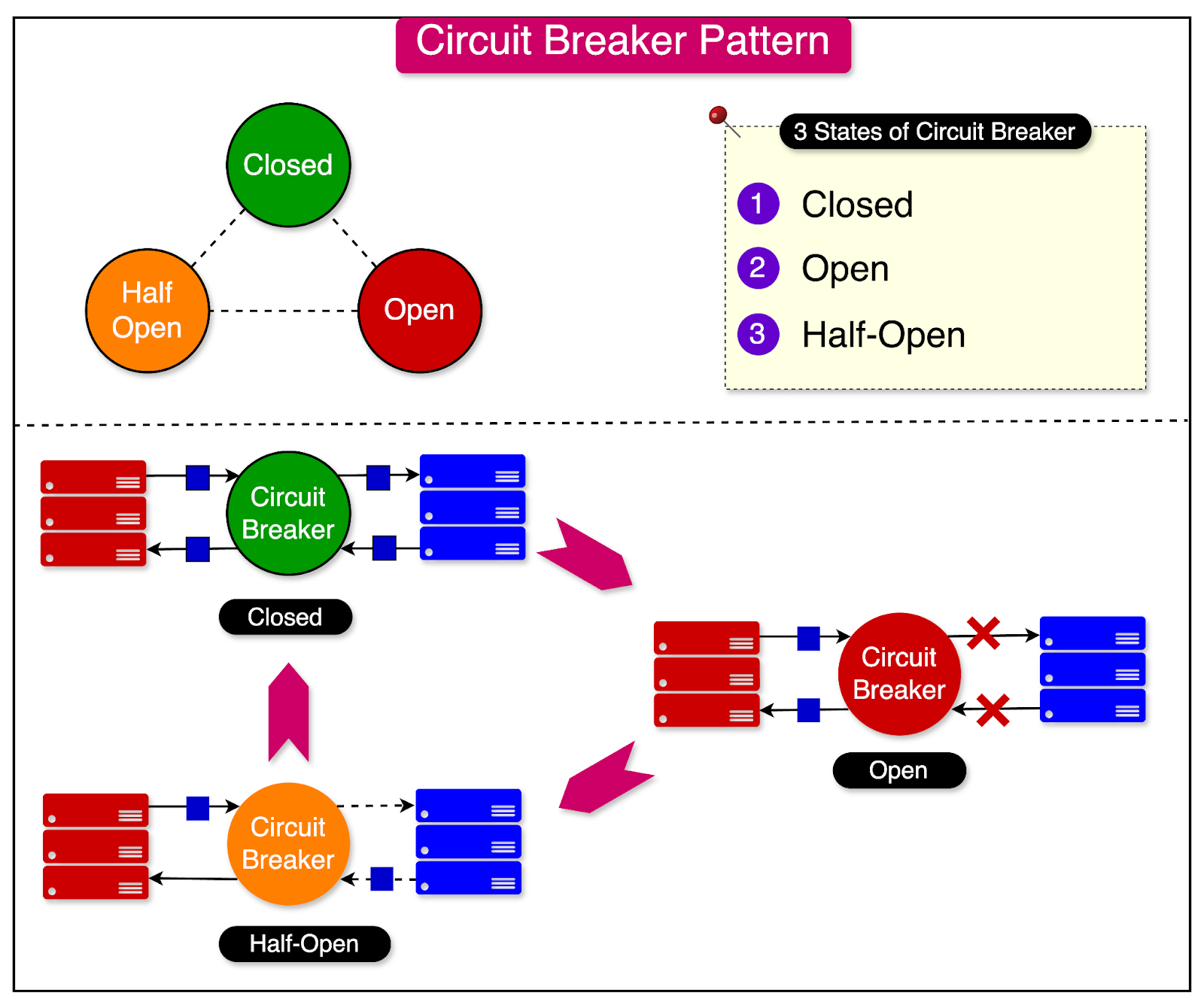
*This diagram shows the three states of the circuit breaker and the transitions between them based on success, failure, and timeouts.*
-
Metaphor for a 5-Year-Old:
Think of an electrical circuit breaker in your house.- CLOSED: Power is flowing, and your lights are on. Everything is normal.
- OPEN: You plug in a faulty toaster that causes a short. The breaker trips! Power is cut to that outlet to prevent a fire. The toaster (failing service) is isolated, but the rest of your house still has power.
- HALF-OPEN: You unplug the toaster and go to the fuse box to flip the breaker switch back. This is you "testing" if the problem is fixed. If it stays on, you've moved back to CLOSED. If it immediately trips again, the problem is still there, and you're back to OPEN.
-
Python Code Snippet (State Definitions):
We'll start by defining the states and the basic structure of ourCircuitBreakerclass.from enum import Enum import time class CircuitBreakerState(Enum): CLOSED = "CLOSED" OPEN = "OPEN" HALF_OPEN = "HALF_OPEN" class CircuitBreaker: def __init__(self, failure_threshold: int, reset_timeout: int): """ :param failure_threshold: Number of failures to trip the breaker. :param reset_timeout: Seconds to wait in OPEN state before moving to HALF-OPEN. """ self.failure_threshold = failure_threshold self.reset_timeout = reset_timeout self._state = CircuitBreakerState.CLOSED self._failure_count = 0 self._last_failure_time = None print(f"Circuit Breaker initialized: threshold={failure_threshold}, timeout={reset_timeout}s") def __str__(self): return f"State: {self._state.value}, Failures: {self._failure_count}" # We will build out the logic in the next section. cb = CircuitBreaker(failure_threshold=3, reset_timeout=10) print(cb)
3. Implementing the Core Logic: Building a Python Circuit Breaker (Medium-Hard)
Let's implement the state transition logic. A circuit breaker is most elegantly implemented as a decorator or a context manager in Python. For clarity, we will create an execute method that wraps the function call.
-
Technical Explanation:
The core logic resides in the method that executes the wrapped function. Before execution, it must check the current state of the breaker.- If OPEN, it checks if the
reset_timeouthas passed. If not, it fails fast. If it has, it moves to HALF-OPEN. - If HALF-OPEN or CLOSED, it attempts the call within a
try...exceptblock.- On success (in CLOSED state), it does nothing.
- On success (in HALF-OPEN state), it resets the failure count and moves to CLOSED.
- On failure, it increments the failure count. If the count exceeds the
failure_threshold, it moves to OPEN and records the time.
Let's read a detailed walkthrough of a real Python implementation to see how these pieces fit together.
- If OPEN, it checks if the
Implementing the Circuit Breaker Pattern in FastAPI
This article provides a fantastic, step-by-step walkthrough of a Circuit Breaker implementation in Python for a FastAPI application. The logic is directly applicable to any Python context.
Read the section 'Exploring the Source Code of the Circuit Breaker Implementation'. Focus on the logic inside the CircuitBreaker class, specifically the handle_open_state and handle_closed_state methods. This will show you exactly how the state transitions are coded.
-
Metaphor for a 5-Year-Old:
Let's refine our bouncer metaphor. The bouncer (CircuitBreaker) is guarding the entrance to a very popular arcade game (downstream service).- Execute Call: A kid wants to play the game. The bouncer first checks his notes (
state). - State is OPEN: The bouncer looks at his watch. "The game has been broken for 10 minutes. I said I'd wait 15. Come back in 5 minutes." (Fails fast). If 15 minutes have passed, he says, "Okay, the repairman might be done. I'll let one of you in." (Moves to HALF-OPEN).
- State is CLOSED: The bouncer lets the kid try the game. The kid comes back happy (success). The bouncer does nothing. The kid comes back sad because the game ate his token (failure). The bouncer makes a tally mark. After 3 tally marks, he declares, "This game is broken! Nobody else plays for 15 minutes!" and puts up a velvet rope (moves to OPEN).
- Execute Call: A kid wants to play the game. The bouncer first checks his notes (
-
Python Code Snippet (A Functional Circuit Breaker):
Here is a complete, runnableCircuitBreakerclass that implements the core logic.import time from enum import Enum class CircuitBreakerState(Enum): CLOSED = "CLOSED" OPEN = "OPEN" HALF_OPEN = "HALF_OPEN" class CircuitBreakerOpenError(Exception): """Custom exception raised when the circuit is open.""" pass class CircuitBreaker: def __init__(self, failure_threshold: int, reset_timeout: int): self.failure_threshold = failure_threshold self.reset_timeout = reset_timeout self._state = CircuitBreakerState.CLOSED self._failure_count = 0 self._last_failure_time = None def _on_success(self): """Resets the breaker upon success.""" print("Call successful. Resetting breaker to CLOSED.") self._state = CircuitBreakerState.CLOSED self._failure_count = 0 self._last_failure_time = None def _on_failure(self): """Records a failure and trips the breaker if threshold is met.""" self._failure_count += 1 self._last_failure_time = time.time() print(f"Call failed. Failure count: {self._failure_count}") if self._failure_count >= self.failure_threshold: self._state = CircuitBreakerState.OPEN print(f"Threshold met. Breaker is now OPEN for {self.reset_timeout}s.") def execute(self, func, *args, **kwargs): """Executes the function wrapped by the circuit breaker.""" if self._state == CircuitBreakerState.OPEN: if time.time() - self._last_failure_time > self.reset_timeout: self._state = CircuitBreakerState.HALF_OPEN print("Timeout expired. Breaker is now HALF-OPEN.") else: raise CircuitBreakerOpenError("Circuit is OPEN. Call rejected.") # In CLOSED or HALF_OPEN state, we attempt the call try: result = func(*args, **kwargs) if self._state == CircuitBreakerState.HALF_OPEN: self._on_success() return result except Exception as e: # In HALF_OPEN, a single failure re-opens the circuit if self._state == CircuitBreakerState.HALF_OPEN: self._on_failure() # In CLOSED, we just record the failure elif self._state == CircuitBreakerState.CLOSED: self._on_failure() raise e # Re-raise the original exception # --- Simulation --- def unreliable_service_call(): """A function that sometimes fails.""" if random.random() < 0.6: raise ConnectionError("Service unavailable") return "Success!" breaker = CircuitBreaker(failure_threshold=2, reset_timeout=5) for i in range(10): print(f"\n--- Request {i+1} ---") try: res = breaker.execute(unreliable_service_call) print(f"Result: {res}") except Exception as e: print(f"Caught exception: {e}") time.sleep(1)
4. Production-Grade Features: Configuration and Fallbacks (Hard)
A basic implementation is good, but for production systems at Google or Netflix, you need more sophistication. This involves careful configuration and graceful degradation.
-
Technical Explanation:
- Smarter Thresholds: Instead of a simple failure count, production breakers use a sliding time window. For example: "trip if more than 50% of requests in the last 10 seconds have failed, provided there were at least 20 requests." This is more robust against random blips and low-traffic periods.
- Specific Exceptions: You should not trip the circuit for every exception. A
400 Bad Requestis a client error, not a service failure. The breaker should only monitor for network errors, timeouts, and5xxserver errors. - Fallback Mechanisms: This is the most critical feature. When the circuit is OPEN, instead of just throwing an error, the system should do something sensible. This is called graceful degradation.
- Return a response from a cache (e.g., stale user profile data).
- Return a default value or a simplified response (e.g., an empty list of recommendations).
- Call a secondary, simpler fallback service.
These features ensure the user experience degrades gracefully rather than failing completely.
Circuit Breaker Pattern - Software Interviews
The 'Software Interviews' resource is excellent for understanding production-level concerns. It covers configuration, pitfalls, and the crucial concept of fallbacks.
First, read 'Production-Grade Configuration' to understand smarter thresholds. Then, carefully review the anti-pattern and better approach for 'Missing Fallback Mechanisms' in the 'Common Pitfalls' section. This demonstrates a key principle of resilient design.
-
Metaphor for a 5-Year-Old (Fallback):
You ask your smart speaker to play your favorite song. It tries to get it from the main music server, but the server is down (circuit is open). Instead of just saying "Sorry, I can't," the smart speaker is programmed with a fallback. It checks if you've played that song recently and has a copy saved locally (a cache). It plays the local copy for you. The sound quality might not be perfect, but you still get to hear your song. The experience is slightly worse, but it's not broken. -
Python Code Snippet (Circuit Breaker with Fallback):
Let's extend our class to support a fallback function.def get_cached_data_fallback(): print("Executing fallback: returning cached data.") return "Cached success data" class CircuitBreakerWithFallback(CircuitBreaker): def execute(self, func, fallback_func=None, *args, **kwargs): """Executes the function, with an optional fallback.""" if self._state == CircuitBreakerState.OPEN: if time.time() - self._last_failure_time > self.reset_timeout: self._state = CircuitBreakerState.HALF_OPEN print("Timeout expired. Breaker is now HALF-OPEN.") else: # Instead of raising an error, call the fallback if fallback_func: return fallback_func() raise CircuitBreakerOpenError("Circuit is OPEN and no fallback is provided.") try: result = func(*args, **kwargs) if self._state == CircuitBreakerState.HALF_OPEN: self._on_success() return result except Exception as e: self._on_failure() # Simplified failure logic for example raise e # --- Simulation --- breaker_with_fallback = CircuitBreakerWithFallback(failure_threshold=2, reset_timeout=5) for i in range(5): print(f"\n--- Request {i+1} ---") try: res = breaker_with_fallback.execute( unreliable_service_call, fallback_func=get_cached_data_fallback ) print(f"Result: {res}") except Exception as e: print(f"Caught exception: {e}")
5. Elite Interview Deep Dive: Circuit Breakers in a Distributed World (Elite)
In a real system, you have many instances of your service running in parallel. How does this affect the circuit breaker? This is a key differentiator in a system design interview.
-
Technical Explanation:
When you have 100 instances ofService Aall callingService B, where should the circuit breaker state live?-
Approach 1: Local, In-Memory Breakers (The Common Standard).
This is the most common implementation. Each instance ofService Amaintains its own circuit breaker in its own memory.- Pros: Simple, no external dependencies, extremely fast. Protects the resources of the individual instance.
- Cons: The state is not shared. If
Service Bis failing, each of the 100 instances ofService Amust independently learn this and trip its own breaker. This can still create a "thundering herd" of requests for a brief period before all breakers trip. - Why it's often acceptable: The primary goal is to protect the caller from resource exhaustion. A local breaker achieves this perfectly for its instance. The brief thundering herd is often a tolerable side effect compared to the complexity of a shared state solution.
-
Approach 2: Distributed Breakers with Shared State.
Similar to our previous lesson on rate limiting, we could store the breaker's state (state,failure_count) in a centralized store like Redis.- Pros: Global, consistent view. If one instance trips the breaker, all other instances know immediately.
- Cons: Introduces a network hop for every single call, increasing latency. Redis becomes a new dependency and a potential point of failure. The implementation is much more complex (requires atomic operations to avoid race conditions, just like the rate limiter).
-
Approach 3: Service Mesh (The Modern, Elite Standard).
In modern cloud-native architectures (using Kubernetes), this problem is often solved at the infrastructure level using a Service Mesh like Istio or Linkerd.- How it works: A "sidecar" proxy runs alongside every service instance and intercepts all incoming and outgoing network traffic. You configure the circuit breaking rules (thresholds, timeouts) on the service mesh control plane. The logic is completely removed from your application code.
- Pros: Developers don't have to worry about implementing circuit breakers at all. It's handled consistently across all services, in any programming language. It's the ultimate separation of concerns.
In an interview, describing Approach 1 is the baseline, contrasting it with Approach 2 shows depth, and explaining Approach 3 demonstrates familiarity with modern, large-scale best practices.
-
-
YAML Snippet (Istio Service Mesh Configuration):
You don't need to memorize this, but being able to sketch it out shows deep knowledge. This is a declarative configuration telling the service mesh how to apply a circuit breaker.# This is an Istio 'DestinationRule' apiVersion: networking.istio.io/v1alpha3 kind: DestinationRule metadata: name: my-downstream-service spec: host: my-downstream-service.prod.svc.cluster.local trafficPolicy: connectionPool: tcp: maxConnections: 100 http: http1MaxPendingRequests: 1000 outlierDetection: # This is Istio's term for a circuit breaker consecutive5xxErrors: 5 # Trip after 5 consecutive 5xx errors interval: 10s # Check for errors every 10 seconds baseEjectionTime: 1m # Stay OPEN for at least 1 minute maxEjectionPercent: 100 # Can eject all instances of the service
Test your understanding! (Interview-Style Question)
You're designing a system where a NotificationService calls a third-party EmailProvider. You've implemented a circuit breaker. The business has a strict SLA that 99.9% of notifications must be sent.
How do you reconcile the "fail-fast" nature of a circuit breaker (which stops sending emails when the provider is down) with this strict SLA? What is your fallback strategy, and what are its potential consequences?
Show answer
This is an excellent question that tests the ability to connect a technical pattern to business requirements.
Reconciliation and Fallback Strategy:
The key is that the circuit breaker's "failure" doesn't have to mean the notification is lost forever. My fallback strategy would be to persist the failed notification to a durable message queue, like AWS SQS or RabbitMQ.
Here's the flow:
- Normal Operation (Circuit Closed): The
NotificationServiceattempts to send the email via theEmailProviderAPI. - Provider Fails (Circuit Opens): The circuit breaker trips. Now, when
executeis called, instead of trying the API, it immediately invokes the fallback mechanism. - Fallback Execution: The fallback function does not try to send the email. Instead, it serializes the notification content (recipient, subject, body) into a message and publishes it to a dedicated "failed-notifications" queue.
- Asynchronous Retry/Recovery: A separate, independent worker process (or a pool of workers) consumes messages from this queue. This worker can use a more patient, exponential backoff strategy to retry sending the emails. Since it's decoupled, its retries don't impact the main
NotificationService's performance.
Potential Consequences and Mitigation:
This strategy allows us to meet the SLA, but it introduces new complexities:
- Delayed Notifications: The most obvious consequence is that notifications will be delayed when the primary provider is down. This needs to be communicated to the business. The SLA should be clarified: does it mean "sent within X seconds" or "eventually sent"?
- Cost: Using a message queue and running separate worker processes incurs additional infrastructure cost.
- Potential for a Second Fallback: What if the
EmailProvideris down for hours? The retry worker will keep failing. A robust design would include a "dead-letter queue" (DLQ). If a message fails processing from the main queue a certain number of times, it's moved to the DLQ for manual inspection by an engineer. For an even more resilient system, the retry worker could be configured to automatically switch to a secondary email provider if the primary one remains unavailable for an extended period (e.g., >30 minutes). This adds cost and complexity but provides maximum availability.
This approach effectively reconciles the need for immediate system stability (provided by the circuit breaker) with the business need for high-reliability delivery (provided by the durable queue and asynchronous workers). It shows an understanding of both resilience patterns and asynchronous system design.
Conclusion
Today, we've added a crucial resilience pattern to our system design toolkit. The circuit breaker protects our services from the failures of their dependencies, preventing catastrophic cascading failures and enabling graceful degradation.
Key Takeaways:
- Cascading failures are a major threat in microservices; the circuit breaker is the primary defense.
- The pattern operates as a three-state machine: Closed, Open, and Half-Open, automatically managing the flow of requests to a potentially failing service.
- Production-ready breakers require careful configuration (e.g., sliding windows, specific exceptions) and, most importantly, a fallback mechanism to ensure graceful degradation.
- In a distributed environment, local in-memory breakers are the common standard, but for modern, large-scale systems, this logic is best offloaded to a service mesh like Istio.
Next Lesson Preview
We've now built a solid foundation in architectural resilience by learning to handle both inbound traffic spikes (rate limiting) and outbound dependency failures (circuit breakers). With our services protected, let's turn to another critical aspect of system design: security. How do we ensure that only authorized users can access our services?
In the next lesson, we will implement stateless authentication using JSON Web Tokens (JWT) and explain its trade-offs. This is a fundamental pattern for securing modern APIs and microservices.