Hello! Welcome to your daily lesson on advanced architectural patterns.
In our previous lesson, we explored Event Sourcing, a powerful pattern for capturing every state change as an immutable log. This provided us with a perfect audit trail and the ability to travel back in time. We've mastered patterns for managing data; now, we shift our focus to patterns that ensure system resilience and stability under load.
Today's lesson addresses a critical operational challenge: protecting your system from being overwhelmed. Your goal is to design a distributed rate limiting system using the token bucket or sliding window counter algorithm. A rate limiter acts as a crucial gatekeeper for your services, preventing abuse and ensuring fair resource allocation. This is a classic system design question asked in interviews at companies like Google and Meta because it tests your understanding of distributed state, race conditions, and scalability trade-offs.
We will master this topic by breaking it down into five key concepts:
- The Core Idea: What is Rate Limiting and Where Does It Live?
- Choosing Your Weapon: A Tour of Rate Limiting Algorithms
- The Distributed Challenge: Centralizing State with Redis
- Solving Concurrency: Race Conditions and Atomic Operations
- Elite Interview Deep Dive: Scaling, Fault Tolerance, and Latency
1. The Core Idea: What is Rate Limiting and Where Does It Live? (Easy)
At its core, rate limiting is a defensive mechanism. It controls the frequency of requests a client can make to a service within a given time frame. Without it, a single buggy script or malicious user could send a flood of requests, exhausting server resources (CPU, memory, network bandwidth) and degrading or crashing the service for everyone—a phenomenon known as the "noisy neighbor problem."
-
Technical Explanation:
A rate limiter is typically implemented as middleware that intercepts incoming requests before they reach your main application logic. The most common place to position a rate limiter is at the API Gateway or Load Balancer. This is known as an "edge" deployment.Placing it at the edge has two key advantages:
- Centralized Control: All traffic passes through this point, allowing you to enforce limits globally before any single microservice is impacted.
- Efficiency: It rejects excess traffic early, saving valuable resources on your backend services. The backend services can then focus solely on their business logic, oblivious to rate limiting concerns.
The system needs to identify the client making the request, which can be done using an IP address, a user ID (often from a JWT token), or a unique API key.
Design a Distributed Rate Limiter w/ a Ex-Meta Staff Engineer: System Design Breakdown
To start, let's get a clear definition of the problem and its requirements from an ex-Meta Staff Engineer. This video frames the 'what' and 'why' of rate limiting perfectly.
Watch from 01:32 to 05:51 to understand the functional requirements. Then, jump to 14:33 - 21:20 to see the discussion on where the rate limiter should be placed and why the API Gateway is the ideal location.
-
Metaphor for a 5-Year-Old:
Imagine a popular candy store. To make sure there's enough candy for everyone and the cashier doesn't get overwhelmed, a friendly bouncer stands at the door (the API Gateway). The bouncer has a rule: "Each person can only enter the store 5 times per hour."The bouncer doesn't care what candy you buy; they only count how many times you've entered. If you try to enter a 6th time within the hour, the bouncer politely stops you and asks you to wait. This ensures the store runs smoothly for all customers.
-
Python Code Snippet (Conceptual In-Memory Limiter):
This highly simplified, single-server example illustrates the basic logic. This approach does not work in a distributed system, but it's a good starting point.import time from collections import defaultdict # WARNING: This is a naive implementation for illustration only. # It has race conditions and only works on a single server instance. # { 'user_ip': [timestamp1, timestamp2, ...] } requests = defaultdict(list) LIMIT = 5 WINDOW = 60 # seconds def is_rate_limited(user_ip: str) -> bool: """Checks if a user is rate limited.""" now = time.time() # Remove timestamps outside the current window user_requests = [t for t in requests[user_ip] if now - t < WINDOW] requests[user_ip] = user_requests # Check if the limit is exceeded if len(user_requests) >= LIMIT: print(f"Rate limit exceeded for {user_ip}") return True # Allow the request and record the timestamp requests[user_ip].append(now) print(f"Request allowed for {user_ip}. Count: {len(requests[user_ip])}/{LIMIT}") return False # Simulate requests from a user for i in range(7): is_rate_limited("192.168.1.100") time.sleep(1)
2. Choosing Your Weapon: A Tour of Rate Limiting Algorithms (Medium)
The "brain" of a rate limiter is its algorithm. Different algorithms offer different trade-offs between accuracy, memory usage, and performance.
-
Technical Explanation:
There are four primary algorithms you should know for an interview:-
Fixed Window Counter: The simplest method. Time is divided into fixed intervals (e.g., one minute). A counter for each user is reset at the start of each interval.
- Pro: Very memory-efficient (one counter per user).
- Con: Prone to "boundary bursts." A user can send
LIMITrequests at the end of a window and anotherLIMITrequests at the very beginning of the next, effectively doubling their rate.
-
Sliding Window Log: Keeps a sorted log of request timestamps for each user. When a request comes in, discard old timestamps and count the remaining ones.
- Pro: Perfectly accurate. No boundary issues.
- Con: Very memory-intensive, as you must store a timestamp for every single request.
-
Sliding Window Counter: A hybrid approach that approximates a sliding window with much lower memory cost. It uses a weighted sum of the previous and current window's counters.
- Pro: Good balance of accuracy and memory efficiency.
- Con: More complex to implement and assumes requests are evenly distributed.
-
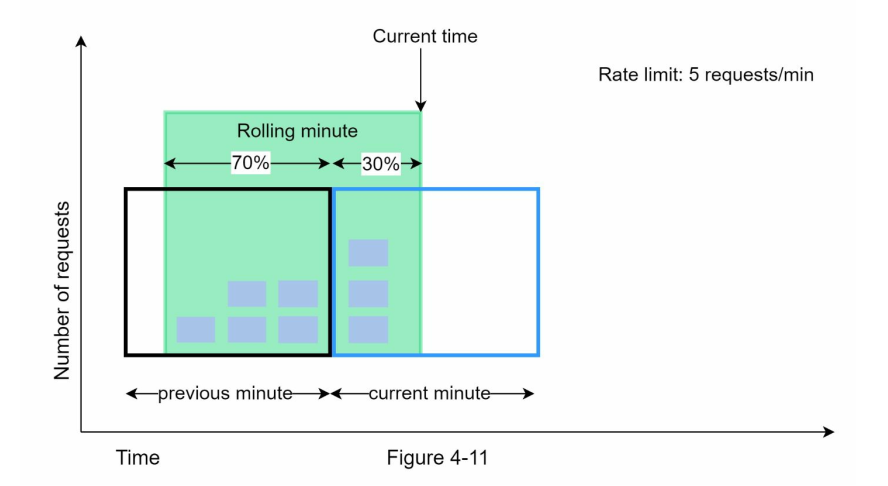
    *This diagram illustrates the sliding window counter algorithm. The 'Rolling minute' window slides over time, providing a more accurate request count than a fixed window by considering portions of two adjacent fixed windows.*

4.  **Token Bucket:** Each user has a "bucket" with a certain capacity of tokens. Tokens are added to the bucket at a steady rate. Each request consumes one token. If the bucket is empty, the request is rejected.
    *   **Pro:** Simple, memory-efficient (just token count and last refill time), and naturally handles bursts of traffic (up to the bucket capacity) while enforcing a steady average rate. This is the most common choice for production systems at companies like Stripe and AWS.
    *   **Con:** Requires tuning of two parameters: bucket size (burst rate) and refill rate (sustained rate).
We will proceed with the Token Bucket algorithm for our design, as it offers the best balance for most real-world scenarios.
Designing a Scalable Rate Limiter for Millions of Requests ...
This article provides a concise overview of the common rate limiting algorithms. Pay attention to the pros and cons of each.
Read the section 'Common Algorithms'. This will quickly familiarize you with the four main approaches and their characteristics. Notice the article's conclusion that Token Bucket is what most production systems use.
-
Metaphor for a 5-Year-Old (Token Bucket):
Imagine you have a jar for arcade tokens. The jar can hold a maximum of 10 tokens (bucket capacity). Every minute, the arcade manager adds 1 new token to your jar (refill rate). To play a game, you must use 1 token.- You can play 10 games all at once if your jar is full (a burst).
- After that, you must wait for the manager to add more tokens. You can only play at a steady rate of 1 game per minute.
- If you try to play when the jar is empty, you can't.
-
Python Code Snippet (Single-Node Token Bucket):
This code shows how the Token Bucket algorithm works in principle.import time class TokenBucket: def __init__(self, capacity: int, refill_rate: float): self.capacity = capacity # max tokens self.refill_rate = refill_rate # tokens per second self.tokens = float(capacity) self.last_refill_timestamp = time.time() def _refill(self): """Add new tokens to the bucket based on elapsed time.""" now = time.time() elapsed = now - self.last_refill_timestamp tokens_to_add = elapsed * self.refill_rate self.tokens = min(self.capacity, self.tokens + tokens_to_add) self.last_refill_timestamp = now def consume(self, num_tokens: int = 1) -> bool: """Consume tokens from the bucket. Returns True if successful.""" self._refill() if self.tokens >= num_tokens: self.tokens -= num_tokens return True return False # --- Simulation --- # Bucket allows 10 burst requests, then refills at 1 token/sec bucket = TokenBucket(capacity=10, refill_rate=1.0) print("--- Burst Phase ---") for i in range(12): if bucket.consume(): print(f"Request {i+1}: Allowed") else: print(f"Request {i+1}: Denied (not enough tokens)") print("\n--- Waiting for refill ---") time.sleep(3) # Wait for 3 seconds, so 3 tokens should be added print("\n--- Sustained Phase ---") for i in range(4): if bucket.consume(): print(f"Request {i+1}: Allowed") else: print(f"Request {i+1}: Denied")
3. The Distributed Challenge: Centralizing State with Redis (Medium-Hard)
Our Python examples so far have a fatal flaw: they only work if you have a single server. In any large-scale system, you'll have many API Gateway instances running behind a load balancer. If each gateway has its own independent rate limiter in memory, the limit is not enforced globally. A user could send requests that get routed to different gateways, effectively bypassing the limit.
-
Technical Explanation:
To solve this, the state of the rate limiter (the token buckets for all users) must be moved out of the individual gateway instances and into a centralized, shared data store. This store needs to be extremely fast to avoid adding significant latency to every single request.The perfect tool for this job is Redis, an in-memory key-value store.
- Low Latency: Redis operations are typically sub-millisecond.
- Shared Access: All gateway instances can connect to the same Redis cluster.
- Data Structures: Redis provides hash maps, which are ideal for storing the two pieces of information we need for each user's token bucket:
token_countandlast_refill_timestamp.
The flow becomes:
- Request hits Gateway A.
- Gateway A connects to Redis and fetches the token bucket state for the user.
- Gateway A performs the token bucket logic.
- Gateway A writes the updated state back to Redis.
Design a Distributed Rate Limiter
The Hello Interview article clearly explains why centralized state is necessary and why Redis is the right tool for the job.
Read the beginning of the section titled '2) The system should limit requests based on configurable rules'. Stop right before the 'But wait - there’s a race condition!' part. Focus on the logic of how Redis is used as a central store for token bucket state.
-
Metaphor for a 5-Year-Old:
The candy store is now huge, with 10 different entrance doors, each with its own bouncer. If each bouncer keeps their own private count, a kid could enter through a different door each time and never get stopped.The solution is to give all the bouncers a shared walkie-talkie connected to a central command center (Redis). When a kid enters through any door, the bouncer radios the command center: "Kid 'Alex' just came in." The command center updates its master list and radios back: "Okay, Alex has entered 3 out of 5 times." Now, all bouncers have the same, correct information, no matter which door the kid uses.
-
Python Code Snippet (Conceptual Redis Interaction):
This code shows how a gateway would interact with Redis.import redis # Connect to Redis (assuming it's running locally) r = redis.Redis(decode_responses=True) def get_token_bucket_state_from_redis(user_id: str) -> dict: """Fetches the bucket state for a user from Redis.""" key = f"rate_limit:{user_id}" state = r.hgetall(key) if not state: return {"tokens": "10", "last_refill": str(time.time())} # Default new bucket return state def save_token_bucket_state_to_redis(user_id: str, tokens: float, last_refill: float): """Saves the updated bucket state to Redis.""" key = f"rate_limit:{user_id}" r.hset(key, mapping={"tokens": str(tokens), "last_refill": str(last_refill)}) r.expire(key, 3600) # Bucket auto-deletes after 1 hour of inactivity # The logic inside the gateway would use these functions # 1. user_state = get_token_bucket_state_from_redis('user123') # 2. Perform TokenBucket logic using user_state # 3. save_token_bucket_state_to_redis('user123', new_tokens, new_timestamp)
4. Solving Concurrency: Race Conditions and Atomic Operations (Hard)
Our Redis-based design is better, but it introduces a new, subtle, and very dangerous bug: a race condition.
-
Technical Explanation:
Imagine a user has 1 token left. Two requests from that user arrive at the exact same time and hit two different gateways (Gateway A and Gateway B).- Gateway A reads from Redis:
tokens = 1. - Gateway B reads from Redis:
tokens = 1. - Gateway A decides the request is allowed, calculates the new state (
tokens = 0), and writes it back to Redis. - Gateway B also decides the request is allowed (it's working with stale data), calculates its new state (
tokens = 0), and overwrites Gateway A's write.
The result: we allowed two requests when only one should have passed. This breaks the rate limit. This is a classic read-modify-write problem.
The solution is to make the entire read-modify-write sequence an atomic operation. Redis provides a powerful mechanism for this: Lua scripting. You can send a script to Redis that contains all the logic (read the current value, calculate the new value, write it back). Redis guarantees that it will execute the entire script without being interrupted.
- Gateway A reads from Redis:
Design a Distributed Rate Limiter w/ a Ex-Meta Staff Engineer: System Design Breakdown
The ex-Meta engineer in this video explains the race condition and its solution using Lua scripting very clearly. This is a critical concept to grasp for distributed system interviews.
Watch the segment from 32:45 to 35:43. Pay close attention to the diagram showing two gateways reading the same value and the explanation of how atomicity via Lua scripting solves this.
-
Metaphor for a 5-Year-Old:
Two bouncers try to update the master count at the same time. Bouncer A radios in: "One entry for Alex." At the same time, Bouncer B radios in: "One entry for Alex." The command center operator gets confused, hears both, but might only mark down one new entry.The atomic solution is a new rule: only one bouncer can talk to the command center at a time. Bouncer A gets on the radio and says, "LOCK CHANNEL. For Alex, what is his current count? (Reply: 4). OK, I'm allowing one. New count is 5. UNLOCK CHANNEL." Only after Bouncer A is completely finished can Bouncer B start their own request. This prevents any confusion or lost updates.
-
Python Code Snippet (Conceptual Lua Script):
You don't need to write perfect Lua in an interview, but you must explain the concept.-- This is a LUA script. It would be sent to Redis for execution. -- KEYS[1] = the user's key, e.g., 'rate_limit:user123' -- ARGV[1] = capacity, ARGV[2] = refill_rate, ARGV[3] = current_time, ARGV[4] = tokens_to_consume local tokens_key = KEYS[1] .. ":tokens" local timestamp_key = KEYS[1] .. ":last_refill" local current_tokens = tonumber(redis.call("GET", tokens_key)) if current_tokens == nil then current_tokens = tonumber(ARGV[1]) -- capacity end local last_refill = tonumber(redis.call("GET", timestamp_key)) if last_refill == nil then last_refill = tonumber(ARGV[3]) -- current_time end local elapsed = tonumber(ARGV[3]) - last_refill local tokens_to_add = elapsed * tonumber(ARGV[2]) local new_tokens = math.min(tonumber(ARGV[1]), current_tokens + tokens_to_add) if new_tokens >= tonumber(ARGV[4]) then -- Allow request redis.call("SET", tokens_key, new_tokens - tonumber(ARGV[4])) redis.call("SET", timestamp_key, ARGV[3]) redis.call("EXPIRE", tokens_key, 3600) redis.call("EXPIRE", timestamp_key, 3600) return 1 -- True else -- Deny request return 0 -- False end
5. Elite Interview Deep Dive: Scaling, Fault Tolerance, and Latency (Elite)
A robust system must be scalable, resilient to failures, and fast. Answering questions about these non-functional requirements demonstrates senior-level thinking.
-
Technical Explanation: The Three Pillars
-
Scalability (Handling 1M+ req/sec):
A single Redis instance will eventually become a bottleneck. We need to distribute the load across multiple Redis instances. This is called sharding. We can use consistent hashing on theuser_idto determine which Redis shard holds that user's bucket. This ensures all requests for a given user consistently hit the same shard. In practice, you'd use a managed solution like Redis Cluster, which handles this sharding and routing for you. -
Fault Tolerance (What if Redis fails?):
- Fail-close vs. Fail-open: If a Redis shard is unavailable, what should the gateway do?
- Fail-close: Reject all requests for users on that shard. This protects the backend services but harms availability. It's the safer default.
- Fail-open: Allow all requests. This maintains availability but risks overwhelming the backend.
- Replication: The standard solution is to have a master-replica setup for each Redis shard. If the master fails, a replica is automatically promoted to be the new master, ensuring high availability.
- Fail-close vs. Fail-open: If a Redis shard is unavailable, what should the gateway do?
-
Low Latency (Keeping it fast):
Every request now has a network hop to Redis. To minimize this latency:- Connection Pooling: Gateways should maintain a pool of persistent connections to Redis, avoiding the expensive overhead of establishing a new TCP connection for every check.
- Geographic Distribution: Deploy your gateways and Redis clusters in the same geographic region (or even data center) as your users to minimize network latency.
-
Client Experience (The Response):
When a limit is exceeded, the API should return:- HTTP Status Code
429 Too Many Requests. - Helpful headers like
X-RateLimit-Limit,X-RateLimit-Remaining, andRetry-Afterto allow clients to implement intelligent backoff strategies.
- HTTP Status Code
-
Design a Distributed Rate Limiter
This article is a great reference for our deep dive topics. It covers scaling with sharding, high availability, and latency optimizations.
First, read the sections on 'How do we scale...', 'How do we ensure high availability...', and 'How do we minimize latency...'. Then, review the section 'When limits are exceeded...' to understand the client-facing response. This covers all our deep dive topics.
Test your understanding! (Interview-Style Question)
You have designed a distributed rate limiter using a sharded Redis Cluster. A new product launch causes a massive, legitimate traffic spike from a single partner's servers, all originating from the same IP address. This one "hot key" is overwhelming its assigned Redis shard, causing high latency for all other users who happen to be on that same shard.
- How would you diagnose this problem in a production environment?
- What are two distinct strategies you could employ to mitigate this issue?
Show answer
This is an excellent question that probes beyond the basic design into operational realities.
1. Diagnosing the Problem:
To diagnose this, I would rely on a robust observability stack:
- Metrics & Dashboards: I would monitor Redis-level metrics for each shard (CPU utilization, memory, network I/O) and application-level metrics (rate limit check latency, number of requests per key). A dashboard would show one Redis shard with a CPU spike and high latency, while others are normal. Drilling down on the application metrics would reveal a single key (the partner's IP address) with an abnormally high request rate directed at that shard.
- Logging & Tracing: Distributed tracing would confirm that requests for keys on the problematic shard are experiencing high end-to-end latency, with the majority of the time spent waiting for the rate limiter's Redis call. Logs would contain the specific keys being rate-limited.
- Alerting: Proactive alerts would have already fired for "High Redis CPU on shard X" and "P99 Rate Limit Latency > 20ms".
2. Mitigation Strategies:
This is a classic "hot key" problem. Here are two distinct strategies:
-
Strategy 1: Offload to Local/In-Memory Caching (Approximate but Fast)
For an extremely hot key, making a network call to Redis for every single request is the bottleneck. We can introduce a short-lived, in-memory cache within each API gateway instance.- Mechanism: When a key is detected as "hot" (e.g., >1000 requests/sec), the gateway can decide to handle its rate limiting locally for a short period (e.g., 1-2 seconds) instead of calling Redis. The gateway would use a local token bucket.
- Trade-off: This sacrifices perfect global accuracy for system stability. If the hot key's traffic is spread across 10 gateways, its actual limit might be 10x the intended local limit. However, this is often an acceptable trade-off to prevent one key from taking down an entire Redis shard and impacting thousands of other users. The local limit would still be much lower than "no limit at all." After the 2-second local window, it would revert to checking the central Redis store.
-
Strategy 2: Policy and Architectural Changes (Precise but Proactive)
This strategy addresses the root cause: treating a high-volume partner the same as a regular user.- Mechanism:
- Isolate the Partner: Work with the business/partner team to issue them a unique API key.
- Create a New Rule: Implement a new, more generous rate limiting rule specifically for this API key.
- Dedicated Resources: For very high-value partners, their rate limiting could even be directed to a separate, dedicated Redis shard or cluster, completely isolating their traffic from the general user pool.
- Trade-off: This is a more strategic, long-term fix. It requires coordination outside of pure engineering but results in a much more robust and fair system. It correctly identifies that not all traffic is equal and provides a scalable way to handle legitimate, high-volume clients without resorting to approximations. In an interview, suggesting this shows you think about business context, not just technical mechanics.
- Mechanism:
Conclusion
Today, we designed a complete, distributed rate limiting system, a cornerstone of any scalable and resilient architecture. We moved from a simple concept to a production-ready design capable of handling millions of requests per second.
Key Takeaways:
- Rate limiting is essential for protecting backend services from abuse and overload, and is best placed at the API Gateway.
- The Token Bucket algorithm provides an excellent balance of performance, memory efficiency, and burst traffic handling.
- In a distributed system, state must be centralized. Redis is the ideal tool for this due to its low latency.
- The read-modify-write race condition is a critical bug that must be solved with atomic operations, for which Redis Lua scripting is the standard solution.
- A production system must be scalable (via sharding), fault-tolerant (via replication and fail-close strategies), and low-latency (via connection pooling and geo-distribution).
Next Lesson Preview
We've now seen how to protect our services by shedding excess load. But what happens when a downstream service we depend on fails? If we keep sending it requests, we can cause a cascading failure across our entire system. In our next lesson, we will tackle this by learning to implement a circuit breaker pattern to prevent cascading failures in a microservices architecture.