Hello! Welcome to the first lesson in our new module on Scalable Data Processing and Platforms.
In our last module, we mastered advanced architectural and security patterns, culminating in a deep dive into secrets management and workload identity. You learned how to secure distributed systems at their foundation. Now, we pivot to what these systems do: process massive amounts of data. The ability to design and reason about large-scale data pipelines is a hallmark of an elite engineer, especially in AI/ML and data platform roles.
Today, your learning outcome is to explain the MapReduce programming model and its application in batch processing. This paradigm, pioneered by Google, was a breakthrough that made processing petabyte-scale datasets on commodity hardware feasible. It laid the groundwork for the entire Big Data ecosystem, including technologies like Hadoop and, later, Apache Spark.
We will deconstruct this topic into five interrelated concepts, moving from the high-level problem to the nitty-gritty implementation details:
- The Problem: Why Distributed Batch Processing is Hard
- The Core Idea: The MapReduce Programming Model
- "Hello, World!" of Big Data: Word Count with MapReduce
- Under the Hood: Data Flow, Fault Tolerance, and Data Locality
- Building Pipelines: Chaining Jobs and Key Limitations
1. The Problem: Why Distributed Batch Processing is Hard (Easy)
-
Technical Explanation:
Batch processing involves executing a job on a large, finite dataset. Examples include calculating daily sales reports, re-indexing a search engine's web crawl, or training a machine learning model on historical data. While simple for small datasets on a single machine, this becomes immensely complex at the scale of terabytes or petabytes.Simply throwing more computers at the problem isn't enough. If you try to write a distributed batch job from scratch, you face a host of difficult engineering challenges:
- Partitioning: How do you break the massive dataset and the work into smaller chunks for each computer?
- Coordination: How do you orchestrate the start and end of tasks across hundreds or thousands of machines?
- Load Balancing: How do you ensure that work is distributed evenly and no machines are idle while others are overloaded?
- Fault Tolerance: What happens when a machine inevitably fails mid-computation? How do you detect the failure and re-run only the lost work without restarting the entire multi-hour job?
Before MapReduce, engineers at places like Google had to solve these problems with custom, complex, and error-prone boilerplate code for every new batch job. This was slow, inefficient, and required deep expertise in distributed systems.
MapReduce - Google Thinks You're Bad At Coding | Distributed Systems Deep Dives With Ex-Google SWE
To understand the context that gave rise to MapReduce, watch this section from the 'Jordan has no life' YouTube channel. It perfectly describes the challenges Google faced and the motivation for creating a standardized framework.
Watch the video from 00:32 to 04:34. Focus on the problems Google was trying to solve: the complexity of writing distributed jobs, the need to handle frequent hardware failures, and the desire to abstract away this complexity from application developers.
-
Metaphor for a 5-Year-Old:
Imagine you're a head chef and you need to prepare a giant feast (the batch job) using 1,000 assistant chefs (computers).
Without a good system, it's chaos. You'd have to tell each chef exactly what to do and when. If one chef gets sick (a machine fails), you have to figure out what they were cooking, find a replacement, and tell them how to remake it. If some chefs are slow and others are fast, you'll have food getting cold while waiting for others. You'd spend all your time managing the chefs instead of designing the menu.
MapReduce is like creating a perfect, standardized recipe and workflow that every chef knows. It automatically handles sick chefs and assigns tasks efficiently, so you can focus on the food (your logic), not the logistics. -
Python Code Snippet:
This concept is architectural, so no code is needed here. The problem is the absence of a good framework, leading to complex, ad-hoc solutions.
2. The Core Idea: The MapReduce Programming Model (Medium)
-
Technical Explanation:
MapReduce solves the problems above by providing a simple yet powerful programming model that abstracts away the distributed system's complexity. The developer only needs to provide two functions:MapandReduce. The framework handles everything else (parallelization, fault tolerance, etc.). The entire process works on key-value pairs and has three distinct phases:- Map Phase: The framework reads the input data, splits it into chunks, and feeds each chunk to a
Maptask. Yourmapfunction processes a piece of the input and emits zero or more intermediate key-value pairs(k_intermediate, v_intermediate). - Shuffle Phase: This crucial phase is handled entirely by the framework. It collects all the intermediate key-value pairs from all mappers, sorts them by key, and groups all values associated with the same key. It then delivers each unique key and its list of associated values to a
Reducetask. - Reduce Phase: Your
reducefunction takes an intermediate keyk_intermediateand a list of all its associated values[v1, v2, v3, ...]. It processes this list to produce a final output, often just a single value or a new key-value pair(k_final, v_final).
- Map Phase: The framework reads the input data, splits it into chunks, and feeds each chunk to a
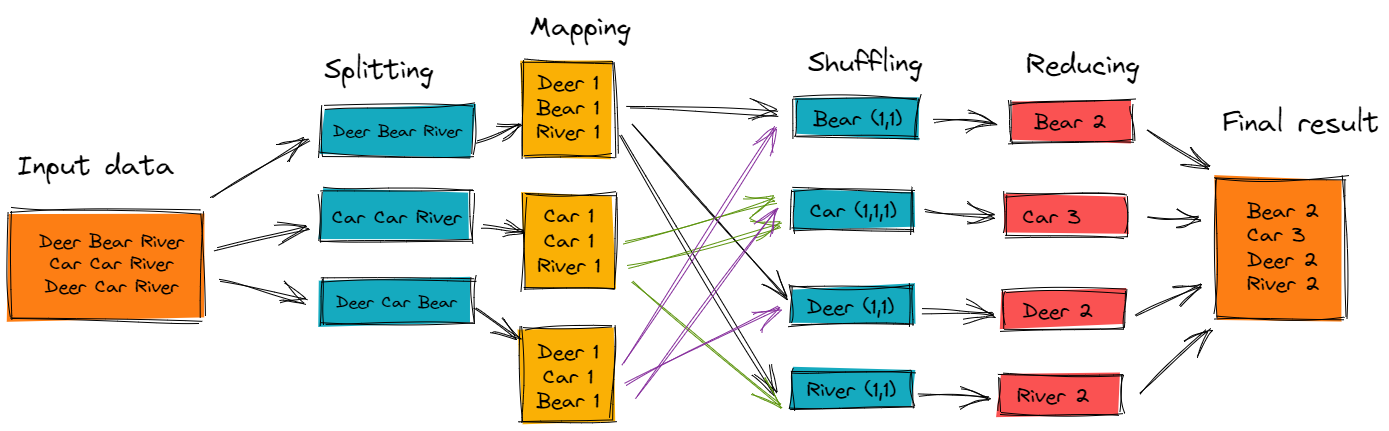
A Simple MapReduce Example with Ray Core
The documentation for Ray, a modern distributed computing framework, provides a very clear and concise definition of the three phases of MapReduce. This will solidify your understanding of the model.
Read the section detailing the three phases: Map, Shuffle, and Reduce. Focus on the input and output of each phase and how they connect to one another.
-
Metaphor for a 5-Year-Old:
Imagine you have a giant pile of LEGO bricks of different colors and you want to count how many bricks of each color you have.- Map: You and your friends (Mappers) each grab a bucket of LEGOs. For every brick you see, you write a note. If you see a red brick, you write a note that says
("red", 1). If you see a blue one, you write("blue", 1). You do this for all the bricks in your bucket. - Shuffle: Your parents come and collect all the little notes from everyone. They sort them into piles based on color. All the
"red"notes go in one pile, all the"blue"notes in another, and so on. - Reduce: You assign one friend to each pile (Reducers). The friend in charge of the
"red"pile counts all their notes and finds the total. They shout out, "Red: 52!" The friend with the"blue"pile does the same. This gives you the final count for each color.
- Map: You and your friends (Mappers) each grab a bucket of LEGOs. For every brick you see, you write a note. If you see a red brick, you write a note that says
-
Python Code Snippet (Conceptual Structure):
This shows the conceptual signatures of the functions you, the developer, would write.# Input data is often just lines from a file or records from a database. # The key might be the line number or document ID, and the value is the content. def map(input_key, input_value): # Process input_value and emit intermediate key-value pairs. # For example: for word in input_value.split(): yield (word, 1) intermediate_key_value_pairs = [] # ... logic to generate pairs ... return intermediate_key_value_pairs # The framework guarantees that all values for a given key go to the same reducer. def reduce(intermediate_key, list_of_values): # Aggregate the list of values. # For example: return (intermediate_key, sum(list_of_values)) final_result = None # ... logic to aggregate values ... return final_result
3. "Hello, World!" of Big Data: Word Count with MapReduce (Medium)
-
Technical Explanation:
Counting word occurrences in a massive corpus of documents is the canonical "Hello, World!" example for MapReduce. Let's trace the data flow for the input sentence "the quick brown fox jumps over the lazy dog".-
Map Phase: The
mapfunction receives the sentence. It splits the sentence into words and, for each word, emits a(word, 1)pair.- Emits
("the", 1) - Emits
("quick", 1) - Emits
("brown", 1) - ... and so on for every word.
- Emits
-
Shuffle Phase: The framework collects pairs from all mappers. It groups them by key:
"the": [1, 1]"quick": [1]"brown": [1]"fox": [1]"jumps": [1]"over": [1]"lazy": [1]"dog": [1]
-
Reduce Phase: A separate
reducetask is invoked for each unique key.reduce("the", [1, 1])is called -> it calculates1 + 1and outputs("the", 2).reduce("quick", [1])is called -> it calculatessum([1])and outputs("quick", 1).- ...and so on for all other words.
The final output is the aggregated list of word counts.
-
MapReduce - SIGMETRICS Tutorial
This tutorial from Google provides a clear pseudo-code implementation for the Word Count example. Seeing it in this format helps separate the core logic from any specific language's syntax.
Find the 'Word Count Example' and 'Word Count Solution' sections (around page 19). Study the map and reduce pseudo-code to see how simple the user-provided logic is.
-
Metaphor for a 5-Year-Old:
This is the exact LEGO metaphor from the previous concept, but now applied to words in a book instead of colored bricks. Each word is a different color of LEGO. -
Python Code Snippet (Simulated Word Count):
This code simulates the MapReduce flow in pure Python for a small list of documents.from collections import defaultdict # 1. The user-defined MAP function def map_word_count(document_id, document_text): """For each word in the text, emits (word, 1).""" for word in document_text.lower().split(): yield (word, 1) # 2. The user-defined REDUCE function def reduce_word_count(word, counts): """Sums the counts for a given word.""" return (word, sum(counts)) # --- Framework Simulation --- if __name__ == "__main__": documents = [ "the quick brown fox", "the lazy dog", "the fox jumps over the lazy dog" ] # MAP PHASE intermediate_data = [] for i, doc in enumerate(documents): # In a real system, each map call would be on a different machine. for key_val_pair in map_word_count(i, doc): intermediate_data.append(key_val_pair) print(f"--- Intermediate Map Output ---\n{intermediate_data}\n") # [('the', 1), ('quick', 1), ..., ('dog', 1)] # SHUFFLE PHASE shuffled_data = defaultdict(list) for key, value in intermediate_data: shuffled_data[key].append(value) print(f"--- Shuffled and Grouped Data ---\n{dict(shuffled_data)}\n") # {'the': [1, 1, 1, 1], 'quick': [1], ...} # REDUCE PHASE final_output = [] for key, values in shuffled_data.items(): # Each reduce call could be on a different machine. final_output.append(reduce_word_count(key, values)) final_output.sort(key=lambda x: x[1], reverse=True) print(f"--- Final Reduce Output ---\n{final_output}") # [('the', 4), ('dog', 2), ('fox', 2), ('lazy', 2), ...]
4. Under the Hood: Data Flow, Fault Tolerance, and Data Locality (Hard)
-
Technical Explanation:
The magic of MapReduce lies in the framework's implementation. Here are the key "under the hood" mechanisms that make it work at scale:- Data Locality (The "Secret Sauce"): The framework has access to the underlying distributed file system (like Google File System or HDFS). It knows where each block of data physically resides. Instead of moving massive amounts of data to the compute nodes, the Master node tries to schedule
maptasks on the same physical machines that hold the data chunks. This minimizes network traffic, which was the primary bottleneck in Google's early data centers. - Master-Worker Architecture: A single Master node coordinates the job. It assigns
mapandreducetasks to many Worker nodes, tracks their progress, and manages data flow. - Fault Tolerance:
- Worker Failure: The Master pings each Worker periodically. If a Worker becomes unresponsive, the Master marks all tasks it was running (in-progress or completed) as failed. The work is then rescheduled on other healthy Workers. This is possible because the input data is on a reliable distributed file system, and the intermediate output of a completed
maptask is written to the local disk of the mapper node. If that node dies, the intermediate data is lost, and themaptask must be re-run. - Straggler Problem: Some tasks may run unusually slowly due to bad hardware or other resource contention ("stragglers"). To prevent them from delaying the entire job, when most tasks are complete, the Master proactively schedules backup executions of the remaining few tasks on other idle workers. The first one to finish "wins," and its result is used.
- Worker Failure: The Master pings each Worker periodically. If a Worker becomes unresponsive, the Master marks all tasks it was running (in-progress or completed) as failed. The work is then rescheduled on other healthy Workers. This is possible because the input data is on a reliable distributed file system, and the intermediate output of a completed
- Combiner Function (Optimization): The developer can optionally provide a
combinerfunction. It's essentially a "mini-reducer" that runs on the mapper machine after themapphase but before the shuffle. For word count, a combiner could sum the counts locally on the mapper node. Instead of sending[("the", 1), ("the", 1), ("the", 1)]over the network, it would send[("the", 3)], significantly reducing network I/O.
- Data Locality (The "Secret Sauce"): The framework has access to the underlying distributed file system (like Google File System or HDFS). It knows where each block of data physically resides. Instead of moving massive amounts of data to the compute nodes, the Master node tries to schedule

MapReduce - Google Thinks You're Bad At Coding | Distributed Systems Deep Dives With Ex-Google SWE
This deep dive video explains the guts of the MapReduce implementation. It is essential for understanding the trade-offs and design decisions that made the system so resilient and scalable.
First, watch from 09:14 to 16:21 to understand the end-to-end data flow, partitioning, and the role of the master node. Then, watch the critical section on optimizations and fault tolerance from 17:30 to 28:22. Pay close attention to how data locality is achieved and how mapper failures, reducer failures, and stragglers are handled.
- Metaphor for a 5-Year-Old:
Back to our chef analogy, the head chef (Master) is now even smarter.- Data Locality: The head chef sends an assistant who is already standing at the vegetable station to chop vegetables, instead of making them walk across the kitchen.
- Fault Tolerance: If an assistant chef faints (worker failure), the head chef sees this, throws away their half-chopped vegetables, and tells another free assistant to start chopping a new batch of the same vegetables from scratch.
- Stragglers: If one assistant is taking forever to peel potatoes, the head chef tells another idle assistant, "You start peeling those potatoes too! Whoever finishes first, bring them to me."
- Combiners: Before an assistant brings their basket of chopped onions to the main prep table, they first put them all into one big bowl on their own station. This is easier to carry than 100 little piles.
5. Building Pipelines: Chaining Jobs and Key Limitations (Harder)
-
Technical Explanation:
Many complex data processing tasks cannot be done in a single MapReduce job. The solution is job chaining: the output of one MapReduce job becomes the input for the next. For example, Google's original search indexing pipeline consisted of a sequence of 5-10 chained MapReduce jobs.- Job 1: Parse raw web pages and output
(URL, text_content). - Job 2: Take
(URL, text_content)and run the word count logic to create an inverted index(word, list_of_URLs). - Job 3: Take the inverted index and other data to calculate PageRank scores.
While powerful, this reveals MapReduce's biggest limitation: high latency due to disk I/O. After each
mapandreducestage, the framework materializes the output—it writes it back to the distributed file system (e.g., HDFS). When chaining jobs, Job 2 can only start after Job 1 has completely finished and written all its output to disk. Job 2 then has to read all that data back from disk. This disk I/O at every step makes MapReduce inefficient for:- Iterative Algorithms: Common in machine learning, where you need to pass over the same dataset many times.
- Interactive Analysis: Ad-hoc querying where a data scientist wants quick answers.
This very limitation was the primary motivation for creating Apache Spark, which performs computations in-memory whenever possible, avoiding the expensive disk I/O between stages.
- Job 1: Parse raw web pages and output
WTF is MapReduce?? [Batch Processing] | Systems Design Interview 0 to 1 with Ex-Google SWE
To see how job chaining works and to understand the limitations of MapReduce, let's watch the final segments of this video.
Watch the short segment on 'Job chaining' (07:25 - 08:17) and then the conclusion (08:17 - 09:12), which explicitly mentions the flaws that led to modern alternatives.
- Metaphor for a 5-Year-Old:
Imagine building a LEGO car on an assembly line.- MapReduce (Chained): Step 1 is to build the car's frame. You build it, then you have to put the finished frame in a box, seal it, and store it in a warehouse (writing to disk). For Step 2 (adding the wheels), another team has to go to the warehouse, find the box, unseal it, and take the frame out. This is very slow.
- Spark (In-memory): This is a modern assembly line. As soon as the frame is built, it moves directly to the next station on a conveyor belt, where the wheels are put on immediately. There's no boxing and unboxing, so it's much, much faster.
Test your understanding! (Interview-Style Question)
You are tasked with processing terabytes of web server logs. Each log line contains a timestamp, IP_address, URL, and country_code. The goal is to produce a daily report of the top 10 most visited URLs for each country.
How would you design a pipeline using the MapReduce model to achieve this? Describe the key-value pairs at each stage. What potential performance issues might you face?
Show answer
This is a great problem that requires a two-stage MapReduce pipeline.
Job 1: Count URL visits per country
-
Map Phase:
- Input: Raw log lines.
- Function: For each line, parse the
country_codeandURL. Emit a composite key. - Output Key-Value:
((country_code, URL), 1) - Example:
(("US", "/home"), 1)
-
Shuffle Phase:
- The framework will group all the
1s for each unique(country_code, URL)pair. - Example:
(("US", "/home"), [1, 1, 1, ...])
- The framework will group all the
-
Reduce Phase:
- Function: Sum the
1s to get the total count for each URL within each country. - Output Key-Value:
(country_code, (URL, count)) - Example:
("US", ("/home", 54321))
- Function: Sum the
Job 2: Find the Top 10 URLs for each country
The output of Job 1 is now the input for Job 2.
-
Map Phase:
- Input: The
(country_code, (URL, count))pairs from Job 1. - Function: This is an identity map. We just need to restructure the data for the next reduce step. The goal is to get all URLs for a single country to the same reducer.
- Output Key-Value:
(country_code, (URL, count))(no change)
- Input: The
-
Shuffle Phase:
- The framework groups all
(URL, count)tuples bycountry_code. - Example:
("US", [("/home", 54321), ("/about", 12345), ("/products", 98765), ...])
- The framework groups all
-
Reduce Phase:
- Function: For each country, take the list of
(URL, count)tuples. Sort this list in memory by count in descending order. Take the top 10 elements. - Output Key-Value:
(country_code, top_10_list) - Example:
("US", [("/products", 98765), ("/home", 54321), ...])
- Function: For each country, take the list of
Potential Performance Issues:
- Job Chaining Latency: The primary issue is the performance hit from writing all intermediate results of Job 1 to the distributed file system and then having Job 2 read them all back.
- "Hot" Keys: In Job 2's reducer, if one country (e.g., "US") has vastly more unique URLs than others, that single reducer will have a huge amount of data to process and sort in memory. This could lead to memory errors or that reducer becoming a straggler, slowing down the entire job.
- Combiner Opportunity: In Job 1, we can use a combiner that runs on the mapper nodes to perform a local sum. This would significantly reduce the amount of data that needs to be shuffled across the network.
Conclusion
Today, you've learned the fundamentals of MapReduce, the programming model that unlocked large-scale data processing for a generation of engineers. We've seen how its simple Map and Reduce abstraction hides immense complexity related to parallel execution, fault tolerance, and data distribution.
Key Takeaways:
- MapReduce provides a restricted programming model (
mapandreducefunctions) that allows a framework to handle the hard parts of distributed computing. - The model's power comes from data locality (moving compute to data) and built-in fault tolerance.
- The Shuffle & Sort phase is the magic that groups data by key for the reducers.
- Complex workflows are built by chaining jobs, but this exposes the main limitation: high latency from writing all intermediate data to disk.
Next Lesson Preview
MapReduce is designed for finite, bounded datasets—the essence of batch processing. But what about data that never ends, like a stream of user clicks, sensor readings, or financial trades? This requires a fundamentally different approach. In our next lesson, we will explore the world of real-time data by having you explain core stream processing concepts: event time vs. processing time, windowing, and watermarks.