Hello! Welcome back to your daily lesson on advanced architectural patterns.
In our previous lessons, you've built a strong foundation in application security. We've covered how to authenticate users with JWTs, authorize their actions with RBAC/ABAC, and defend against common code-level attacks like SQLi, XSS, and CSRF. We've secured the application's logic. Today, we address a different, but equally critical, question: how does our application securely access other systems, like databases, APIs, and cloud services?
Your learning outcome for this lesson is to design a strategy for secrets management in a distributed application using a vault service. This is a cornerstone skill for building secure, scalable, and operable systems at an elite level. Mishandling secrets is one of the most common ways distributed systems are compromised.
We will break this down into five interrelated concepts, building from the fundamental problem to the most advanced solutions:
- The Problem: Secret Sprawl and Its Dangers
- The Solution: The Centralized Vault Model
- Authentication & Authorization: Who Gets the Secrets?
- Dynamic Secrets: Short-Lived, Just-in-Time Credentials
- The "Bottom Turtle" Problem & Workload Identity
1. The Problem: Secret Sprawl and Its Dangers (Easy)
-
Technical Explanation:
In any distributed application, components need to authenticate to each other. This requires "secrets"—credentials like database passwords, API keys, TLS certificates, and cloud access keys. Without a deliberate strategy, these secrets tend to scatter across the environment in a phenomenon known as secret sprawl. You'll find them:- Hardcoded in source code.
- In plain text configuration files.
- As environment variables in CI/CD pipelines.
- Stored locally on developer machines.
This sprawl creates massive security risks:
- No Visibility: It's impossible to know who or what has access to a particular secret.
- No Audit Trail: If a secret is compromised, you can't determine how it was leaked or who has used it.
- Difficult Rotation: When a secret needs to be changed (e.g., after an employee leaves or a key is suspected to be leaked), updating it in every location is a manual, error-prone nightmare that often leads to downtime.
HashiCorp Vault Tutorial for Beginners - What, Why and How
To start, let's watch a concise explanation of what secrets are and the chaos that 'secret sprawl' causes in real-world projects. This video from TechWorld with Nana sets the stage perfectly.
Watch the first two sections of the video, 'What are secrets and why manage them?' (00:36 - 03:55) and the explanation of 'Secret Sprawl' (03:55 - 08:36). Focus on the two main problems discussed: the lack of visibility and the challenge of secret rotation.
-
Metaphor for a 5-Year-Old:
Imagine secrets are the keys to your house. Secret sprawl is like leaving copies of your keys everywhere: one under the doormat, another in the mailbox, one taped behind a flowerpot, and giving copies to every contractor you've ever hired. It becomes impossible to track who has which key. If your house gets robbed, you have no idea which key was used, and changing all the locks (and redistributing new keys to the right people) is a huge, expensive job. -
Python Code Snippet (The "Bad" Way):
This common pattern in development environments demonstrates secret sprawl. The database password is read from a configuration file that might be accidentally committed to source control.import configparser import psycopg2 # config.ini (potentially committed to Git) # [database] # host = localhost # user = postgres # password = my-super-secret-password-123 def get_db_connection(): config = configparser.ConfigParser() config.read('config.ini') # VULNERABLE: The secret is in a static file on disk. password = config['database']['password'] conn = psycopg2.connect( host=config['database']['host'], user=config['database']['user'], password=password ) return conn
2. The Solution: The Centralized Vault Model (Medium)
-
Technical Explanation:
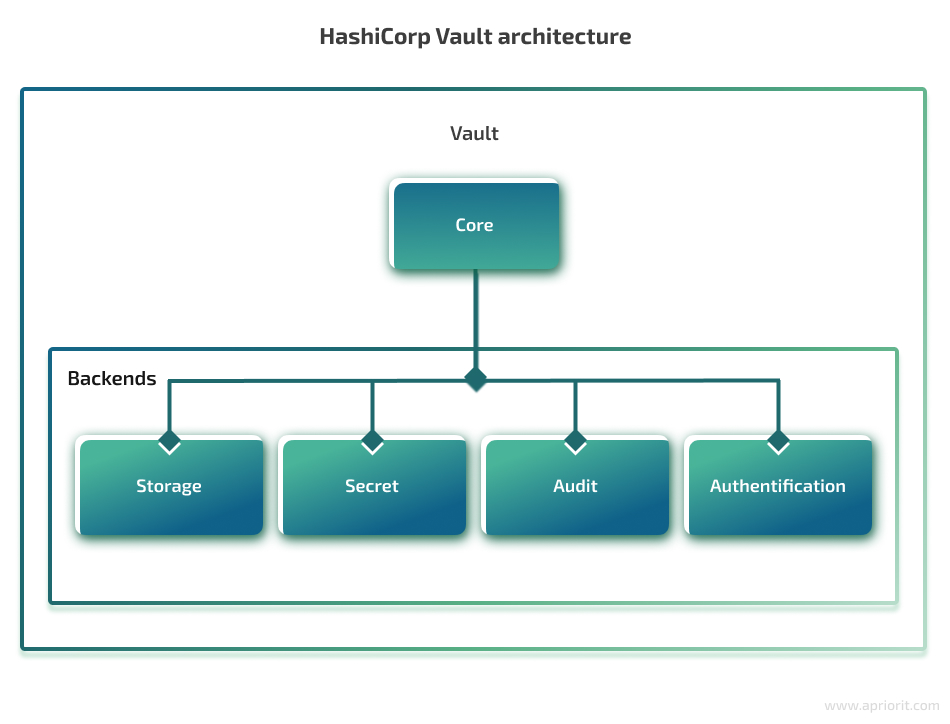
The solution to secret sprawl is a dedicated, centralized service for secrets management, often called a vault (HashiCorp Vault is the canonical example). A vault is a purpose-built system designed around four core principles:- Centralization: It acts as the single source of truth for all secrets.
- Strict Access Control: Fine-grained policies define precisely which user or application can access which secret.
- Detailed Auditing: Every single action (authentication, secret access, configuration change) is logged, providing a clear audit trail.
- Encryption Everywhere: Secrets are always encrypted in transit (using TLS) and at rest in the vault's storage backend. The vault itself doesn't trust its own storage; data is encrypted before it's written.
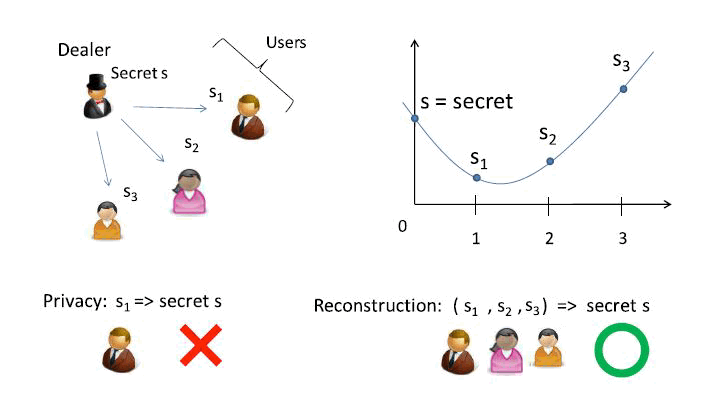
An important operational concept for many vaults is the seal/unseal process. The vault's master encryption key is itself encrypted. To start the vault, a quorum of operators must each provide a piece of the key (an "unseal key"). This is often implemented using Shamir's Secret Sharing, preventing any single person from having the power to expose all secrets.
-
Metaphor for a 5-Year-Old:
A vault is like a bank with safe deposit boxes.- Centralization: All the valuable keys are stored in one ultra-secure building, not under doormats.
- Access Control: To open your box, you need your key and your signature. The bank teller verifies your identity and won't let you open anyone else's box.
- Auditing: The bank keeps a detailed log every time you access your box.
- Encryption: Your items are inside a locked metal box (encrypted at rest).
- Unsealing: The main bank vault door requires three different managers to turn their keys at the same time to open it in the morning (Shamir's Secret Sharing). No single manager can open it alone.
-
Python Code Snippet:
At this stage, the concept is architectural. We will write code to interact with a vault in the subsequent sections.
3. Authentication & Authorization: Who Gets the Secrets? (Medium)
-
Technical Explanation:
A critical question is: how does a client (human or application) prove its identity to the vault? This is handled by pluggable Auth Methods. While humans might use familiar methods like LDAP or OIDC, the application authentication problem is more interesting for system design. Common methods include:- Token Auth: A client is given a bootstrap token. This is simple but begs the question: how do you securely deliver that token? This pushes the problem one step back.
- AppRole Auth: A popular method where an application has a public
RoleID(like a username) and a secretSecretID(like a password). It provides both to log in. This is more structured than a simple token but still requires secure delivery of theSecretID. - Cloud/Platform Auth (e.g., AWS IAM, Kubernetes): This is the modern best practice. The vault is configured to trust an external authority like AWS IAM or a Kubernetes cluster. An application proves its identity by providing a signed document from that trusted authority (e.g., an AWS Instance Identity Document or a Kubernetes Service Account Token). The vault verifies this document with the authority and, if valid, issues a token.
Once authenticated, Policies are attached to the client's token. These policies, which you can design using principles like RBAC and ABAC from our previous lessons, define exactly which secret paths the client is authorized to read, write, or delete.
HashiCorp Vault Tutorial for Beginners - What, Why and How
The 'TechWorld with Nana' video has an excellent deep dive into Vault's pluggable architecture, which clearly explains how Auth Methods, Secret Engines, and other components work together.
Watch the section on Vault's Architecture (18:44 - 28:50). Pay close attention to the explanation of 'Authentication Methods' and how they use trusted identity providers like Kubernetes and AWS. Also, note how the client receives a token with policies attached after successful authentication.
-
Metaphor for a 5-Year-Old:
To get into your safe deposit box, you must prove who you are.- Token Auth: You have a special, one-time-use access card.
- AppRole Auth: You tell the teller your public account number (
RoleID) and whisper a secret PIN (SecretID). - Cloud Auth: You show the bank teller your government-issued driver's license (your AWS identity document). The teller uses a special machine to verify with the government that the license is real. This is the most secure method because a highly trusted party issued your ID.
-
Python Code Snippet (Conceptual Client Interaction):
This code uses thehvacclient library to illustrate authenticating to Vault via the AppRole method.import hvac import os client = hvac.Client(url='https://vault.example.com:8200') # The RoleID is often public and can be configured. role_id = 'your-app-role-id' # The SecretID is the sensitive part, which must be delivered securely. # We will solve the delivery of this in Concept 5! secret_id = os.environ.get('VAULT_SECRET_ID') try: # The application authenticates using the AppRole method. client.auth.approle.login( role_id=role_id, secret_id=secret_id ) if client.is_authenticated(): print("Authentication successful!") # Now the client is ready to request secrets. else: print("Authentication failed.") except Exception as e: print(f"An error occurred: {e}")
4. Dynamic Secrets: Short-Lived, Just-in-Time Credentials (Hard)
-
Technical Explanation:
This is a revolutionary feature of modern vaults and a significant leap in security. Instead of storing a static, long-lived database password, you configure the vault with administrative privileges over the target system (e.g., the database).
When an application needs database access, it doesn't ask for a stored password. Instead, it asks the vault to generate one. The vault connects to the database, creates a brand new database user with a unique password and a short Time-To-Live (TTL), and returns these credentials to the application.The benefits are immense:
- "Leakage" becomes almost meaningless: The credentials expire automatically, often in minutes or hours.
- Automatic Rotation: The "problem" of rotating secrets is completely eliminated.
- Granular Auditing: You can trace every database session back to the specific application instance that requested the credential.
- Reduced Blast Radius: A compromised credential has a very limited time window for misuse.
HashiCorp Vault Tutorial for Beginners - What, Why and How
Let's revisit the 'TechWorld with Nana' video to see a clear explanation of this powerful concept.
Watch the segment on 'Dynamic Secrets' (11:39 - 15:24). Understand how generating short-lived, unique credentials for each client fundamentally changes the security model compared to sharing a static secret.
-
Metaphor for a 5-Year-Old:
Instead of giving you a permanent key to the database room that you could lose, you go to the security guard (the vault). You ask for access. The guard creates a brand-new keycard that only works on the database room door, is valid for just 10 minutes, and has your name electronically encoded on it. After 10 minutes, the card is automatically deactivated. If you lose it, the finder has a very short window to use it, and if they do, the security system knows it was your card. -
Python Code Snippet (Requesting Dynamic Secrets):
Assuming theclientis authenticated from the previous step, here's how it would fetch dynamic database credentials.# Assume 'client' is an authenticated hvac.Client instance. # The application requests credentials from a pre-configured 'database' role. # Vault will connect to the database and generate a new user/password. try: read_response = client.secrets.database.generate_credentials( name='my-postgres-db-role' ) username = read_response['data']['username'] password = read_response['data']['password'] lease_duration = read_response['lease_duration'] # in seconds print(f"Obtained dynamic credentials. User: {username}, Lease: {lease_duration}s") # Now, use these credentials to connect to the database. # The application is also responsible for renewing the lease if it needs # the credentials for longer than the initial TTL. except hvac.exceptions.InvalidPath: print("Database secrets engine or role not configured correctly.") except Exception as e: print(f"Error fetching dynamic secret: {e}")
5. The "Bottom Turtle" Problem & Workload Identity (Harder)
-
Technical Explanation:
We've dodged a crucial question: how does an application get its first secret (e.g., theSecretIDfor AppRole) to authenticate to the vault? This is the "secure introduction," "credential zero," or famously, the "bottom turtle" problem. If you solve secrets management by introducing a new secret that needs to be managed, you haven't solved the root problem.The definitive solution is Workload Identity and Attestation.
The principle is that a workload proves its identity to the vault without a pre-existing secret, using verifiable attributes of the platform it's running on. This is what the Cloud/Platform auth methods enable.- Workload Attestation: A process where a workload's identity is cryptographically verified based on its environment. For example, a Vault Agent on an AWS EC2 instance can query the trusted AWS metadata service to get a signed document proving the instance's identity. This document is the "proof" it presents to Vault.
- SPIFFE/SPIRE: The Secure Production Identity Framework for Everyone (SPIFFE) standardizes this concept, making it platform-agnostic. A SPIRE agent running on a node performs attestation and issues a short-lived, cryptographic identity document (an SVID) to every workload on that node via a local API. The workload can then use this SVID to authenticate to Vault or any other SPIFFE-aware system. This completely eliminates the need for any bootstrapped secrets.
Solving the Bottom Turtle: The SPIFFE and SPIRE Book
To understand this fundamental problem and its modern solution, we will read from 'Solving the Bottom Turtle', the definitive book on SPIFFE and SPIRE.
First, read the section 'Houston, We Have a Problem' (starts page 15). Pay special attention to the part that discusses secrets management tools like Vault and explicitly names the 'turtles all the way down' problem (page 17). This frames the core challenge. Next, read the section 'Secrets managers' in the chapter 'Comparing SPIFFE to Other Security Technologies' (starts page 164). This section explains exactly how SPIFFE/SPIRE complements a secret manager to solve the 'credential zero' problem.
-
Metaphor for a 5-Year-Old:
How do you get your very first ID card if you need an ID card to prove who you are? You can't. Instead, you use a birth certificate. Your birth certificate was issued by a trusted source (the hospital/government) at the moment you were "created."
Workload attestation is the same idea. An EC2 instance, when it's "born" by AWS, comes with a digital "birth certificate." An application can show this birth certificate to the vault to get its first access token. SPIFFE/SPIRE is a system that gives a standardized, secure birth certificate to every application, no matter where it's born (AWS, GCP, your own data center). -
Python Code Snippet (Conceptual K8s Workload Attestation):
This demonstrates how an app in Kubernetes can authenticate to Vault without a pre-configured secret.import hvac import os # In Kubernetes, a projected service account token is mounted into the pod's filesystem. # The path is well-known. KUBE_SA_TOKEN_PATH = '/var/run/secrets/kubernetes.io/serviceaccount/token' # The role in Vault must be pre-configured to trust this K8s service account. VAULT_KUBE_ROLE = 'my-app-role' client = hvac.Client(url='https://vault.example.com:8200') if os.path.exists(KUBE_SA_TOKEN_PATH): # 1. Read the JWT token provided by Kubernetes itself. This is the 'proof'. with open(KUBE_SA_TOKEN_PATH, 'r') as f: jwt = f.read() try: # 2. Authenticate to Vault using the Kubernetes auth method, # presenting the JWT as proof of identity. client.auth.kubernetes.login( role=VAULT_KUBE_ROLE, jwt=jwt ) if client.is_authenticated(): print("Kubernetes workload attestation successful!") # Now the client can request static or dynamic secrets. else: print("Authentication failed.") except Exception as e: print(f"An error occurred during K8s auth: {e}") else: print("Not running in a Kubernetes environment with a service account token.")
Test your understanding! (Interview-Style Question)
A teammate proposes using HashiCorp Vault to store the company's database passwords. They suggest using the AppRole auth method. The RoleID will be stored in a config file, and the SecretID will be passed to the application as an environment variable in the CI/CD pipeline at deploy time.
Critique this approach. What are its strengths and weaknesses? What is a more secure, modern alternative you would propose for an application running on AWS or Kubernetes, and why is it better?
Show answer
This is an excellent question that tests your understanding of the "bottom turtle" problem and modern best practices.
Critique of the AppRole Approach:
-
Strengths:
- It's a huge improvement over having the database password itself in a config file or environment variable.
- It centralizes secret management in Vault, gaining auditing and centralized access control.
- The credentials used to access Vault (
RoleID/SecretID) are distinct from the database credentials, limiting the blast radius if the app's environment is compromised.
-
Weaknesses:
- It doesn't solve the "bottom turtle" problem. It just replaces one secret (the database password) with another (
SecretID). TheSecretIDis now the new "credential zero" that must be securely managed and delivered. - The delivery mechanism is still vulnerable. Passing the
SecretIDas an environment variable means it's visible to anyone with access to the CI/CD pipeline configuration, deployment logs, or the running application's environment. It's a long-lived secret that now exists outside of Vault. - Rotation is still a manual process. If the
SecretIDis compromised, it needs to be revoked in Vault and updated in the CI/CD pipeline, which can be cumbersome.
- It doesn't solve the "bottom turtle" problem. It just replaces one secret (the database password) with another (
Proposed Alternative: Platform-Based Attestation
A more secure and modern alternative is to leverage the cloud/container platform as a trusted identity provider.
-
The "What": Instead of AppRole, I would propose using the AWS IAM Auth Method (if on AWS) or the Kubernetes Auth Method (if on Kubernetes).
-
The "How" (The Process of Workload Attestation):
- Configure Trust: In Vault, we would create a role that trusts a specific AWS IAM Role or Kubernetes Service Account. This tells Vault, "Any workload legitimately assuming this platform identity is allowed to authenticate as this Vault role."
- Prove Identity: The application, upon startup, would not look for any pre-configured secrets.
- On AWS: It would make an API call to the local EC2 Instance Metadata Service (IMDS) to get a cryptographically signed "Instance Identity Document."
- On Kubernetes: It would read the projected Service Account Token from the well-known file path
/var/run/secrets/kubernetes.io/serviceaccount/token.
- Authenticate: The application presents this platform-provided identity document (the proof) to Vault. Vault verifies the document's signature and validity with the platform's control plane (AWS IAM or the K8s API server). If valid, Vault issues a short-lived Vault token to the application.
-
The "Why" (The Benefits):
- Solves the Bottom Turtle Problem: There are zero static secrets bootstrapped into the application. The identity is inherent to the platform the workload is running on.
- Highly Secure: The identity documents are short-lived, automatically rotated by the platform, and cannot be easily forged by other applications.
- Fully Automated: There is no need for CI/CD pipelines to inject secrets. This simplifies operations and removes a major attack surface.
- Tightly Scoped: The trust is narrowly defined. Only a workload running with a specific IAM role or K8s service account can get the corresponding Vault token.
This approach represents a paradigm shift from managing secrets to managing trust and identity, which is the hallmark of a modern, secure, and scalable system.
Conclusion
Today we've designed a complete, end-to-end strategy for secrets management. We started by identifying the chaos of "secret sprawl" and moved to a centralized, secure vault model. More importantly, you've learned to solve the fundamental "bottom turtle" problem by leveraging platform-native identity and workload attestation, a concept that separates elite engineers from the rest.
Key Takeaways:
- Problem: Secret sprawl is insecure and unmanageable.
- Solution: A centralized vault service provides encryption, access control, and auditing.
- Advanced Features: Dynamic, just-in-time secrets dramatically reduce the risk of credential leakage.
- The "Elite" Solution: Solve the "credential zero" problem by using workload attestation (e.g., cloud or Kubernetes auth methods) to bootstrap trust, eliminating the need to manage any initial secrets for your applications. SPIFFE/SPIRE provides a universal framework for this.
Next Lesson Preview
In our next module, we pivot from security and architecture patterns to the world of large-scale data processing. Modern systems generate and consume vast amounts of data, and processing it efficiently is a core challenge. In our next lesson, you will explain the MapReduce programming model and its application in batch processing. This foundational paradigm, pioneered by Google, unlocked the ability to process petabyte-scale datasets on commodity hardware and laid the groundwork for technologies like Hadoop and Spark.