Hello! In our last lesson, we contrasted monolithic and microservice architectures, concluding that asynchronous communication is a powerful technique for decoupling services. This approach avoids the tight dependencies and cascading failures that can plague synchronous, request-response systems.
Today, we will dive deep into the primary architectural style that embodies this asynchronous philosophy: Event-Driven Architecture (EDA). Your learning outcome for this lesson is to explain event-driven architecture components (producer, consumer, broker) and design a basic event-driven workflow. Mastering this pattern is a significant step toward developing the architectural mindset you're aiming for, as it's fundamental to building modern, resilient, and scalable systems.
1. From Synchronous Chains to Asynchronous Flows
In many traditional architectures, services communicate directly and synchronously. A user action triggers a chain of API calls where each service must wait for the next one to respond. As we discussed, this creates tight coupling and fragility. If one service in the chain is slow or fails, the entire request can hang or fail.
Event-driven architecture flips this model on its head. Instead of services calling each other directly, they communicate by broadcasting and reacting to events—immutable facts about something that has happened in the system.
To understand the core components and the flow, let's watch a short, clear explanation.
How Event Driven Architecture Works (System Design)
The video 'How Event Driven Architecture Works' by Arjay McCandless provides an excellent introduction to the three key components of EDA and how they interact. It contrasts this pattern with the synchronous API calls we've discussed before.
Please watch from the beginning to 02:10. Focus on the definitions and responsibilities of the Producer, the Broker, and the Consumer.
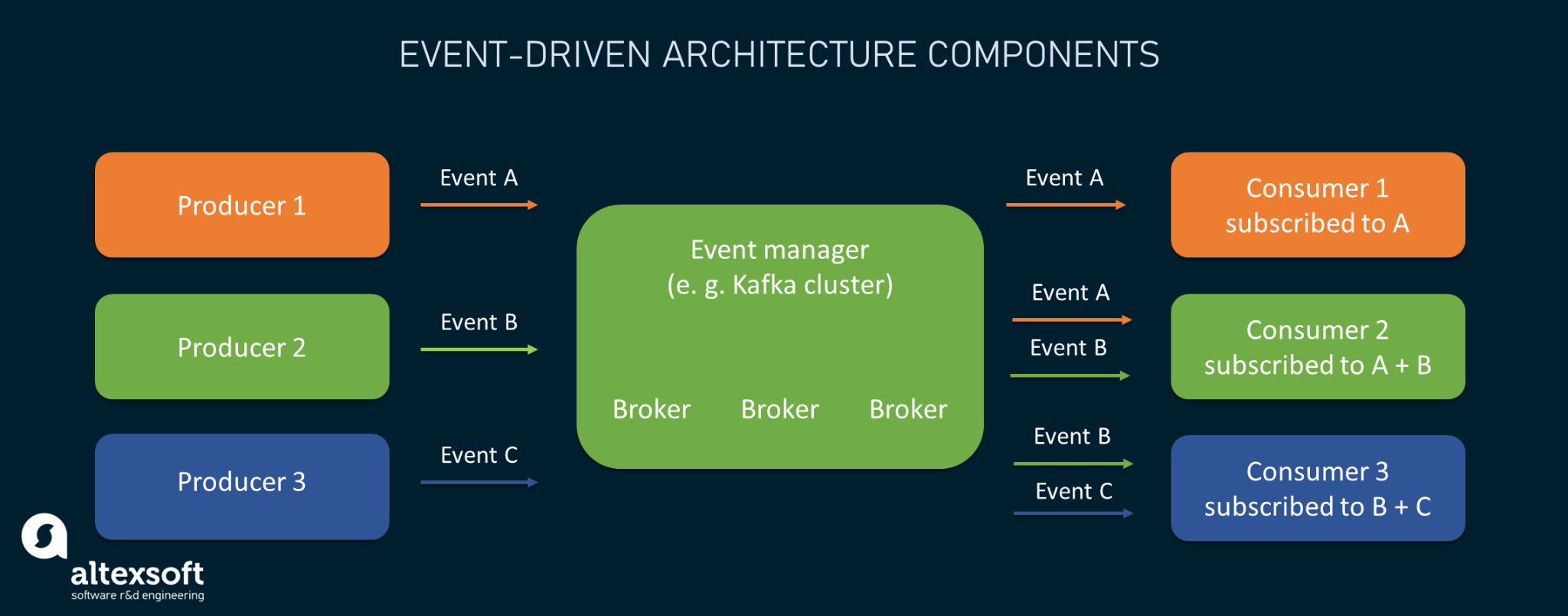
As the video explains, an event-driven system is composed of three main components:
- Producer: A service or component that detects a state change and publishes an event. For example, an
OrderServiceproduces anOrderPlacedevent. The producer's job is done once it sends the event; it doesn't know or care who is listening. - Event Broker (or Bus/Channel): A message router that receives events from producers and delivers them to interested consumers. It acts as the central hub, decoupling producers from consumers. Popular examples include Apache Kafka, RabbitMQ, and cloud services like Amazon EventBridge.
- Consumer: A service that subscribes to specific types of events. When it receives an event from the broker, it triggers a process to perform some action. For example, a
NotificationServicemight consume theOrderPlacedevent to send a confirmation email.
This relationship is beautifully illustrated in the following diagram.
2. Designing an Event-Driven Workflow
Now that we understand the components, let's tackle the practical side: how do you design a workflow using this pattern? A common mistake is to just start drawing lines between boxes, which can quickly become unmanageable. A more structured approach is needed.
We'll use a classic e-commerce "create order" use case. Imagine a user clicks "Buy Now". In a synchronous system, the OrderService might have to directly call the InventoryService, then the PaymentService, and finally the ShippingService, waiting for each one. In an event-driven world, the flow is very different.
The following video introduces a practical, table-based method for designing and documenting these flows. This is an excellent technique to bring into your own engineering practice.
How to DESIGN EVENT-DRIVEN applications! The best method for production applications!
The video 'How to DESIGN EVENT-DRIVEN applications!' by FooBar Serverless presents a powerful, structured method for designing event flows. It walks through an e-commerce example and shows how to handle both the 'happy path' and error scenarios.
Watch the segment from 10:13 to 18:58. Pay close attention to the table structure (API, Input Event, Service, Action, Output Event) and how the 'create an order' workflow is built step-by-step.
Let's summarize the design process from the video with a simplified version of the table for our e-commerce "happy path":
| API Call | Input Event | Service | Action | Output Event(s) |
|---|---|---|---|---|
POST /orders |
- | Order Service | createOrder |
OrderCreated |
| - | OrderCreated |
Inventory Service | reserveItem |
ItemReserved |
| - | ItemReserved |
Payment Service | processPayment |
PaymentSucceeded |
| - | PaymentSucceeded |
Shipping Service | createShipment |
ShipmentCreated |
| - | PaymentSucceeded |
Notification Service | sendOrderConfirmation |
OrderConfirmationSent |
Notice a few key things here:
- Choreography: There is no central controller telling each service what to do. Services react independently to events they care about. This is often called a choreography in contrast to an orchestration where a central component directs the workflow.
- Parallelism: The
PaymentSucceededevent triggers both theShippingServiceand theNotificationServicesimultaneously and independently. If the notification service is down, the shipment can still be created. - Extensibility: As the video mentions later (section 7, from 21:40), adding new functionality is easy. If we want to add a loyalty points system, we just create a new
LoyaltyServicethat also consumes thePaymentSucceededevent. No existing services need to be changed.
Test your understanding!
Using the table format above, how would you model the error handling flow if the processPayment action fails? What event would be produced, and which service would consume it to revert the previous action?
Show answer
If the processPayment action fails, it should produce a PaymentFailed event. The InventoryService would then consume this event to revert the item reservation.
| API Call | Input Event | Service | Action | Output Event(s) |
|---|---|---|---|---|
| ... | ... | ... | ... | ... |
| - | ItemReserved |
Payment Service | processPayment |
PaymentFailed |
| - | PaymentFailed |
Inventory Service | unreserveItem |
ItemUnreserved |
| - | PaymentFailed |
Notification Service | sendPaymentFailedEmail |
PaymentFailedEmailSent |
This demonstrates how EDA handles compensating actions to maintain data consistency across services in the case of failures.
3. The Architectural Trade-Offs
Like any architectural pattern, EDA is not a silver bullet. It introduces its own set of challenges. As an aspiring architect, recognizing these trade-offs is paramount.
To explore this, let's look at a text resource that provides code examples and digs into the practical implications of building these systems.
The article 'Event-driven workflow' by Mr Ben Abdallah provides a great analysis of the pros and cons from a developer's perspective, complete with code snippets and advanced concepts.
Read sections 4 ('Anatomy of Reactivity'), 5 ('Architectural Superpowers'), 6 ('Robustness: Managing Failure'), and 10 ('Limitations & Best Practices'). Focus on how EDA enables resilience but introduces new forms of complexity.
Let's summarize the key trade-offs, combining insights from all our resources:
Advantages:
- Loose Coupling & Extensibility: Producers and consumers are completely decoupled. You can add, remove, or update services without impacting others, leading to highly maintainable and evolvable systems.
- Resilience & Fault Tolerance: The event broker acts as a buffer. If a consumer service is down, events can queue up and be processed when the service recovers. This prevents cascading failures.
- Scalability: You can scale producers and consumers independently. If the
NotificationServiceis under heavy load, you can spin up more instances of it without touching any other part of the system. This is the Competing Consumers Pattern mentioned in the article.
Disadvantages:
- Increased Complexity: The overall system can be much harder to understand and debug. A single user request might trigger a long chain of events across many services. Without proper tools like distributed tracing, following this flow is very difficult.
- Eventual Consistency: Since data updates happen asynchronously, the system is not instantly consistent. After placing an order, a user might not see their loyalty points update for a few seconds. This requires careful design and can be a non-starter for business processes that require strong, immediate consistency.
- Operational Overhead: You now have a new, critical piece of infrastructure to manage: the event broker. Ensuring its high availability, performance, and durability is a significant operational responsibility.
- Guaranteed Delivery & Idempotency: Brokers typically guarantee "at-least-once" delivery. This means a consumer might receive the same event more than once (e.g., after a network failure). Consumers must therefore be idempotent, meaning that processing the same event multiple times has the same effect as processing it once. For example,
SET status='shipped'is idempotent, butADD 1 to inventoryis not.
Conclusion
Today we've unpacked Event-Driven Architecture, a powerful pattern for building decoupled, resilient, and scalable applications, especially in a microservices context. You've learned to identify its core components, apply a structured method for designing event workflows, and, most importantly, analyze the critical trade-offs involved.
Key Takeaways:
- EDA replaces direct, synchronous calls with asynchronous communication via an Event Broker, decoupling Producers from Consumers.
- This decoupling fosters resilience (failures are isolated), scalability (components scale independently), and extensibility (new features can be added without modifying existing code).
- Designing event flows can be managed systematically using a table-based approach to map events, services, and actions.
- This power comes at the cost of significant complexity, including the challenges of debugging distributed flows, managing eventual consistency, and ensuring consumer idempotency.
Preview of the Next Lesson:
EDA provides the "how" for communication between services. But how do we decide on the boundaries of those services in the first place? In our next lesson, we will explore the core concepts of Domain-Driven Design (DDD), such as Bounded Context and Ubiquitous Language. You will see how DDD provides the strategic principles for defining your microservices, and how EDA serves as a key tactical pattern for making them communicate effectively.