Hello! In our last lesson, we explored Event-Driven Architecture (EDA) as a powerful pattern for enabling asynchronous communication between services. We saw how this approach fosters resilience and scalability. However, a crucial question remained: how do we decide on the boundaries of the services themselves? EDA tells us how services can communicate, but not what each service should be.
Today, we will answer that question by diving into Domain-Driven Design (DDD). Your goal for this lesson is to explain the core concepts of DDD, specifically Bounded Context and Ubiquitous Language. This is a fundamental step in cultivating the "architectural mindset" you're aiming for. DDD shifts the focus from technology-first decisions to a deep understanding of the business domain, ensuring that the software we build is a true reflection of the problems it's meant to solve.
1. The Challenge of Complexity and Ambiguous Language
As software systems grow, so does their complexity. In a large organization, different departments often use the same words to mean different things. For a full-stack developer, this is a familiar problem. Think about the word "Product":
- To the Warehouse team, a "Product" is a physical item with a location, weight, and stock level.
- To the Marketing team, a "Product" is a concept with a target audience, marketing campaigns, and sales analytics.
- To the Customer Support team, a "Product" has a warranty, a user manual, and a history of related support tickets.
If you try to create a single Product class or database table to satisfy everyone, you end up with a bloated, confusing model that is difficult to maintain and understand. This ambiguity, where a word has multiple meanings depending on the situation, is a core problem that DDD aims to solve.
This is where our first key concept comes into play: the Ubiquitous Language.
2. Ubiquitous Language: A Shared Dictionary for the Team
The central premise of DDD is that to build effective software, developers and business experts must collaborate closely and, most importantly, speak the same language.
A Ubiquitous Language is a shared, rigorous language crafted by the entire team—developers, domain experts, business analysts, and project managers. It is used in all communication, from whiteboard sessions and user stories to the source code itself.
To build this shared understanding, we need to carefully select terms from both the business and technical domains.

The key is that this language isn't just for conversation; it directly shapes the software. Class names, methods, variables, and database schemas should all use terms from the Ubiquitous Language.
Let's look at an article that formally defines this concept.
Domain-Driven Design (DDD): A Summary
The article 'Domain-Driven Design (DDD): A Summary' from softengbook.org provides a clear, concise definition of Ubiquitous Language and its purpose.
Please read the section titled 'Ubiquitous Language'. Focus on its dual purpose: facilitating communication and providing names for code elements. Note the example from the library management system.
As the article points out, developers must resist the urge to use purely technical jargon when discussing the model with domain experts.
3. DDD Strategic Design in under 15 minutes
This video from Alpha Code demonstrates the practical application of Ubiquitous Language, highlighting the importance of using domain-centric terms instead of overly technical ones.
Watch from 07:31 to 09:42. Pay attention to the contrast between a developer's technical explanation of a search feature and how it can be rephrased using the Ubiquitous Language.
This discipline ensures that the code remains an accurate expression of the business domain, making it more intuitive for everyone involved.
3. Bounded Context: The Boundary of Meaning
A single Ubiquitous Language works well for a simple domain. But what about our "Product" example with multiple departments? In a large enterprise, it's unrealistic to force everyone into a single, unified language. This is where our second core concept, the Bounded Context, becomes essential.
A Bounded Context is an explicit boundary (like a fence) within which a specific domain model and its Ubiquitous Language are consistent and unambiguous. Inside the "Warehouse Context," the word "Product" has a clear and single meaning. Inside the "Marketing Context," it has a different, but equally clear, meaning.
By defining these boundaries, we stop trying to create a single model for the entire enterprise. Instead, we create multiple, smaller, more focused models that are each consistent within their own context.
Domain Driven Design — The Bounded Context - Medium
The article 'Domain Driven Design — The Bounded Context' by John Boldt explains why the idea of a single 'enterprise domain model' often fails and how Bounded Contexts provide the solution. It uses the term 'polysemy' (a word having multiple meanings) to frame the problem.
Read the sections 'Addressing Polysemy', 'In Search Of The Enterprise Domain Model', and the excellent practical example of a 'SKU'. Notice how the meaning of a single concept changes depending on the business context (Warehouse, Marketing, etc.).
This partitioning is the key to managing complexity. Let's visualize this with a concrete e-commerce example.
3. DDD Strategic Design in under 15 minutes
Now let's see an example of Bounded Contexts in an e-commerce system. This video illustrates how the concept of a 'customer' has different models in the Sales, Support, and Accounting contexts.
Watch the segment from 09:42 to 11:34. Observe how the 'customer' model in each context contains only the attributes relevant to that specific domain's needs.
The resulting architecture might look something like this:
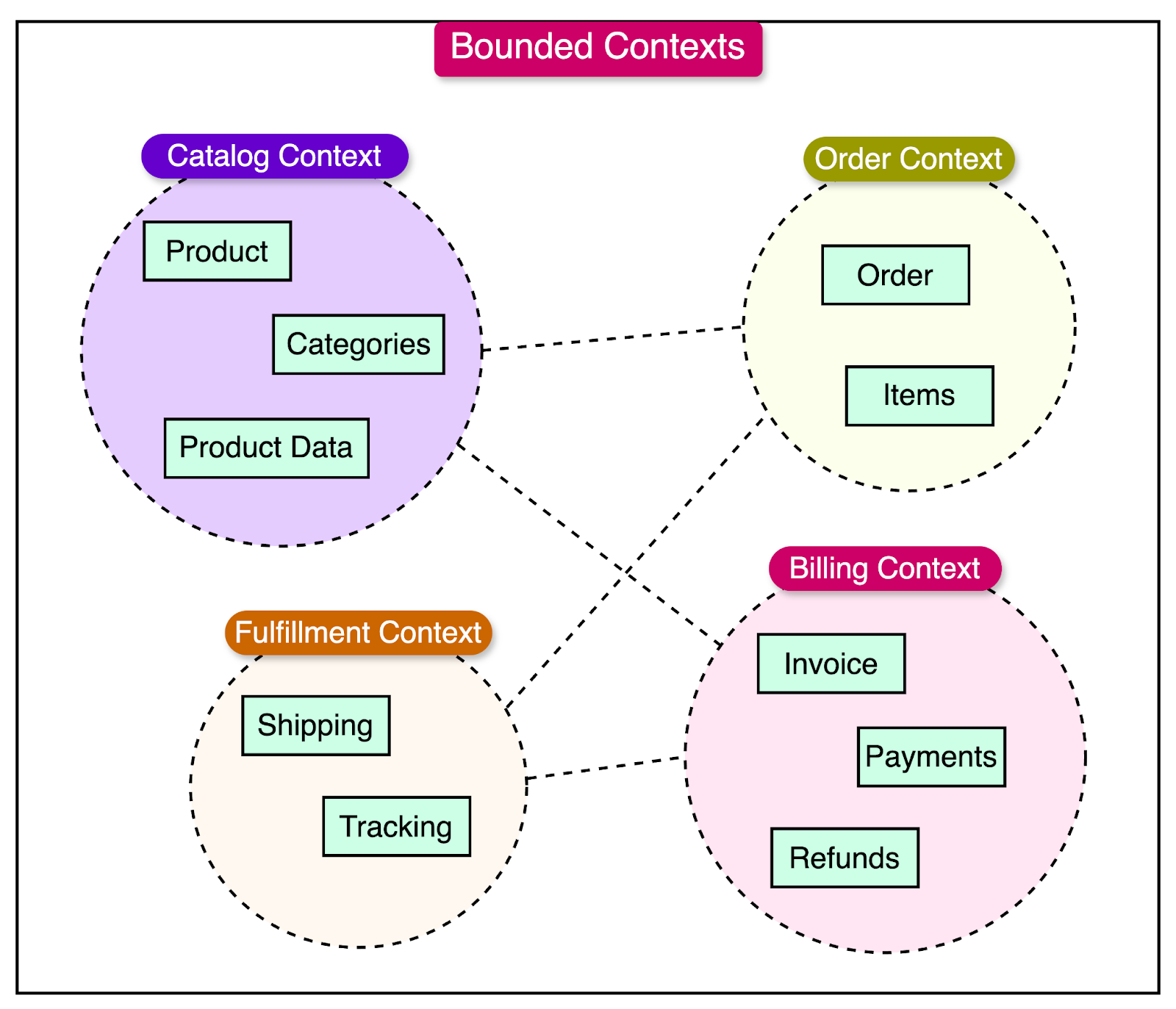
This is where DDD connects back to our previous lessons. These Bounded Contexts are perfect candidates for becoming your microservices. And the communication between them (the dashed lines) can be implemented using patterns like the Event-Driven Architecture we just studied.
Test your understanding!
Consider a university management system. Identify at least three potential Bounded Contexts. Then, pick one common entity (like a "Student") and describe how its model and Ubiquitous Language terms might differ between two of those contexts.
Show answer
Potential Bounded Contexts could be:
- Admissions Context: Focused on prospective students, applications, and enrollment decisions.
- Registrar Context: Focused on course registration, grades, transcripts, and graduation.
- Library Context: Focused on book checkouts, fines, and resource access.
- Financials Context: Focused on tuition billing, payments, and financial aid.
Let's compare the "Student" entity in the Registrar Context vs. the Library Context:
- In the Registrar Context, a
Studentmodel would includeStudentID,Major,RegisteredCourses,GPA, andGraduationStatus. The Ubiquitous Language would include terms like "credit hour," "add/drop period," and "academic probation." - In the Library Context, the
Student(or perhaps calledPatron) model would includeLibraryCardID,CheckedOutItems,FinesDue, andBorrowingHistory. Its language would involve terms like "due date," "renewal," and "interlibrary loan."
Both models represent the same person, but they are tailored to the specific problems and language of their respective contexts.
4. From Problem Space to Solution Space
We now have the tools to manage complexity, but how do we decide where to draw the boundaries for our contexts? The answer lies in analyzing the business domain itself, which DDD categorizes into three types of subdomains.
DDD Bounded Contexts & Subdomains
To apply these concepts strategically, we need to classify parts of the business domain. This video from Drawing Boxes explains the difference between core, supporting, and generic subdomains.
Watch from 02:16 to 03:19. Focus on the definitions of core, supporting, and generic domains and what each implies for your development strategy (e.g., build vs. buy).
This analysis helps you map the problem space (the business) to the solution space (your software architecture).
- Core Domain: This is what makes the business unique and gives it a competitive advantage. This is where you should invest your best engineering talent to build custom, sophisticated software. For Amazon, this would be its recommendation engine and logistics.
- Supporting Domain: These are necessary for the business to function but are not competitive differentiators. They often require specialized knowledge. An example might be a content management system for a blog. These might be built in-house but with less investment, or potentially outsourced.
- Generic Domain: These are "solved problems" that are not specific to the business. Examples include authentication, email services, or payment processing. The best strategy here is almost always to buy an off-the-shelf solution (e.g., use Stripe for payments). A third-party system is its own Bounded Context.
This strategic classification is a cornerstone of the architectural mindset. It prevents teams from wasting time reinventing the wheel (a generic domain) and ensures the most effort is focused on the part of the system that delivers the most business value (the core domain).
Conclusion
In this lesson, we've explored the foundational strategic concepts of Domain-Driven Design. By moving beyond a purely technical viewpoint to one that is driven by the business domain, you can design systems that are more coherent, maintainable, and aligned with business goals.
Key Takeaways:
- DDD is a strategic approach to software design that prioritizes a deep understanding of the business domain.
- The Ubiquitous Language is a shared vocabulary between developers and domain experts that eliminates ambiguity and is used directly in the code.
- A Bounded Context is an explicit boundary within which a specific Ubiquitous Language and domain model are consistent. This is the primary tool for taming complexity in large systems.
- Bounded Contexts are excellent candidates for microservice boundaries, and patterns like EDA can manage their communication.
- Analyzing the business into core, supporting, and generic subdomains provides a strategic framework for deciding where to invest development resources.
Preview of the Next Lesson:
We now have a strategic framework (DDD) for defining the boundaries and responsibilities of our services. We've also seen how they can communicate asynchronously (EDA). But services also need to expose their capabilities for synchronous interactions. In our next lesson, we will explore how to design RESTful APIs, a standard and powerful way to define the public interfaces for the services that emerge from your DDD process.