Hello! In our last lesson, we established that "monolith" isn't a dirty word and explored how structuring it as a Layered or Modular Monolith can manage complexity. We saw that a modular monolith, organized by business domain, provides clearer boundaries and better team autonomy, all while retaining the operational simplicity of a single deployment unit.
Today, we're taking that concept of separation to its logical conclusion. What happens when those modules are no longer just logical code groupings but become physically separate, independently deployable applications? This brings us to one of the most significant architectural debates in modern software engineering.
Your learning outcome is to analyze the principles and trade-offs of microservices vs. monolithic architectures. We will dissect the costs and benefits of distributing a system into smaller services, equipping you to make informed architectural decisions—a key component of the "architectural mindset" you're building.
1. From Modular Monolith to Microservices
The transition from a modular monolith to microservices is a natural evolutionary step. Imagine taking each vertical slice (or module) from our modular monolith—like 'Users', 'Products', and 'Orders'—and deploying each one as its own separate application. That is the essence of a microservice architecture.
To visualize this transition, let's start with a short, conceptual video.
Microservices vs Monolithic Architecture
This animated video from the Drawing Boxes channel provides an excellent visual bridge from the concepts in our last lesson to the microservices architecture. It clearly shows how a monolith can be structured into a modular monolith, and then how those modules can be 'pulled apart' into independent services.
Watch the segment from 00:52 to 02:24. Pay close attention to how it defines a Modular Monolith and then transitions to defining microservices as independently hosted modules, each with its own process and database.
The video highlights two critical characteristics of microservices that represent a fundamental departure from the monolith:
- Independent Deployment: Each service is a separate application that can be changed, tested, and deployed on its own without affecting others.
- Decentralized Data Management: Each service owns and manages its own database. Other services cannot access this database directly; they must communicate via a well-defined API.
This structural difference is a core concept in system design.
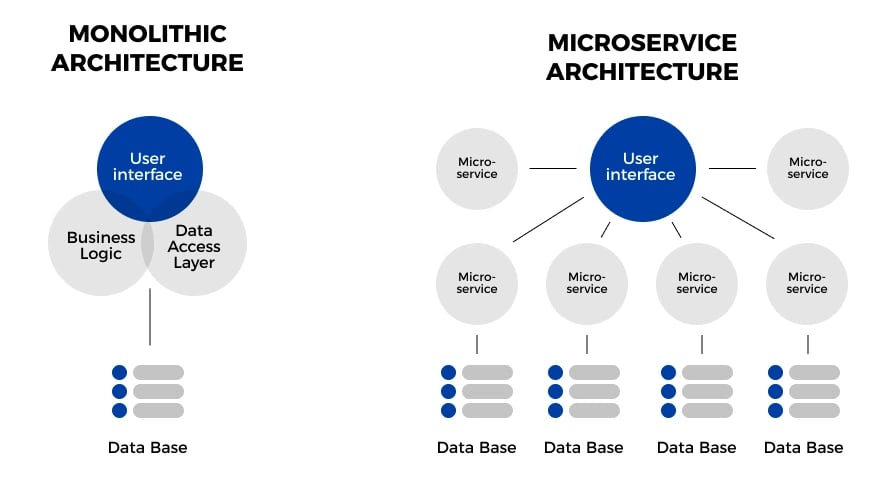
This separation raises a new question: if services are independent, how do they collaborate to fulfill a business request?
Monolithic vs Microservice Architecture: Which To Use and When?
The video 'Monolithic vs Microservice Architecture' by Alex Hyett explains the common communication patterns used between microservices. Understanding these is crucial because inter-service communication is one of the main sources of complexity in this architecture.
Watch the section on microservice communication from 04:06 to 05:14. Focus on the distinction between synchronous communication (like direct API calls) and asynchronous communication (using a message broker).
As you can see, the moment we separate our modules into services, we introduce the network, which brings a host of new challenges. This is the heart of the microservices trade-off.
2. The Core Trade-Offs: A Deep Dive
Making an architectural choice is never about finding a "perfect" solution; it's about understanding the trade-offs and choosing the set of problems you'd rather have. The following article by Martin Fowler, a highly respected author and speaker on software design, provides a canonical analysis of these trade-offs.
We will structure our analysis around the key pros and cons he outlines. For each point, I'll provide a summary, and then you'll read the corresponding section of his article for a more detailed perspective.
The article 'Microservice Trade-Offs' is a foundational text on this topic. It moves beyond superficial lists of pros and cons to explain the deep, underlying reasons for them. We will read it section by section.
You don't need to read the whole article at once. I will guide you to specific sections as we discuss each trade-off below. For now, just have it open and ready.
Trade-Off #1: Strong Module Boundaries vs. The Wrong Boundaries
-
The Pro (Strong Boundaries): In a monolith, even a modular one, it's often easy for a developer on a deadline to bypass module boundaries and create "spaghetti code." Microservices make this much harder. The boundary is a physical network call, which enforces decoupling and aligns with Conway's Law (an organization's communication structure shapes the systems it designs). This is especially beneficial for large teams.
-
The Con (Wrong Boundaries): If you define your service boundaries incorrectly, you create a "distributed ball of mud." You might find that a simple feature change requires updating multiple services in a coordinated, complex release. You get all the pain of a distributed system with none of the benefits of true autonomy.
Now, read Fowler's take on this.
Reading Task: In the "Microservice Trade-Offs" article, read the section "Strong Module Boundaries (Pro)". Note his point about how microservices make it "harder to do the wrong thing."
Trade-Off #2: Independent Deployment vs. Operational Complexity
-
The Pro (Independent Deployment): This is a huge driver for microservices. The ability to deploy a small, isolated change to a single service reduces risk and massively speeds up release cycles. This is a core enabler of Continuous Delivery and an agile workflow.
-
The Con (Operational Complexity): A monolith is one thing to deploy, monitor, and manage. A microservices system might have dozens or hundreds of services. This creates an explosion in operational overhead. You now need sophisticated automation for deployment (CI/CD pipelines for every service), robust monitoring to trace a request across multiple services, and a mature DevOps culture to manage it all.
Reading Task: In the article, read the sections "Independent Deployment (Pro)" and "Operational Complexity (Con)". Focus on the idea that the complexity doesn't disappear; it moves from the application code into the operations and infrastructure.
Trade-Off #3: Technology Diversity vs. Development Sprawl
-
The Pro (Technology Diversity): Because each service is a separate application, a team can choose the best language, framework, or database for its specific job. The 'Search' service could be written in Python with Elasticsearch, while the 'Real-time Notifications' service uses Node.js. This also simplifies managing library dependencies, as each service has its own.
-
The Con (Development Sprawl): Without discipline, this freedom can lead to chaos. Having ten different programming languages and fifteen different databases in your organization makes it incredibly difficult to maintain, hire for, and create standardized tooling.
Reading Task: In the article, read the section "Technology Diversity (Pro)". Note the balancing act between "best tool for the job" and the need for organizational standards.
Trade-Off #4: The Price of Distribution
This is arguably the single biggest "con" of microservices. When you move from in-process function calls (in a monolith) to remote calls over a network, you pay a steep price.
- Distribution (Latency & Reliability): Network calls are orders of magnitude slower than in-process calls. They can also fail for countless reasons. As Fowler notes, you must design for this failure, which adds significant complexity to your code (e.g., retries, circuit breakers).
- Eventual Consistency: In a monolith, you can update multiple database tables in a single transaction, ensuring data is always consistent. With distributed services each owning their own database, this is no longer possible. Distributed transactions are complex and often avoided. Instead, you must deal with eventual consistency, where updates propagate through the system over time. This can lead to bugs and confusing user experiences if not handled carefully.
Reading Task: In the article, read the sections "Distribution (Con)" and "Eventual Consistency (Con)". These are perhaps the most important sections for understanding the true cost of microservices.
Test your understanding!
A well-funded startup is building a new social media platform. The CTO, eager to use modern practices, mandates a microservices-from-day-one approach to "ensure scalability." The lead architect pushes back, advocating for a modular monolith.
Based on the trade-offs, what is the lead architect's likely reasoning? Refer to the concept of the "Microservice Premium."
Show answer
The lead architect's reasoning is likely centered on avoiding the "Microservice Premium" at a stage where it provides little benefit. The "Microservice Premium" is the inherent cost and complexity that a microservices architecture imposes from the start, including:
- High Operational Overhead: The startup would immediately need to invest in complex CI/CD, service discovery, centralized logging, and monitoring tooling for many services, instead of focusing on building features.
- Slower Initial Development: The team will spend significant time dealing with the complexities of a distributed system (network latency, data consistency, service-to-service communication) before they've even validated their core product.
- Uncertain Boundaries: For a new product, the business domain is often not yet fully understood. Committing to service boundaries early on is risky and could easily lead to a "distributed ball of mud" that is very difficult to refactor.
By advocating for a modular monolith, the architect is proposing to start with a simpler architecture that allows for fast development and easy deployment, while still maintaining clean internal boundaries. This allows the team to defer the cost of the "Microservice Premium" until the system's complexity actually warrants it and the domain boundaries are well-understood.
3. Making the Choice: Monolith First
So, when should you choose which? The consensus in the industry has converged on a pragmatic approach, often called "Monolith First."
Monolithic vs Microservice Architecture: Which To Use and When?
Let's conclude with some practical advice from the Alex Hyett video on when to use each architecture.
Watch the final segment from 09:11 to 10:33. This section provides clear, actionable guidance on making this architectural choice for a new project.
The key idea is this: Don't start with microservices. Start with a well-structured monolith (ideally, a modular monolith). Focus on getting your product to market and understanding your domain. As the system grows, you will discover the real scaling bottlenecks and the natural "seams" in your application. At that point, you can begin to strategically and incrementally extract the most problematic or independent modules into their own microservices.
This approach allows you to defer the high cost of the Microservice Premium until you actually need the benefits and have enough knowledge to draw your service boundaries correctly.
Conclusion
Today we've moved from the organized-but-unified world of monoliths to the decoupled-but-complex world of microservices. This is not a simple choice, and as an architect, your job is to weigh these trade-offs against your specific context—your team's skills, your business goals, and your application's complexity.
Key Takeaways:
- Microservices offer strong module boundaries, independent deployment, and technology flexibility, which are powerful benefits for large, complex systems and teams.
- These benefits come at the cost of the immense complexity introduced by distribution: network latency, unreliability, the challenge of eventual consistency, and massive operational overhead.
- The "Microservice Premium" refers to this inherent complexity. It is a cost you should only pay when the complexity of your application domain truly justifies it.
- The recommended strategy for most projects is "Monolith First": begin with a well-structured modular monolith and evolve towards microservices by extracting services incrementally as needed.
Preview of the Next Lesson:
In this lesson, we saw that asynchronous communication using message brokers is a key pattern for decoupling services. In our next lesson, we will explore this concept in depth. We will explain event-driven architecture components (producer, consumer, broker) and design a basic event-driven workflow, a powerful style frequently used in modern microservice systems to build resilient and scalable applications.