Hello! Welcome to the next lesson in our module on "Designing Scalable & Resilient Systems."
In our previous lesson, we explored how Content Delivery Networks (CDNs) are used to scale read-heavy applications and deliver static content to users globally with low latency. That's a crucial pattern for handling the "front door" of your application. But what happens behind the scenes? Modern systems are composed of many services that need to communicate, perform background jobs, and process data. How do we orchestrate these tasks without creating a fragile, tightly-coupled system?
This lesson addresses that question by focusing on asynchronous communication. Our learning outcome is to describe how message queues can be used to decouple services and improve resilience. This is a foundational pattern in virtually every large-scale distributed system, and understanding it is essential for shifting from a developer's mindset to an architect's.
1. What is a Message Queue?
At its simplest, a message queue is an intermediary component that allows services to communicate without connecting to each other directly. It operates on a simple principle: one service, the Producer, sends a Message to the queue. Another service, the Consumer, retrieves that message from the queue and processes it.
Think of it like a coffee shop. The customer (producer) gives their order (message) to the cashier, who puts it in a line (the queue). The baristas (consumers) pick up orders from the line at their own pace. The customer doesn't need to know which barista will make their coffee, and the baristas don't need to be available the instant the order is placed.
Let's watch a short video to solidify this core concept.
Why Every (great) System Design Uses Queues
The video 'Why Every (great) System Design Uses Queues' by Arjay McCandless provides a great introduction to what queues are and the role they play in large-scale systems.
Please watch the first 49 seconds of the video (00:00 - 00:49). It introduces the basic concept of a queue, the different types, and how they manifest as real-world cloud services like Amazon SQS and RabbitMQ.
This cheatsheet provides a fantastic visual summary of the components, the workflow, and the key benefits we will be discussing.
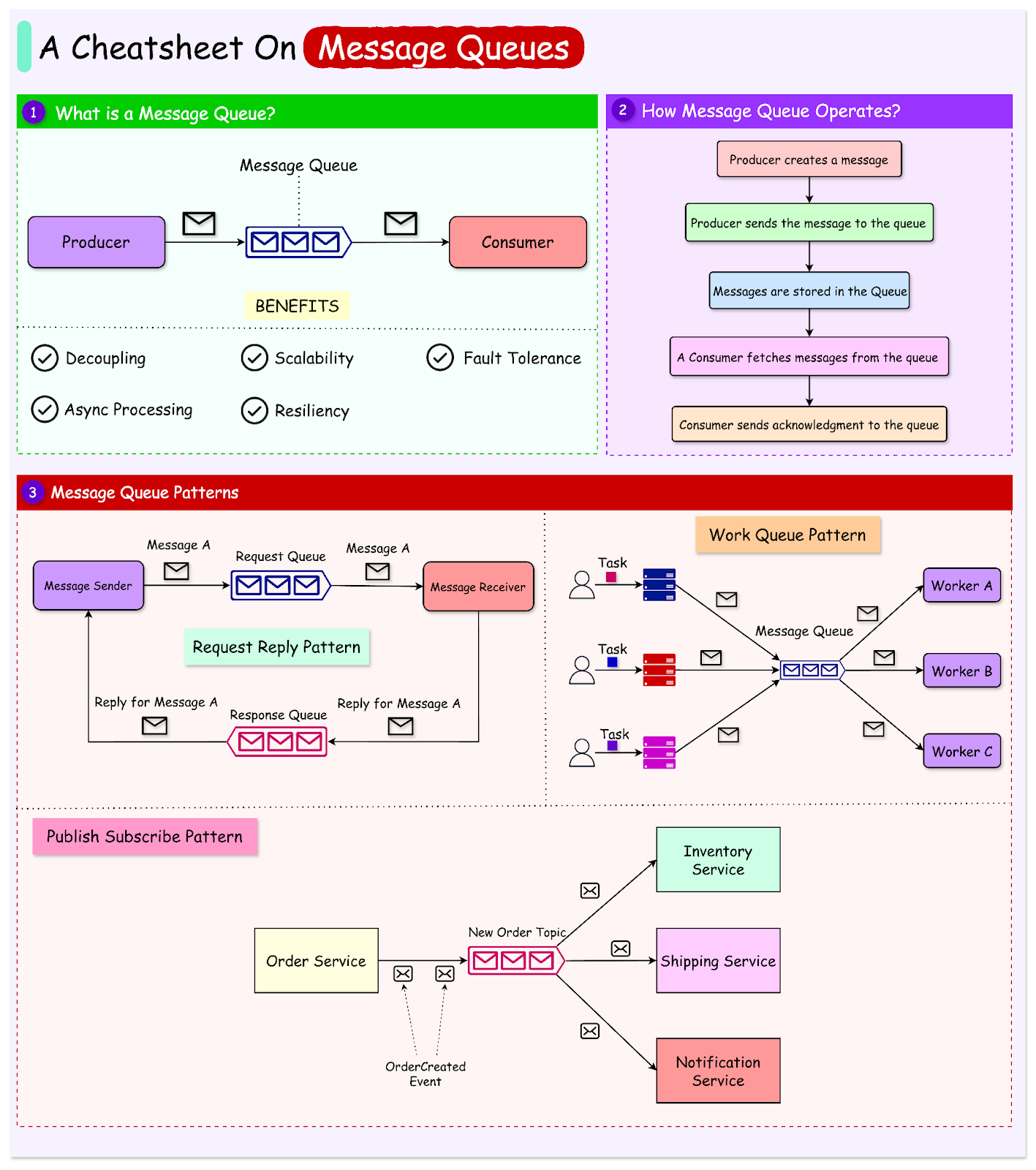
The primary benefits listed—Decoupling, Scalability, Fault Tolerance, Asynchronous Processing, and Resiliency—are exactly what we will unpack next.
2. The Power of Decoupling
The single most important benefit of using a message queue is decoupling. In a synchronous, request-response architecture (e.g., one microservice making a direct HTTPS call to another), the services are tightly coupled. The calling service must know the address of the other service and must wait for a response. If the receiving service is down, slow, or being updated, the calling service is blocked or fails.
Message queues break this direct dependency.
Message queues vs HTTPS in microservices, part 1
To see the contrast between tightly-coupled and decoupled architectures, let's look at the article 'Message queues vs HTTPS in microservices' from the CloudAMQP blog. It uses a practical e-commerce example that clearly illustrates the problem.
Read the sections 'Tight coupling in https-based microservices' and 'Messages queues and microservices: Towards a more decoupled architecture'. Pay close attention to the two diagrams and how the introduction of a message queue changes the system's dependencies.
The article highlights two key forms of decoupling that queues provide:
- Spatial Decoupling: The producer doesn't know or care about the consumer's location (IP address), language, or implementation. It only needs to know the address of the queue. This means you can add, remove, or change consumers without affecting the producer at all.
- Temporal Decoupling: The producer and consumer do not need to be running at the same time. The producer can add a message to the queue, and the consumer can process it seconds, minutes, or even hours later. The queue acts as a durable buffer, holding the message until a consumer is ready.
This leads to a far more flexible and maintainable architecture. For instance, if an Order Service publishes a user_created event, a Notification Service, an Analytics Service, and a CRM Service can all subscribe and react to that event independently, without the Order Service even knowing they exist. This is known as the Publish-Subscribe (or Fan-out) pattern.
3. Improving Resilience and Scalability
Decoupling is the mechanism, but the architectural goals it serves are resilience and scalability. Let's see how queues help us achieve them.
3.1 Load Leveling and Handling Spikes
Imagine your application is featured on the news and traffic suddenly spikes 10x. Your web servers might handle the incoming requests, but your database could be overwhelmed by the sudden flood of write operations, causing it to slow down or crash for everyone.
A message queue acts as a shock absorber.
Why Every (great) System Design Uses Queues
The 'Why Every (great) System Design Uses Queues' video has an excellent segment explaining this buffering capability.
Watch the segment from 00:49 to 01:59. It shows how a queue can sit between incoming traffic and a database to smooth out traffic spikes and prevent overload.
This process, known as load leveling, ensures that your consumer services (like a database writer or a processing worker) can operate at a steady, sustainable rate, even when the ingress rate is highly variable. The queue buffers the requests, and the consumers work through the backlog once the spike subsides. This prevents system failure and data loss.
3.2 Enabling Asynchronous Workflows
Not all tasks need to be completed instantly. When a user uploads a video to YouTube, they get an "Upload received" message almost immediately. The actual processing—encoding, compressing, creating thumbnails—happens in the background. This is a classic use case for a message queue.
- The web server (producer) takes the uploaded file, places a "process video" message in a queue, and immediately returns a success response to the user.
- A separate fleet of worker services (consumers) pulls messages from this queue and performs the time-consuming video processing tasks.
This pattern dramatically improves user experience by making the application feel fast and responsive, while offloading heavy work to dedicated background processors that can be scaled independently.
3.3 Building in Fault Tolerance
What happens when things go wrong? This is where queues truly shine in building resilient systems.
Why Every (great) System Design Uses Queues
Let's watch two final segments. The first explains built-in fault tolerance mechanisms, and the second summarizes the key use cases for queues.
Watch the section from 03:40 to 04:48. It covers two critical concepts for resilience: visibility timeouts (automatic retries) and dead-letter queues (DLQs).
Let's break down these two crucial concepts:
- Automatic Retries: When a consumer picks up a message, the queue doesn't delete it immediately. It just makes it invisible to other consumers for a "visibility timeout" period. If the consumer processes the message successfully, it sends an acknowledgment (
ack) to the queue, which then deletes the message. If the consumer crashes or fails to send an ack before the timeout expires, the queue makes the message visible again, so another consumer can retry it. This provides built-in resilience against transient failures. - Dead-Letter Queues (DLQs): Sometimes a message fails repeatedly because it's malformed or triggers a bug (a "poison pill" message). To prevent it from being retried forever and blocking the queue, after a certain number of failed attempts, the system automatically moves the message to a separate queue called a DLQ. This gets the toxic message out of the main workflow and allows engineers to inspect it later without halting the entire system.
These mechanisms, combined with the inherent buffering and decoupling, make queue-based architectures significantly more resilient than their synchronous counterparts.
Test your understanding!
You are designing a photo-sharing application. When a user uploads a high-resolution image, the app needs to:
- Generate several thumbnails of different sizes.
- Apply a watermark.
- Scan the image for inappropriate content.
How would you use a message queue to design this workflow? What are the benefits over having the web server perform all these tasks synchronously upon upload?
Show answer
A synchronous approach would mean the user has to wait for all three tasks to complete before their upload is confirmed, which could be slow and frustrating. If any step fails, the entire upload might fail.
A better, queue-based architecture would be:
- The Event: When the image is successfully uploaded to storage, the web server publishes a single message,
image_uploaded, to a topic (a type of queue for fan-out). The message would contain information like the image ID and its storage location. - The Consumers: Three separate services would subscribe to this topic, each with its own queue:
- A
Thumbnailing Servicereceives the message and generates the required thumbnails. - A
Watermarking Servicereceives the message and applies the watermark. - A
Content Moderation Servicereceives the message and scans the image.
- A
Benefits:
- Decoupling & Flexibility: You can add a new service (e.g., a
Metadata Extraction Service) just by having it subscribe to the same event, without changing any existing code. - Improved User Experience: The user gets an immediate confirmation once the image is uploaded. All the heavy processing happens asynchronously in the background.
- Resilience: If the
Watermarking Serviceis down, thumbnailing and content moderation can still proceed. The watermark message will remain in its queue to be processed when the service recovers. - Scalability: If thumbnail generation is computationally expensive, you can scale up the number of
Thumbnailing Serviceconsumers independently of the other services to handle the load.
Conclusion
In this lesson, we've seen how message queues are a fundamental tool for building modern, distributed systems. They are not just a data structure, but a powerful architectural pattern.
Key Takeaways:
- Message queues enable asynchronous communication, breaking the rigid request-response cycle of synchronous calls.
- They decouple services spatially and temporally, allowing components to evolve independently and operate even if other parts of the system are temporarily offline.
- They improve resilience by acting as a buffer against traffic spikes (load leveling), automatically retrying failed operations, and isolating problematic messages in a Dead-Letter Queue (DLQ).
- They enhance scalability by distributing work across multiple consumers and offloading long-running tasks to background workers.
Preview of the Next Lesson:
While message queues are perfect for decoupling services and handling asynchronous tasks, some interactions in a distributed system must be synchronous. For example, fetching critical user data for a page render might require a direct service-to-service call. What happens when such a critical dependency fails? It can cause a chain reaction of failures, known as cascading failures.
In our next lesson, we will explore the Circuit Breaker pattern, a crucial technique for preventing these cascading failures and building resilient synchronous communication pathways.