Hello! Welcome to your next lesson in the "Designing Scalable & Resilient Systems" module.
In our last lesson, we explored how message queues provide a powerful way to build resilient systems by decoupling services and enabling asynchronous communication. This is perfect for tasks that can happen in the background. However, many interactions in a distributed system must happen synchronously—a service needs an immediate response from another service to proceed. What happens when that critical dependency fails?
This lesson tackles that exact problem. We will focus on the learning outcome: Explain the Circuit Breaker pattern for preventing cascading failures in distributed systems. This is a cornerstone pattern for building robust, fault-tolerant applications and a key piece of the "architectural mindset" you're aiming to develop.
1. The Problem: Cascading Failures
In a microservices architecture, services often call each other to fulfill a request. For example, an Order Service might call a Payment Service, which in turn calls a Fraud Detection Service. This chain of synchronous calls creates a fragile dependency graph.
If one service deep in the chain becomes slow or unresponsive, it can cause a "traffic jam." The services calling it become blocked, waiting for a response. Their resources (like threads and network connections) get tied up. This exhaustion can cause them to fail, which then impacts the services calling them, and so on. This chain reaction is called a cascading failure. A single point of failure can ripple through the system, potentially causing a total outage.
To visualize this, let's watch a short video that illustrates the problem in the context of an e-commerce application.
Circuit Breaker Pattern in Microservices
The video 'Circuit Breaker Pattern in Microservices' from ByteMonk clearly demonstrates how a failure in one microservice can cascade and affect the entire system.
Watch the section from 03:44 to 05:49. Pay attention to how the failure of the 'Product Service' impacts the 'Shopping Cart', 'Order', and 'Recommendation' services one by one.
As you saw, a single database failure in one service can render the entire platform useless. The core issue is that the calling services keep trying to contact the failing service, wasting resources and propagating the failure.
2. The Solution: The Circuit Breaker Pattern
To prevent this, we can use the Circuit Breaker pattern. The name comes from the analogy of an electrical circuit breaker in your home. When it detects an overload or short circuit, it "trips" to break the circuit, stopping the flow of electricity and preventing a fire. It isolates the fault.
In software, the Circuit Breaker pattern does the same thing for network calls. It's a stateful proxy that wraps calls to a remote service. It monitors for failures (like timeouts or error responses) and, if they exceed a certain threshold, it "trips" or opens the circuit. Once open, it immediately rejects any further calls to that service without even trying to connect, a principle known as failing fast. This protects the calling service from getting bogged down and prevents the failure from cascading.
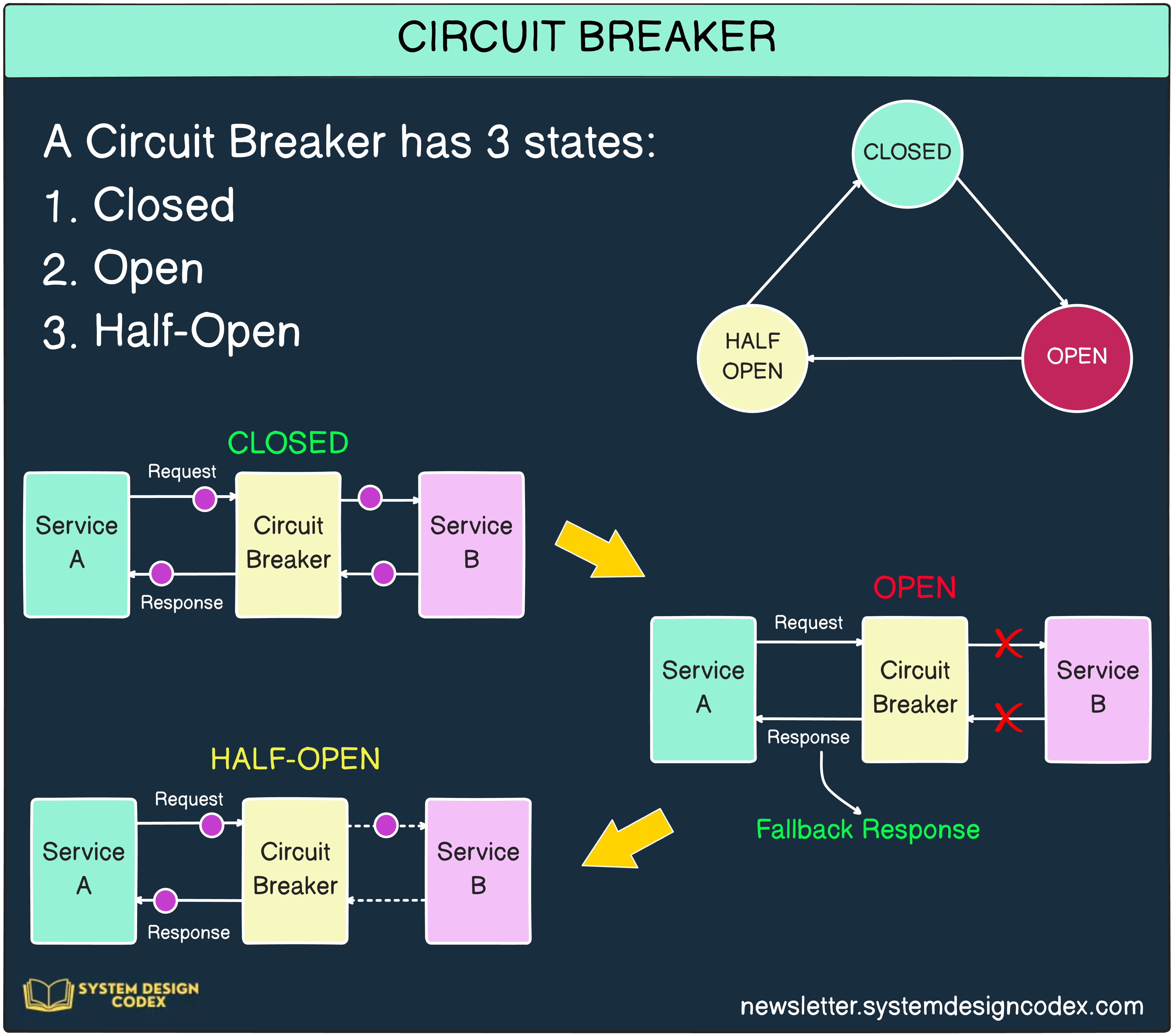
3. The Mechanism: States and Transitions
The power of the Circuit Breaker lies in its three states and the automatic transitions between them. The classic pattern, as described in Martin Fowler's influential article "Circuit Breaker", defines these states.
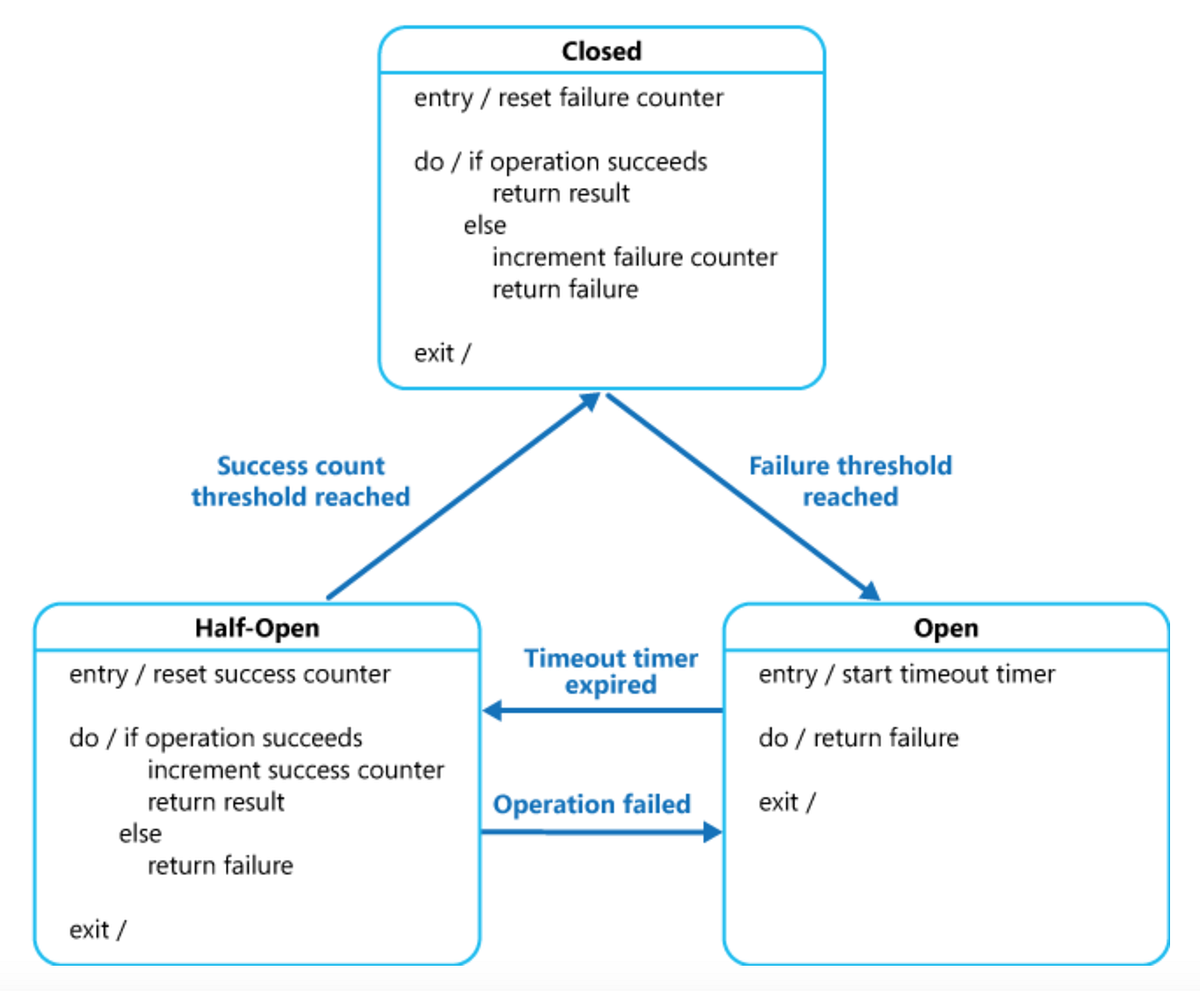
Let's break down each state:
-
CLOSED: This is the normal operating state. The circuit is "closed," and all calls pass through to the remote service. The circuit breaker monitors these calls, and if a call fails, it increments a failure counter. If a call succeeds, it resets the counter. If the failure counter reaches a pre-defined threshold within a time window, the breaker trips and moves to theOPENstate. -
OPEN: In this state, the circuit is "open." The circuit breaker immediately rejects all calls to the remote service with an error or a fallback response, without making any attempt to contact it. This is the "fail fast" mechanism. It remains in this state for a configured timeout period. After the timeout expires, it transitions to theHALF-OPENstate to check if the underlying service has recovered. -
HALF-OPEN: This is a probing state. The circuit breaker allows a single (or a limited number of) "trial" request to pass through to the remote service.- If the trial request succeeds, the breaker assumes the service has recovered. It resets the failure counter and transitions back to the
CLOSEDstate, restoring normal operation. - If the trial request fails, the breaker assumes the service is still down. It transitions back to the
OPENstate and starts the timeout timer again before attempting another probe.
- If the trial request succeeds, the breaker assumes the service has recovered. It resets the failure counter and transitions back to the
This self-resetting mechanism allows the system to automatically recover from failures without manual intervention.
To see a detailed walkthrough of these state transitions, the following video provides a great explanation.
Introduction to circuit breaker in microservices (for beginners)
The video 'Introduction to circuit breaker in microservices' by sudoCODE provides a clear animation and pseudocode for the state transitions.
Watch from 04:07 to 07:27. This segment first defines the three states and then uses a state machine diagram and pseudocode to explain the logic of moving between them.
4. How It Prevents Cascading Failures
Now, let's connect this mechanism back to our original problem. By implementing these states, the Circuit Breaker pattern provides several crucial benefits for system resilience.
What is the circuit breaker pattern and how does it prevent ...
The article 'What is the circuit breaker pattern' from DesignGurus.io provides an excellent summary of how the pattern prevents cascading failures.
Read the section titled 'How the Circuit Breaker Pattern Prevents Cascading Failures'. Focus on the four key mechanisms described: Fail Fast, Isolate Failures, Graceful Degradation, and Automatic Recovery.
To summarize the key points from the article:
- Fail Fast to Protect Resources: By immediately rejecting calls when the circuit is open, the pattern prevents the calling service's resources from being consumed by waiting on an unresponsive dependency.
- Isolate and Contain Failures: The faulty service is effectively quarantined, preventing its problems from affecting upstream services. The rest of the system can continue to function.
- Enable Graceful Degradation: When a call fails fast, the application can execute fallback logic. This could mean returning cached data, a default value, or a user-friendly error message (e.g., "User profile information is temporarily unavailable"). This provides a better user experience than a hang or a crash.
- Automatic Recovery: The
HALF-OPENstate allows the system to detect when the failed service is healthy again and automatically resume normal operations.
Test your understanding!
Imagine you are building a social media app. The main feed service (FeedService) calls a ProfilePictureService to get the avatar for each user in a list of posts. The ProfilePictureService suddenly experiences high latency, taking 30 seconds to respond to each request.
Without a circuit breaker, what would happen to the FeedService and the user experience? How would a circuit breaker change this scenario? Describe the state transitions.
Show answer
Without a circuit breaker:
The FeedService would make a call for each post's avatar and wait up to 30 seconds for each one. Its request-handling threads would become occupied, quickly leading to resource exhaustion. The service would become slow and unresponsive, and users would see a perpetually loading screen. This is a classic cascading failure.
With a circuit breaker:
CLOSEDstate: Initially, calls go through. The first few calls toProfilePictureServicetime out. The circuit breaker records these failures.- Transition to
OPEN: Once the failure count hits the configured threshold (e.g., 5 failures in 10 seconds), the circuit breaker trips and moves to theOPENstate. OPENstate: Now, when theFeedServicetries to get an avatar, the circuit breaker immediately returns an error or triggers a fallback. The fallback logic could return a default/generic avatar image. The user's feed now loads quickly, albeit with placeholder images instead of real ones (graceful degradation). TheFeedService's resources are protected.- Transition to
HALF-OPEN: After a timeout (e.g., 60 seconds), the breaker moves toHALF-OPEN. HALF-OPENstate: It allows one trial request to go to theProfilePictureService.- If the service has recovered and responds quickly, the request succeeds. The breaker moves back to
CLOSED. The feed now starts showing real avatars again. - If the service is still slow and the request fails, the breaker moves back to
OPENfor another timeout period.
- If the service has recovered and responds quickly, the request succeeds. The breaker moves back to
5. Best Practices for Implementation
The Circuit Breaker is not a magic bullet; it requires thoughtful configuration to be effective. As an architect, you need to consider several parameters.
For a comprehensive list of best practices, let's turn back to the DesignGurus.io article.
What is the circuit breaker pattern and how does it prevent ...
This section provides practical advice for configuring and using circuit breakers effectively.
Read the section 'Best Practices for Using Circuit Breakers'. Focus on understanding the importance of thresholds, fallbacks, and monitoring.
Key considerations for your architectural design include:
- Thresholds: How many failures should trip the circuit? You can configure this based on a raw count of failures (e.g., 10 consecutive failures) or a percentage (e.g., 50% of calls fail over a 1-minute window).
- Timeouts: How long should the circuit stay open before moving to the half-open state? This needs to be long enough to give the failing service time to recover but short enough to not unnecessarily prolong the outage.
- Defining Failure: Be specific about what constitutes a failure. Are HTTP
4xxerrors failures, or only5xxerrors and network timeouts? This depends on your business logic. - Fallback Logic: This is crucial. What should the system do when the circuit is open? Return cached data? A default object? An informative error? A well-designed fallback turns a catastrophic failure into a graceful degradation of service.
- Use Proven Libraries: You rarely need to implement this from scratch. Well-established libraries like Resilience4j (Java), Polly (.NET), or language-agnostic service mesh tools like Istio provide robust, battle-tested implementations.
Conclusion
Today we've delved into a critical pattern for building resilient distributed systems. The Circuit Breaker is your primary defense against the dangerous domino effect of cascading failures in synchronous communication.
Key Takeaways:
- Cascading failures occur when a failure in one service propagates to upstream services, potentially causing a system-wide outage.
- The Circuit Breaker pattern prevents this by wrapping remote calls in a stateful proxy.
- It operates in three states:
CLOSED(normal),OPEN(failing fast), andHALF-OPEN(probing for recovery). - By failing fast, it protects the resources of the calling service and allows for graceful degradation through fallback logic.
- Its automatic recovery mechanism makes the system more resilient and self-healing.
Preview of the Next Lesson:
We have now examined a key pattern for asynchronous communication (Message Queues) and a key pattern for resilient synchronous communication (Circuit Breaker). But when should you choose one over the other? In our next lesson, we will differentiate between synchronous and asynchronous communication patterns and their use cases, consolidating your knowledge and equipping you to make informed architectural decisions about how your services should interact.