Hello! Welcome to the sixth lesson in our module on "Designing Scalable & Resilient Systems."
In our last two lessons, we explored specific patterns for building robust distributed systems. We saw how message queues enable resilient background processing through asynchronous work, and how the Circuit Breaker pattern protects systems from cascading failures during synchronous, real-time requests.
Now, it's time to step back from the specific implementations and focus on the fundamental architectural decision that underpins them. This lesson directly addresses the learning outcome: Differentiate between synchronous and asynchronous communication patterns and their use cases.
Mastering this distinction is central to developing the "architectural mindset" you're aiming for. The choice between synchronous and asynchronous communication is one of the most critical decisions you'll make, as it fundamentally shapes your system's scalability, resilience, and complexity.
1. Synchronous Communication: The Direct Conversation
Synchronous communication is like a phone call. When you call someone, you wait for them to answer, have the conversation, and only after you both hang up can you move on to your next task. The interaction is direct, in real-time, and blocking.
In system design, this means a client service sends a request to a server service and waits for the response before it can continue its own execution.

To explore this pattern in more detail, let's watch an excellent video from Arpit Bhayani that illustrates synchronous communication with a practical example.
Synchronous and Asynchronous Communication between Microservices
This segment from 'Synchronous and Asynchronous Communication between Microservices' defines synchronous communication, explains its blocking nature, and discusses common implementation methods.
Watch from 03:06 to 08:11. Focus on understanding why it's called a 'blocking call' and the role of protocols like HTTP (REST, gRPC).
Key Characteristics of Synchronous Communication
- Blocking: The caller is blocked until the callee completes its work and returns a response.
- Real-time: The caller gets immediate feedback. The response is part of the same transaction or flow.
- Tightly Coupled: The caller and callee are temporally coupled—they must both be running and available at the same time for the interaction to succeed. The caller also needs to know the direct address (or an address through a load balancer) of the callee.
- Simple to Implement and Reason About: The execution flow is linear and predictable, which makes it easier to design and debug for simple use cases.
The Trade-Offs: Advantages and Disadvantages
Synchronous communication is intuitive, but it comes with significant architectural trade-offs. The next part of the video breaks these down.
Synchronous and Asynchronous Communication between Microservices
This segment discusses the pros and cons of the synchronous approach.
Watch from 08:11 to 15:49. Pay close attention to the disadvantages, especially 'blocking calls', 'proactive provisioning', 'cascading failures', and 'strong coupling'.
To summarize the trade-offs:
| Advantages | Disadvantages |
|---|---|
| Simplicity: Easy to understand and implement. | Reduced Resilience: A failure in a downstream service directly impacts the upstream service. |
| Immediate Feedback: Well-suited for real-time, user-facing interactions. | Cascading Failures: Failures can ripple through the system, as we saw in the Circuit Breaker lesson. |
| Strong Consistency: Data is consistent immediately after the operation completes. | Tight Coupling: Services are dependent on each other's availability and location. |
| Performance Bottlenecks: The overall response time is the sum of all synchronous calls. |
Notice that the Circuit Breaker pattern we studied previously is a direct response to the major disadvantages of this communication style.
2. Asynchronous Communication: The Postal Service
Asynchronous communication is like sending a letter. You drop it in a mailbox and go about your day. You trust the postal service (a message broker) to deliver it. The recipient reads it and responds when they have time. You are not blocked waiting for them.
In system design, this means a service sends a message to an intermediary (like a message queue) and immediately continues its work. Another service will consume and process that message at a later time.
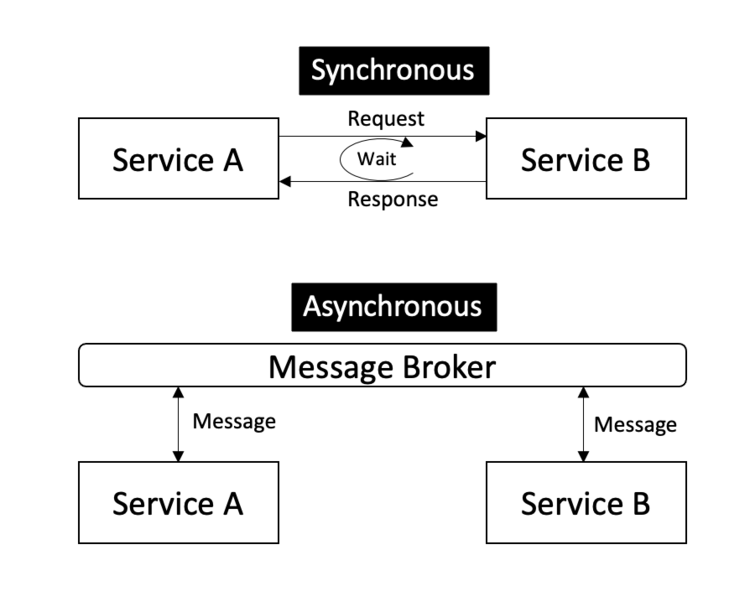
Let's return to the video to see how this works in practice.
Synchronous and Asynchronous Communication between Microservices
This section introduces asynchronous communication, highlighting its non-blocking nature and the central role of a message broker.
Watch from 18:35 to 22:57. Focus on how the message broker acts as a buffer and how this makes the main request flow 'lean'.
Key Characteristics of Asynchronous Communication
- Non-blocking: The caller is free to perform other tasks immediately after sending the message.
- Loosely Coupled: The producer and consumer services are decoupled. They don't need to be available at the same time and don't need to know about each other's location. They only need to know about the message broker.
- Resilient & Scalable: The message broker acts as a shock absorber. It can buffer requests during traffic spikes, and if a consumer service is down, messages can wait in the queue until it recovers.
- Eventual Consistency: Since processing is deferred, the system state is not immediately consistent after an action. It will become consistent eventually.
The Trade-Offs: Advantages and Disadvantages
This resilience and scalability come at the cost of increased complexity. The final video segments detail these trade-offs.
Synchronous and Asynchronous Communication between Microservices
These segments cover the many advantages of asynchronous communication (like improved response time and decoupling) and its significant disadvantages (like eventual consistency and the broker being a single point of failure).
Watch from 22:57 to 34:24. This is a crucial section. Absorb the benefits of decoupling and then the challenges that come with it.
To summarize the trade-offs:
| Advantages | Disadvantages |
|---|---|
| High Resilience: Failure of a consumer doesn't affect the producer. | Increased Complexity: Requires managing a message broker, which itself can be a point of failure. |
| Enhanced Scalability: Can handle traffic bursts by queuing messages. | Eventual Consistency: Not suitable for operations that require immediate, consistent state. |
| Loose Coupling: Services can be developed, deployed, and scaled independently. | Difficult to Debug: Tracing a request across multiple services and queues is complex. |
| Improved User Experience: The requesting client gets a faster response. | No Immediate Feedback: The client doesn't know if or when the task was successfully completed. |
3. Making the Architectural Choice
So, when do you choose one over the other? This is a fundamental architectural decision. There's no single right answer; the choice depends entirely on the specific requirements of the operation.
Secrets to Microservices Communication | How Microservices Talk to Each Other | Sync VS Async
The video 'Secrets to Microservices Communication' by Lazy Programmer offers a very concise summary to guide this decision.
Watch from 11:17 to 12:28. This provides a clear, high-level rule of thumb for when to use each pattern.
Here's a framework to guide your decision-making process:
| Use Synchronous When... | Use Asynchronous When... |
|---|---|
| ✅ You need an immediate response. | ✅ The task can run in the background. |
| ✅ The client cannot proceed without the result. | ✅ You want to decouple services for resilience and scalability. |
| ✅ The operation is fast and reliable. | ✅ The job is long-running (e.g., video encoding). |
| ✅ The system requires strong data consistency. | ✅ You need to absorb traffic spikes. |
| Example: User authentication, retrieving a product's price. | Example: Sending an email notification, processing an uploaded image. |
For a more nuanced view, it's helpful to think in terms of system dimensions, as this article from Priyank Gupta explains.
Patterns for microservices - Sync vs Async
The article 'Patterns for microservices - Sync vs Async' introduces key 'Dimensions' to consider when choosing a communication style, which is perfect for thinking like an architect.
Read the 'Dimensions' section. Focus on how factors like 'Consumers' and 'Read/Write frequency bias' influence the decision.
Test your understanding!
You are designing a feature for a photo-sharing application where a user uploads a new high-resolution photo. The following tasks need to happen:
- The photo file is stored.
- The UI confirms to the user that the upload is complete.
- Thumbnails of various sizes (small, medium, large) are generated from the original photo.
- The photo is analyzed by an AI service to detect objects for automatic tagging.
- The user's followers are notified about the new photo.
For each of the five tasks, would you choose synchronous or asynchronous communication? Justify your choice.
Show answer
- Store the photo file (Synchronous): The client needs to wait for the file to be successfully stored on the server before it can confirm the upload is done. This is a blocking, critical-path operation.
- Confirm to the user (Synchronous): This is the response to the initial synchronous upload request. The user is waiting for this feedback.
- Generate thumbnails (Asynchronous): This can be a time-consuming process. It's a perfect background job. The main application can send a
PhotoUploadedevent, and a separateThumbnailServicecan listen for this event and generate the images. The user doesn't need to wait for this to be done. - AI analysis for tagging (Asynchronous): This is another potentially long-running, computationally expensive task. It's a classic background job. An
AIServicecan consume the samePhotoUploadedevent. Eventual consistency is acceptable here; the tags can appear a few moments after the photo is visible. - Notify followers (Asynchronous): Sending potentially thousands of push notifications or emails should never block the user's request. A
NotificationServicecan listen for thePhotoUploadedevent and handle sending notifications in the background.
4. The Hybrid Reality
As the exercise implies, real-world systems are rarely purely synchronous or purely asynchronous. They are almost always a hybrid, using the right pattern for the right job.
Consider placing an order on an e-commerce site:
- Synchronous Flow: You click "Buy". The
Order Servicemight synchronously call thePayment Serviceand theInventory Service. The user must wait to know if their payment was accepted and the item was in stock. - Asynchronous Flow: Once the order is confirmed, the
Order Servicepublishes anOrderPlacedevent. Asynchronous consumers then spring into action:- The
Notification Servicesends a confirmation email. - The
Shipping Servicebegins the warehouse fulfillment process. - The
Analytics Servicelogs the sale for reporting.
- The
This hybrid model delivers an immediately responsive experience for the user while offloading heavy, non-critical work to resilient background processes.
Conclusion
You have now built a solid framework for one of the most important decisions in system architecture. By understanding the trade-offs between these two communication patterns, you can design systems that are not only functional but also scalable, resilient, and provide a great user experience.
Key Takeaways:
- Synchronous communication is blocking, simple, and real-time, but creates tight coupling and risks cascading failures. It's best for fast, critical-path operations requiring immediate consistency.
- Asynchronous communication is non-blocking, scalable, and resilient, but introduces complexity and eventual consistency. It's ideal for background tasks, long-running jobs, and decoupling services.
- The choice is a fundamental architectural trade-off between simplicity/consistency and scalability/resilience.
- Most robust systems are hybrid, using both patterns strategically for different parts of a workflow.
Preview of the Next Lesson:
This was the final theoretical lesson in this module! You've learned about load balancing, caching, CDNs, message queues, circuit breakers, and now, the fundamental communication patterns that tie them together. In our next and final lesson for this module, you will apply everything you've learned to design a high-level, scalable architecture for a web application.