Hello! Last lesson, you traced power through the PCS, transformers, and collection network to the point of interconnection (POI). That established where a reading is taken. Now you need a second piece of information before interpreting it: which direction the device calls positive.
This lesson uses an explicitly defined grid-import meter convention and an inverter producer convention. You will translate charging, discharging, and reactive-power exchange between them without treating a PCS reading and a POI reading as though they were taken at the same place.
Establish the direction before assigning a sign
Imagine standing at one AC connection and asking two questions. Is active power flowing from the BESS toward the grid, or from the grid toward the BESS? Independently, is reactive power being supplied to the grid or absorbed from it? The answers describe physical exchange. A plus or minus sign describes how a particular device reports that exchange.
For this lesson, define the two conventions as follows:
| Reported value | Positive means | Negative means |
|---|---|---|
| Inverter | Active power supplied toward the grid: discharging | Active power absorbed from the grid: charging |
| Inverter | Reactive power supplied toward the grid | Reactive power absorbed from the grid |
| Import-positive meter | Active power imported from the grid: charging | Active power exported to the grid: discharging |
| Import-positive meter | Reactive power imported from the grid | Reactive power exported to the grid |
Here, is active power and is reactive power, as in the power triangle from the first lessons. The subscripts identify the reporting convention—not necessarily the physical location. “Import-positive meter” is a stipulation for this example, not a promise about every installed meter.
The two perspectives in the diagram below are a useful warning: words such as import and export depend on whose connection you are describing. Its quadrant labels and phasor layout should not replace the explicit sign definitions in the table.
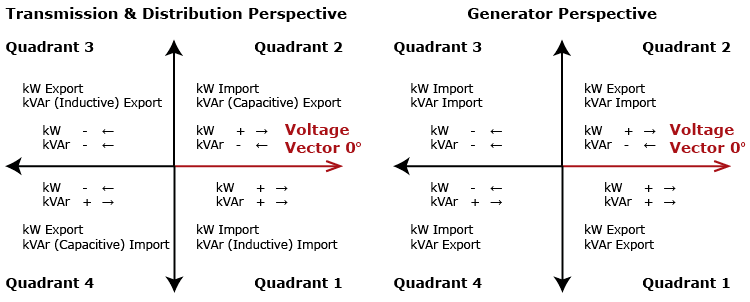
SunSpec’s DER Active Power/Reactive Power/Power Factor Value Encoding explains why a four-quadrant device needs a consistent reference. Read its producer-versus-consumer explanation and its numbered generator-reference summary; the latter gives a concise check on the inverter convention used here.
DER Active Power/Reactive Power/Power Factor Value Encoding
Read SunSpec's explanation of reference orientation to distinguish a producer's injection-positive readings from a consumer's import-positive readings.
In “Reference Orientation,” read the reference definition, ending where it states the signs for injection and absorption. Then find “Value Encoding Summary” and read the numbered summary through item 12. Focus on the separate rules for active and reactive power; you do not need its power-factor encoding rules for this translation.
Translate at one measurement boundary
First suppose both reports describe the same AC boundary, with compatible units and aligned measurement times. Every positive export in the inverter convention is a negative import in the meter convention. The same reversal applies independently to reactive power:
For example, an inverter report of and means it is supplying both active and reactive power toward the grid. An import-positive meter observing that same boundary would report and . Neither device is disagreeing about the flow; their positive directions differ.
Reverse the operating direction and the logic still works. If an inverter reports and , the BESS is charging while supplying reactive power. The corresponding same-boundary import-positive readings are and . Charging does not force reactive power to be imported.
The minus signs above are a convention conversion, not an equipment model. In the plant path from last lesson, a PCS measurement and a POI meter measurement have transformers, cables, and possibly auxiliary loads between them. You must not turn a live PCS value into an exact POI value merely by negating it. If a PCS reports on discharge while an import-positive POI meter reports , the signs are consistent; the unequal magnitudes require an account of the intervening equipment and loads. The next lesson develops that accounting.
Keep active and reactive directions independent
A BESS may operate on either side of zero active power while supplying or absorbing reactive power, subject to its equipment limits. The four combinations below assume the inverter and import-positive meter refer to the same boundary.
| Physical operation | Inverter | Inverter | Meter | Meter |
|---|---|---|---|---|
| Discharging; supplying reactive power | ||||
| Discharging; absorbing reactive power | ||||
| Charging; supplying reactive power | ||||
| Charging; absorbing reactive power |
Notice what remains fixed across the rows: the sign of identifies charging or discharging; the sign of identifies reactive-power direction. Neither sign, by itself, determines the other. At , an inverter may still report nonzero if reactive-power operation is permitted; zero active power is not automatically zero reactive power.
A manufacturer's sign table is often more valuable than a familiar-sounding label. In Annex 1 of Application Guideline for UNO-DM and TRIO-TM inverters, Table A1 sets out a producer-reference example for delivered and absorbed and . It also shows why you should not assume that a signed power-factor value uses the same sign as .
Application Guideline for UNO-DM and TRIO-TM inverters
Read the manufacturer's Annex 1 as an example of how a device documents its own signs—not as a configuration manual for a BESS PCS.
Find “Annex 1: Sign of Power Set Points” on printed page 44. Read the convention and Table A1, stopping at the table caption. Compare its inverter active- and reactive-power columns across all four rows. Notice separately that its power-factor sign columns differ; do not use a signed power-factor display as a substitute for checking a device's Q definition.
In PPC signal handling, this calls for a small but consequential discipline. Record the measurement location, units, what positive means, and what positive means for each incoming signal. Do the same for commands: a positive inverter active-power setpoint under the producer convention requests discharge, whereas a positive import-positive active-power target describes charging. A number without its direction definition is not yet a usable control signal.
Key takeaways
Physical direction and reported sign are different things. Under the conventions defined here, inverter-positive means supply toward the grid, while meter-positive means import from the grid. At the same boundary, translating between them negates and separately. Charging does not determine the direction of reactive-power exchange.
Always check the device's documented convention and the signal's measurement location before applying that translation. Next, you will account for why aggregate PCS active power and POI active power can have different magnitudes, even after their signs have been put into a common convention.