Hello! Welcome to a new module in your AZ-204 journey.
In the previous module, we focused on a critical aspect of cloud development: security. You learned how to use managed identities and Azure Key Vault to refactor an application, moving a sensitive connection string out of configuration files and into a secure vault. This is a foundational skill for building robust, secure applications in Azure.
Now, we shift our focus from security to another vital pillar of application architecture: performance and optimization. This module, "Optimizing Applications with Caching and CDN," will equip you with the tools to make your applications faster and more scalable.
Our first lesson addresses the learning outcome: Describe the features and use cases of Azure Cache for Redis. We will explore what caching is, why the in-memory data store Redis is so popular, and how Azure provides it as a fully managed service. This is a conceptual lesson that lays the groundwork for the hands-on labs that will follow.
1. Why Caching Matters
Before diving into a specific technology like Redis, let's establish why caching is so important. In many applications, the biggest performance bottleneck is repeatedly fetching data from a primary data store, such as a SQL database or a NoSQL database like Cosmos DB. These operations can be slow and resource-intensive, especially under heavy load.
Caching aims to solve this by storing frequently accessed data in a faster, temporary storage layer that is closer to the application.
To understand the fundamental principles, let's start with some general caching guidance from the Azure Architecture Center. This will explain when and why to use a cache.
Please read the introduction and the sections 'Caching in distributed applications', 'Private caching', and 'Shared caching'. Focus on understanding the core benefits of caching (improving performance and scalability) and the difference between a private, local cache and a shared cache.
As you've just read, Azure Cache for Redis is an implementation of a shared cache. This is a crucial concept for distributed applications, as it provides a single, consistent source of cached data that multiple instances of your application (e.g., multiple servers in a web farm) can access.
2. Introducing Redis: More Than Just a Cache
Redis (which stands for REmote DIctionary Server) is an open-source, in-memory data store that has become the industry standard for caching. Its speed is its most famous attribute, as memory access is orders of magnitude faster than disk access.
However, calling Redis "just a cache" is an oversimplification. It's a versatile tool that supports various data structures, making it suitable for a wide range of use cases beyond simple key-value caching.
To get a solid overview of Redis and its primary use case, the cache-aside pattern, please watch the following video.
John Savill provides an excellent introduction to Redis, explaining what it is at a fundamental level and how it's most commonly used.
Watch the first two segments of this video (from 00:00 to 04:51). Pay close attention to: What Redis is: an in-memory, key-value store. The data structures it supports (strings, lists, hashes, etc.). The detailed explanation of the cache-aside pattern (also called lazy loading). This pattern is fundamental to using Redis as a cache and is a key concept for the AZ-204 exam.
The cache-aside pattern you just saw is a core software design pattern. Given your background in computer science and development, you can see its elegance: the application logic is responsible for managing the cache. This gives you, the developer, full control over what is cached and when.
3. Common Use Cases for Redis
While database caching with the cache-aside pattern is the most common use case, the power and flexibility of Redis lend it to many other scenarios. As an experienced developer, you'll recognize many of these as common challenges in building scalable web applications.
What is Azure Cache for Redis?
This document from Microsoft Learn provides a concise table of key scenarios where Azure Cache for Redis is beneficial.
Read the 'Key scenarios' section and review the table. This will formalize your understanding of the different ways Redis can be used.
The scenarios from that table—data cache, content cache, session store, and message queuing—are all highly relevant to the applications you build. For example:
- Session Store: In a stateless web application scaled across multiple servers, you can't store user session state in memory on a single web server. Redis provides a fast, centralized location to store this state, accessible to all servers.
- Content Cache: For a .NET application, you can cache the final rendered HTML of a page or component. This is much faster than re-executing the logic and re-rendering the view for every request.
- Message Queuing: The list data structure in Redis can be used to implement a simple, fast message queue for background job processing.
The following video segment expands on these and other interesting use cases, including a very modern one involving AI.
Let's return to John Savill's video to explore a broader range of use cases for Redis.
Watch the segment from 04:51 to 09:47. This part covers other things you can cache (like tokens and API payloads) and non-caching scenarios like message queues and leaderboards.
4. Features of Azure Cache for Redis
Now that you understand what Redis is and what it's used for, let's focus on the Azure service: Azure Cache for Redis. This is a fully managed service, which means Azure handles provisioning, patching, scaling, security, and high availability for you.
A managed service lets you focus on using Redis in your application, not on the operational overhead of running it. The most important feature to understand is the different service tiers, as they dictate the cost, performance, and available features.
What is Azure Cache for Redis?
Let's review the official documentation on the service tiers and their features. This is critical knowledge for making architectural decisions and for the exam.
Read the sections 'Service tiers' and 'Choosing the right tier'. Pay close attention to the 'Feature comparison' table, which breaks down what you get with each tier.
To summarize the key features determined by the tiers:
- Basic: For development/test. A single node, no SLA.
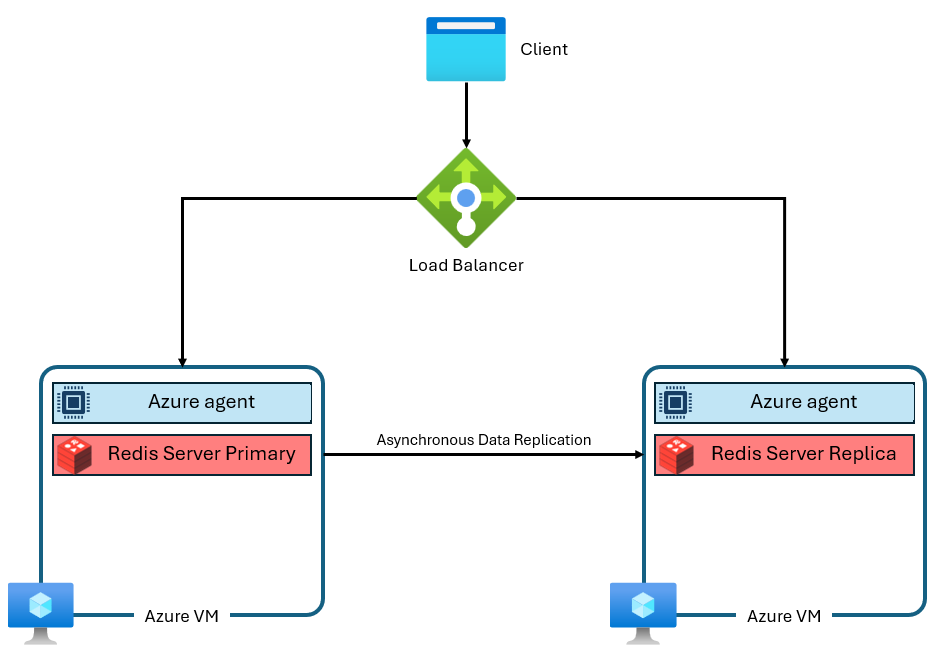
- Standard: For production. Includes a primary/replica pair for high availability, backed by an SLA.
- Premium: Adds more features on top of Standard, including data persistence (saving cache data to storage), clustering (sharding data across multiple nodes for greater scale), and VNet isolation.
- Enterprise / Enterprise Flash: Built on Redis Enterprise software. These tiers offer advanced capabilities like Redis Modules (e.g., RediSearch, RedisJSON) and active geo-replication for the most demanding workloads.
This image from the Azure Portal clearly visualizes how these tiers are presented when you're managing a cache instance.

And this diagram illustrates the high-availability architecture you get with the Standard tier and above, which uses a primary server and a replica with asynchronous data replication.
Conclusion
In this lesson, we have laid the conceptual foundation for using caching in your Azure solutions. You now have a clear understanding of what Azure Cache for Redis is, what it's for, and the features it offers.
Key Takeaways:
- Caching is a technique to improve application performance and scalability by storing frequently used data in fast, temporary storage.
- Redis is a high-performance, in-memory key-value store that supports rich data structures.
- Azure Cache for Redis is the fully managed service offering of Redis on Azure.
- The primary use case is the cache-aside pattern to reduce load on backend databases. Other use cases include session storage, content caching, and even message brokering.
- The service tiers (Basic, Standard, Premium, Enterprise) determine critical features like high availability, data persistence, clustering, and security options.
Next Steps
You've covered the "what" and "why." In our next lesson, we'll move to the "how." You will get hands-on experience as we tackle the next learning outcome: "Create and configure an Azure Cache for Redis instance." You'll learn how to provision a cache using the Azure Portal and prepare for connecting to it from your .NET applications.