Hello! Welcome to our lesson.
In our last two sessions, we explored the principle of Malotsarga from two perspectives. We first discussed the dangers of suppressing the urge to defecate (vega dharana) and then the profound benefits of heeding that urge in a timely manner to regulate Apana Vayu.
Today, we address a crucial point of clinical discernment that moves beyond this simple binary. What if the urge is inappropriate, or what if a patient tries to force an urge that isn't there? This lesson will tackle the learning outcome: Recognize contraindications for forced elimination and harmful effects of improper habits in conditions like atisara and grahani.
Understanding "what not to do" is as important as knowing "what to do." We will delve into why forcing or improperly stopping elimination can be detrimental, particularly in the context of two of the most common and complex gastrointestinal disorders in Ayurvedic practice.
1. The Principle of Inopportune Action: Vega Udeerana and Stambhana
While suppressing a natural urge (vega dharana) is harmful, so is artificially inducing an urge (vega udeerana) or improperly arresting a natural cleansing process.
- Pravahana (Straining): This is a form of vega udeerana. While gentle straining may be necessary to initiate a normal bowel movement, excessive or forceful straining against resistance is contraindicated. It violently aggravates Apana Vayu, potentially causing it to move abnormally and leading to complications like hemorrhoids (arsha), anal fissures (parikartika), and rectal prolapse (gudabhramsha).
- Stambhana (Arresting/Stopping): This refers to therapies that arrest the flow of bodily fluids. While therapeutically useful in certain conditions, applying stambhana prematurely—especially when the body is trying to expel ama (metabolic toxins)—is a critical clinical error. It traps the toxins, leading to more severe, chronic diseases.
We will now examine how these improper actions manifest in Atisara and Grahani.
2. The Clinical Context of Atisara (Diarrhea)
Atisara is classically defined as gudena bahu dravasaranam—the frequent passage of copious liquid stools. While symptomatic relief is tempting, the first step is to diagnose the stage of the disease.
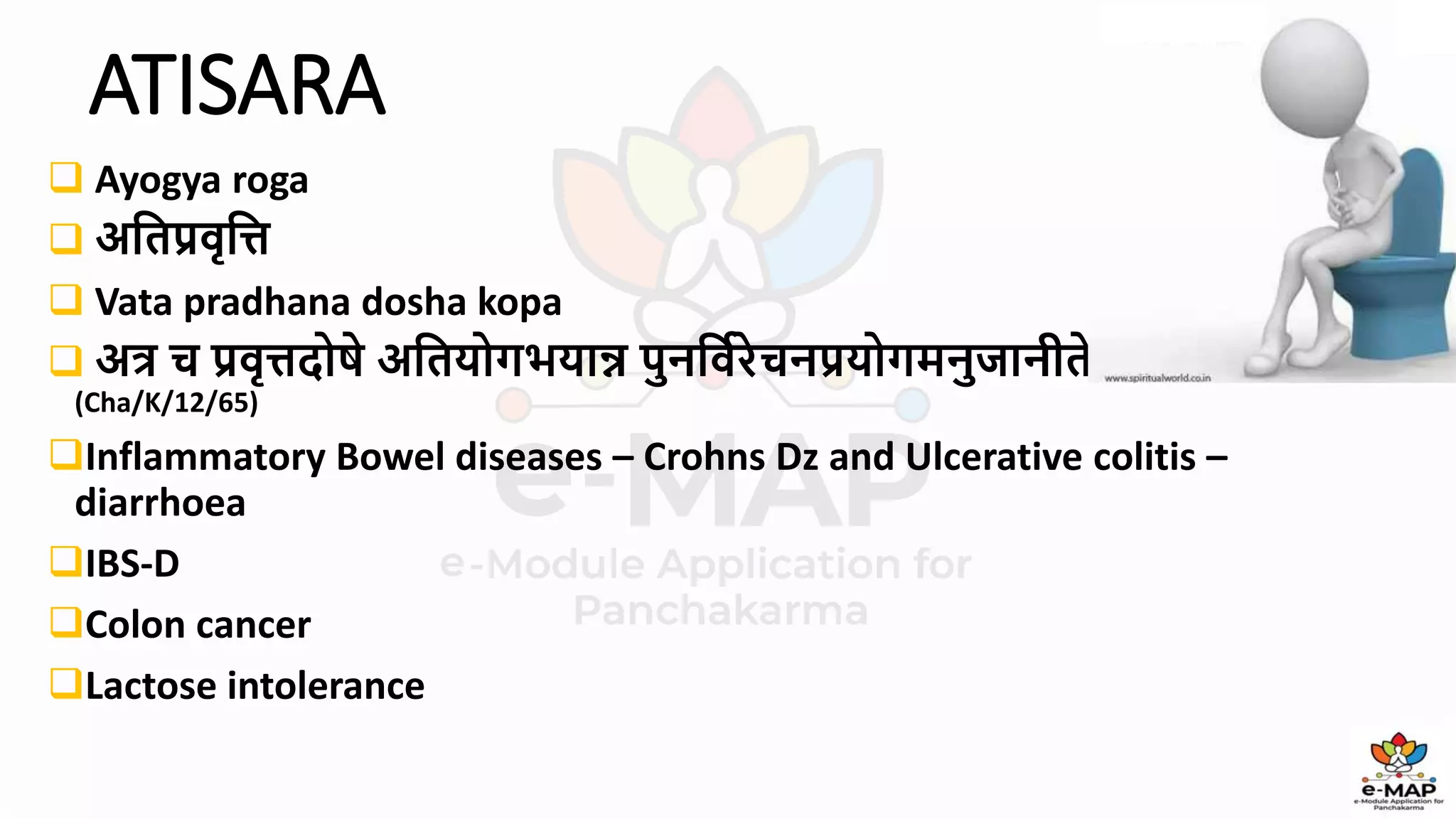
The most important clinical distinction is between:
- Amatisara: Diarrhea with ama. The stools are foul-smelling, sticky (picchila), and sink in water. It's often accompanied by abdominal heaviness and indigestion. Here, the diarrhea is a natural and necessary effort by the body to expel toxins.
- Niramatisara (or Pakvatisara): Diarrhea without ama. The stool is watery but lacks the foul smell or stickiness. The root cause has been addressed, but the fluid loss continues.
Contraindications and Harmful Effects in Atisara
The primary improper habit in Amatisara is not forcing elimination, but forcing it to stop. Using potent bowel-binding (stambhana) agents in this stage is a grave mistake.
Charaka Atisara Chikitsa - 19th Chapter - Easy Ayurveda
To understand the classical view on this, let's turn to Charaka Samhita's chapter on Atisara Chikitsa, as explained in this article from Easy Ayurveda.
Please read the section titled 'Atisara Line of treatment'. Focus on the clear instruction against using bowel-binding therapies (Sangrahana chikitsa) in the initial 'Ama' stage and the extensive list of complications that arise from this improper action.
As the text explicitly states, obstructing the elimination of aggravated doshas and ama can cause a host of severe, chronic diseases, including:
- Grahani (Sprue syndrome / IBS)
- Adhmana (Flatulence)
- Arshas (Hemorrhoids)
- Pandu (Anemia)
- Kushta (Obstinate skin diseases)
- Gulma (Abdominal tumors)
- Udara (Ascites and other major abdominal diseases)
This directly illustrates how an improper habit during an acute condition like Atisara can lead to a chronic, difficult-to-treat disease like Grahani. The correct approach in Amatisara is to support the body's cleansing process with langhana (fasting) and pachana (digestive) herbs, not to suppress it.
To deepen your theoretical understanding, it's vital to differentiate the pharmacological actions involved.
International Journal of Research Publication and Reviews - ijrpr
This research paper provides a brilliant differential analysis of 'Grahi', 'Stambhana', and 'Deepana-Pachana' actions. Understanding this is key to advanced clinical practice.
Please read the 'Differential Analysis' section and study 'Table 1: Comparative Analysis'. Then, read the section 'Management of Atisara (Diarrhea)'. Focus on why Stambhana agents are contraindicated in Amatisara, where Grahi agents (which have a digestive component) are appropriate.
In summary:
- Stambhana (e.g., Kutaja in Nirama state): Cold, dry, arresting. It stops flow but traps ama. Contraindicated in Amatisara.
- Grahi (e.g., Shunthi, Musta): Hot, digestive, absorbent. It first digests ama (pachana) and then absorbs fluid. Indicated in Amatisara.
3. The Clinical Context of Grahani (Malabsorption/IBS)
Grahani Roga is a chronic disorder of the seat of Agni itself. It's often a consequence of repeated digestive insults, including the improper management of Atisara.
Let's start with a clear overview of this complex condition.
5 Things You Need to Know About Enteritis and Grahani Right Now
This video from Ayurveda Academy provides a comprehensive explanation of Grahani, from its pathophysiology to its clinical features and management.
Please watch from 01:23 to 25:28. The speaker explains how Grahani develops from weakened Agni, its location and function, and the cardinal symptom of 'muhurbaddham muhurdravam' (alternating constipation and diarrhea). Pay close attention to the discussion of how this disease leads to systemic tissue depletion (dhatu kshaya).
The defining symptom of Grahani is muhurbaddham muhurdravam—bouts of constipation alternating with bouts of diarrhea. This is where improper elimination habits become particularly destructive.
Contraindications and Harmful Effects in Grahani
-
Forced Elimination (Pravahana) During the Constipated Phase: A patient experiencing the baddha (constipated) phase of Grahani might be tempted to strain excessively or use harsh laxatives.
- Harmful Effects: This aggressive approach further deranges the already sensitive Apana Vayu, damages the colonic mucosa, and can provoke the drava (diarrhea) phase, perpetuating the vicious cycle. It also leads to complications like arsha and parikartika.
-
Improper Use of Stambhana During the Diarrheic Phase: Similar to Atisara, if the loose stools in Grahani are associated with ama, using purely astringent medicines will worsen the condition by trapping toxins and further weakening Agni. This is why Grahi drugs, which also support digestion, are a cornerstone of Grahani management.
The resource LINK, in its section on "Management of Grahani Roga," makes this point clearly: the Ayurvedic strategy is restorative (restoring Agni) rather than purely palliative (just stopping the symptom).
- Consequences of Long-Term Improper Habits: The chronic nature of Grahani means that these improper habits, repeated over time, lead to severe systemic depletion (dhatu kshaya). As explained in the video, this manifests as:
- Daurbalya (Weakness)
- Krushata (Weight loss)
- Pandu (Anemia)
- Shotha (Edema)
- Joint issues, due to the connection between the Purishadhara Kala and Asthidhara Kala.
Test your understanding!
You have two patients.
- Patient A has acute-onset, foul-smelling, sticky diarrhea (Amatisara) for two days.
- Patient B has chronic Grahani and is currently in a phase of hard, difficult-to-pass stools (baddha) and is complaining of severe straining.
What is the primary "improper habit" you would advise each patient to avoid at this moment, and why?
Show answer
-
Patient A (Amatisara): You would advise them to avoid taking over-the-counter anti-diarrheal medications (Stambhana). The reason is that their body is actively trying to expel ama (toxins). Stopping this process would trap the toxins, potentially leading to a more severe or chronic condition like Grahani. The correct approach is fasting (langhana) and taking digestive herbs (pachana dravyas).
-
Patient B (Grahani - Baddha phase): You would advise them to avoid forceful straining (pravahana) and using harsh, stimulating laxatives. The reason is that their digestive system is already weak and sensitive. Straining will further vitiate Apana Vayu and can cause physical damage (hemorrhoids, fissures). Harsh laxatives could trigger a severe diarrheic episode, continuing the disease cycle and further depleting their tissues. The correct approach involves gentle, Vata-pacifying measures, emollients, and appropriate fiber and oils to soften the stool, not to force it out violently.
Conclusion
Today's lesson has added a critical layer of clinical nuance to our understanding of elimination. We have moved from the simple 'good vs. bad' of heeding or suppressing urges to the complex decision-making required in pathological states.
Key Takeaways:
- Avoid premature Stambhana: In acute diarrhea with signs of ama (Amatisara), do not use bowel-binding drugs. This traps toxins and can cause severe complications, including the transition to chronic Grahani.
- Avoid forceful Pravahana: In chronic constipation, especially in the context of Grahani, advise patients against excessive straining or using harsh laxatives. This practice damages the body and perpetuates the disease cycle.
- Discern the stage (Avastha): The core of effective treatment lies in correctly identifying the presence or absence of ama. This determines whether the therapeutic goal is pachana (digestion), grahi (digestion and absorption), or stambhana (arresting flow).
- The goal is restoration, not just suppression: True Ayurvedic management aims to restore the function of Agni and normalize Vayu, not merely to stop an inconvenient symptom.
Having established what to do, what not to do, and why, we are now prepared to synthesize this knowledge into a practical plan. In our next lesson, we will focus on the learning outcome: Design an integrated morning plan to regulate apana vayu and agni for common elimination issues.