Welcome to the first lesson in our module on the longitudinal analysis of emotional dynamics. In our previous module, we developed a powerful statistical framework—the cross-classified multilevel model—to partition emotional variance and understand the static influence of individuals and their relationships within the triad. We answered the question: "Is the jealousy in this triad driven more by the husband's personality or by the unique dynamics of the marriage?"
However, emotions are not static. They ebb and flow, reacting to events and influencing each other over minutes, hours, and days. To capture this dynamic interplay, we need to move from cross-sectional or single-time-point measurements to data that reflects life as it is lived. This lesson is dedicated to the methodology for collecting such data. Your objective is to design an experience sampling method (ESM) protocol for capturing real-time emotional responses from all three participants before, during, and after specific activities.
This is a critical design phase that precedes any statistical modeling. Your background in the design of experiments will be particularly useful here, as designing an ESM protocol involves making a series of strategic trade-offs to maximize data quality while minimizing participant burden—much like designing a clinical trial or industrial experiment. The protocol you design will provide the raw material for the dynamic models we will explore in the upcoming lessons.
What is Experience Sampling and Why Is It Necessary?
Traditional psychological research often relies on retrospective self-reports, where participants are asked to recall their feelings or behaviors over the past week or month. While useful, these methods are prone to recall biases and tend to smooth over the very fluctuations you are interested in. Experience Sampling Methods (ESM), also known as Ecological Momentary Assessment (EMA), are a family of techniques designed to overcome these limitations.
The core idea is to collect data in real-time, in the participants' natural environments, as they go about their daily lives. The following video provides an excellent introduction to the core principles of EMA/ESM.
Ecological Momentary Assessment to Measure Emotion, Cognition, and Behavior in Daily Life | DIGIT-MI
This video from the Eisenberg Family Depression Center offers a clear and practical overview of Ecological Momentary Assessment. It defines the method and its key advantages over traditional approaches.
Please watch the segment from the beginning of the EMA discussion. Pay close attention to the four defining features of EMA that are presented: Data collection in real-world environments. Focus on the individual's current state ("right now"). Sampling of moments, not just people. Multiple, repeated assessments over time.
For your research, ESM is not just an alternative; it's a necessity. It is the only way to obtain a high-resolution picture of the causal processes linking specific activities (e.g., a conversation between the wife and bull, the husband's solitary reflection) to immediate emotional outcomes (e.g., spikes in guilt or jealousy).
The Architecture of an ESM Protocol: The Three D's
Designing an ESM study involves a series of critical decisions that determine the quality and type of data you will collect. A helpful framework for organizing these decisions is the "Three D's": Density, Depth, and Duration.
Ecological Momentary Assessment to Measure Emotion, Cognition, and Behavior in Daily Life | DIGIT-MI
The same video provides a structured way to think about these core design parameters and the trade-offs they entail.
Please watch the section covering the three D's, from the introduction to the concept, and then the section that discusses how to balance them, from "what you're studying".
Let's break these down in the context of your triadic study:
-
Density (Frequency): How often should you prompt participants?
- The goal is to match the sampling frequency to the timescale of the phenomenon. Emotions like jealousy or guilt can fluctuate rapidly. A study with only one measurement per day would likely miss these crucial dynamics.
- Research has shown that for many psychological states, within-day variance is significantly larger than between-day variance. This strongly argues for a high-density design with multiple assessments per day.
- A common starting point is 4-6 prompts per day. This is dense enough to capture daily rhythms but manageable for participants.
-
Depth (Length): How many questions should you ask at each prompt?
- This is a trade-off between detail and fatigue. Long surveys lead to lower compliance and poorer data quality.
- The goal is a "brief" assessment, typically taking 1-3 minutes to complete. This means using very short, validated scales or even single-item measures. Given your familiarity with psychometrics, you know the importance of using well-vetted items.
- The video mentions the ESM Item Repository, which is an invaluable resource for finding such items.
-
Duration (Length of Study): For how many days should you collect data?
- Longer durations allow for the study of weekly patterns (e.g., differences in activities and emotions on weekdays vs. weekends) and more stable estimates of individual tendencies.
- However, as the video notes, duration is the single biggest predictor of compliance drop-off.
- A typical duration for an intensive ESM study is 7 to 14 days. This is often long enough to capture variability and events of interest without overly burdening participants.
The following paper provides a concrete example of these principles in practice within a dyadic study, which serves as an excellent reference point.
Measuring motivational relationship processes in experience ...
This research by Schönbrodt et al. applies ESM to study relationship dynamics in couples, providing a rigorous example of protocol design and its justification.
First, review the Procedure section. Note their specific design choices: five times a day for 14 or 28 days. Also, observe the practical detail that surveys were scheduled at identical times for both members of the dyad, a key consideration for your triadic design. Next, read the Discussion and the subsection on Variance decomposition and reliability estimation. The key finding to note is that within-day variance was much larger than between-day variance. This is the empirical justification for using a high-density (multiple prompts per day) design.
Sampling Schemes: Capturing General Mood and Specific Events
Perhaps the most crucial design choice is the sampling scheme—the logic that determines when a prompt is triggered. There are two primary types, which can be used in combination.

1. Signal-Contingent (Time-Based) Sampling
This approach is used to capture the general flow of experience and emotion over time, independent of any specific event. Prompts are sent according to a pre-programmed schedule. As the video LINK explains, this can be:
- Fixed: Prompts at the same times every day (e.g., 9 am, 1 pm, 5 pm, 9 pm).
- Random: Prompts sent completely at random within a waking-hours window.
- Semi-Random (or Interval-Contingent): The day is divided into blocks (e.g., four 3-hour blocks), and one random prompt is sent within each block. This is the most common and often most effective strategy, as it ensures coverage across the day without being predictable.
For your study, a semi-random schedule with 5-6 prompts per day, synchronized for all three participants, would provide a robust dataset on the "background" emotional climate of the triad.
2. Event-Contingent Sampling
This approach is tailored to capture experiences related to specific, predefined events. The participant (or the researcher) initiates a survey when an event occurs. This is essential for addressing the "before, during, and after specific activities" part of your learning outcome.
In your context, a key "event" is a date or significant interaction between the wife and the bull. An event-contingent protocol would look like this:
- Initiation: The wife (or another designated participant) would manually trigger an "event protocol" in the app when a date is planned.
- Pre-Event Assessment (e.g., T-60 minutes): The app automatically sends a survey to all three participants to measure anticipatory emotions (excitement, anxiety, jealousy).
- Post-Event Assessment (e.g., T+60 minutes): The app sends a survey to all three participants to capture the immediate emotional aftermath, details of the interaction, and communication between the husband and wife.
- Follow-up Assessment (e.g., T+24 hours): A final survey captures delayed emotional processing, reflections, and any lingering effects.
The following image illustrates the timeline of a single ESM prompt, which is the building block of both signal- and event-contingent schemes. It highlights the interruption of a person's primary task.
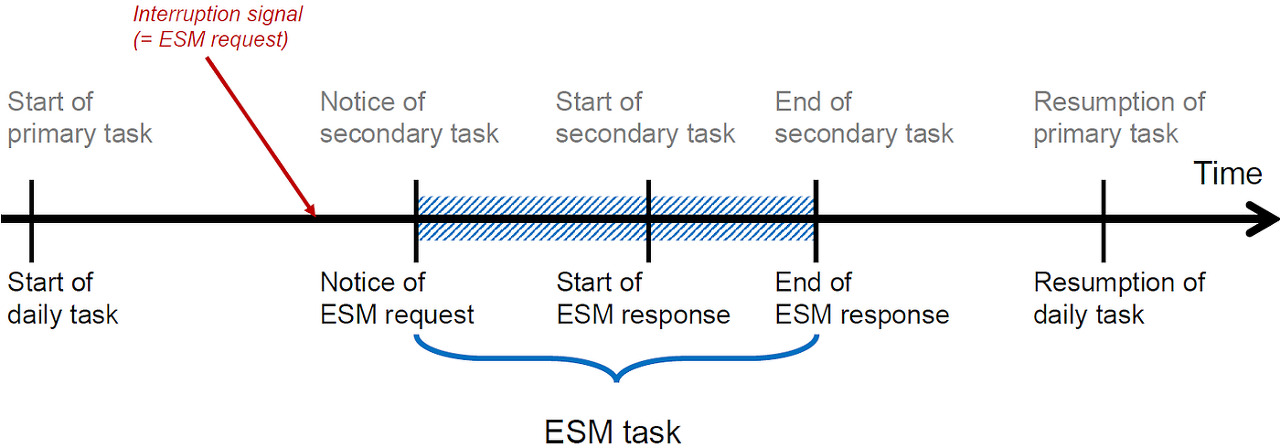
The challenge with event-contingent sampling is that it relies on the participant to initiate the assessment, which can sometimes be forgotten. Therefore, the most powerful design for your research would be a hybrid model, combining signal-contingent sampling for a continuous baseline with event-contingent sampling layered on top for deep dives into specific activities.
A Blueprint for Your Triadic ESM Protocol
Let's synthesize these elements into a concrete, actionable protocol. While the paper by Saxbe et al. below uses a physiological measure (cortisol), its procedural design for capturing triadic responses around a specific event is an excellent model.
Relative Influences: Patterns of HPA Axis Concordance ... - PMC
This study examines physiological linkage in family triads around a conflict discussion. The principles of its data collection protocol are directly transferable to your study of emotional responses around a cuckold-hotwife activity.
First, examine Figure 1 and the accompanying Procedures section. Note how they structure the data collection with multiple samples timed relative to the central event (the discussion). This is a perfect template for your "before, during, and after" design. Next, briefly look at the Time-Lagged Results section, particularly the introduction to the Hierarchical Linear Models. They analyze how one person's state at a prior timepoint predicts another person's current state (fathers' prior cortisol). This gives you a preview of exactly why collecting this time-stamped data is so powerful and directly sets up the cross-lagged models we will discuss in our next lesson.
Drawing on these examples, here is a potential blueprint for your study:
1. General Parameters:
- Duration: 14 days.
- Participants: Husband, wife, bull. All three participate for the full duration.
- Technology: A HIPAA-compliant ESM platform (e.g., MetricWire, m-Path, etc.) that supports synchronized, semi-random, and user-triggered prompts.
2. Signal-Contingent Protocol (Baseline Monitoring):
- Density: 5 prompts per day for all 3 participants.
- Schedule: Semi-random, with one prompt in each of five daily blocks (e.g., 9am-12pm, 12pm-3pm, 3pm-6pm, 6pm-9pm, 9pm-12am).
- Synchronization: Prompts are delivered to all three participants simultaneously to create time-matched emotional snapshots of the triad.
- Depth: A brief 2-minute survey assessing core emotions (jealousy, guilt, happiness, arousal), current context (Who are you with? What are you doing?), and recent communication.
3. Event-Contingent Protocol (Date-Specific Monitoring):
- Trigger: The wife initiates the "Date Protocol" via a button in the app at the beginning of a day when a date with the bull is planned.
- Schedule:
- Pre-Date Survey (T-1 hour): Sent to all 3 participants. Focus on anticipation, expectations, and baseline emotions.
- Post-Date Survey (T+1 hour after date ends): Sent to all 3 participants. Focus on immediate emotional reactions, perceptions of the date, and initial communication within the primary couple.
- Debrief Survey (Morning after): Sent to all 3 participants. Focus on emotional processing, communication quality, and any lingering feelings from the previous day.
- Depth: These surveys can be slightly longer (3-5 minutes) to capture more detail about the specific event.
4. Practical Considerations:
- Training: A thorough onboarding session is critical. All three participants must understand the protocol, practice using the app, and have a chance to ask questions.
- Compliance & Compensation: As discussed in the LINK video, compensation is key. A model of paying per survey (e.g., $1) with a bonus for high compliance (e.g., >80%) is effective. Daily monitoring and gentle "nudges" from the research team for missed days can also significantly boost compliance.
Conclusion
In this lesson, you have learned the principles of designing an Experience Sampling Method protocol tailored to the unique challenges and opportunities of your triadic research. We have moved from the theoretical need for real-time data to a concrete blueprint for its collection. You now have a framework for making informed decisions about sampling density, depth, duration, and scheduling to capture the rich, dynamic emotional data your causal questions require.
Key Takeaways:
- ESM is essential for capturing the real-time emotional fluctuations that are at the heart of your research, overcoming the limitations of retrospective reports.
- Designing a protocol involves balancing the "Three D's": Density (frequency of prompts), Depth (survey length), and Duration (study length).
- A hybrid sampling scheme is ideal for your study: signal-contingent (semi-random) prompts to capture the daily emotional climate, combined with event-contingent prompts to capture detailed reactions before, during, and after specific lifestyle activities.
- Coordinating prompts across all three participants is a key design feature that will enable powerful, time-linked analysis of mutual influence.
This protocol design is the foundation upon which your longitudinal analysis will be built. Now that you have a plan for collecting this intensive time-series data, our next lesson will equip you with the tools to analyze it. We will explore the triadic cross-lagged panel model (CLPM), a statistical technique designed specifically to test directional hypotheses of influence (e.g., "Does the wife's guilt at Time 1 predict the husband's jealousy at Time 2?") using the very data your ESM protocol will generate.