In our last lesson, we designed the blueprint for a cross-classified multilevel model, recognizing that an individual in your triadic research context is simultaneously a member of multiple, overlapping dyadic relationships. We established that this structure is necessary to avoid confounding the emotional influences of, for example, the husband-wife dyad with those of the wife-bull dyad.
This lesson takes the crucial next step from specification to application. We will now focus on how to estimate and interpret the variance components from this model. This is where the model delivers its primary insight: quantifying the sources of emotional variation. By the end of this lesson, you will be able to partition the total variance in an emotion like jealousy or guilt and attribute it to the influence of the individual's stable traits versus the unique dynamics of their specific relationships. This directly addresses your goal of understanding the causal drivers of emotion within the triad.
The Social Relations Model (SRM) as an Interpretive Framework
The cross-classified model we specified is the statistical engine that powers a well-established framework in social psychology called the Social Relations Model (SRM). Before we dive into the numbers, understanding the SRM's conceptual language will give us a powerful lens for interpretation. Your background in experimental design, which emphasizes the decomposition of variance (e.g., in ANOVA), will make this framework intuitive.
The SRM decomposes any interpersonal perception or behavior into three primary sources of variance:
- Actor Effect: The tendency of an individual to feel or act in a certain way across all partners. For example, a husband's general disposition to be jealous. This is a property of the individual.
- Partner Effect: The tendency of an individual to elicit a certain feeling or action from all partners. For example, a wife's tendency to consistently elicit jealousy from her partners. This is also a property of the individual, but from the "target" perspective.
- Relationship Effect: The unique dynamic between a specific actor and a specific partner that cannot be explained by their general tendencies. For example, the unique level of jealousy a specific husband feels in relation to his specific wife, above and beyond his general jealousy and her general tendency to elicit it. This is a property of the dyad.
The following resource provides an excellent introduction to these concepts and the types of questions the SRM can answer.
The Social Relations Model for Asymmetric-Block-Design ...
This tutorial by Eastwick and colleagues clearly explains the core components of the SRM and how it applies to data where two distinct groups of people interact, which is analogous to your triad (e.g., husband interacting with wife/bull).
Please read the introductory section, "The Social Relations Model (SRM)" (p. 1-2). This will formally define the actor, partner, and relationship components. Then, review the section "The Asymmetric Block Design Questions" (p. 2-3), which frames the research questions in terms of these components.
When we estimate a cross-classified model, the variance components we extract correspond directly to these SRM effects.
- Variance in Actor Effects (): How much do individuals differ in their general emotional tendencies?
- Variance in Partner Effects (): How much do individuals differ in the emotions they elicit from others?
- Variance in Relationship Effects (): How much do specific relationships vary in their unique emotional dynamics?
Estimating and Partitioning Variance
With the conceptual framework in place, let's turn to estimation. The goal is to obtain numerical estimates for , , and , plus the residual or error variance, . We can then calculate the proportion of the total variance attributable to each component. This is often called the Intraclass Correlation (ICC) for a given component.
For example, the proportion of variance due to actor effects is:
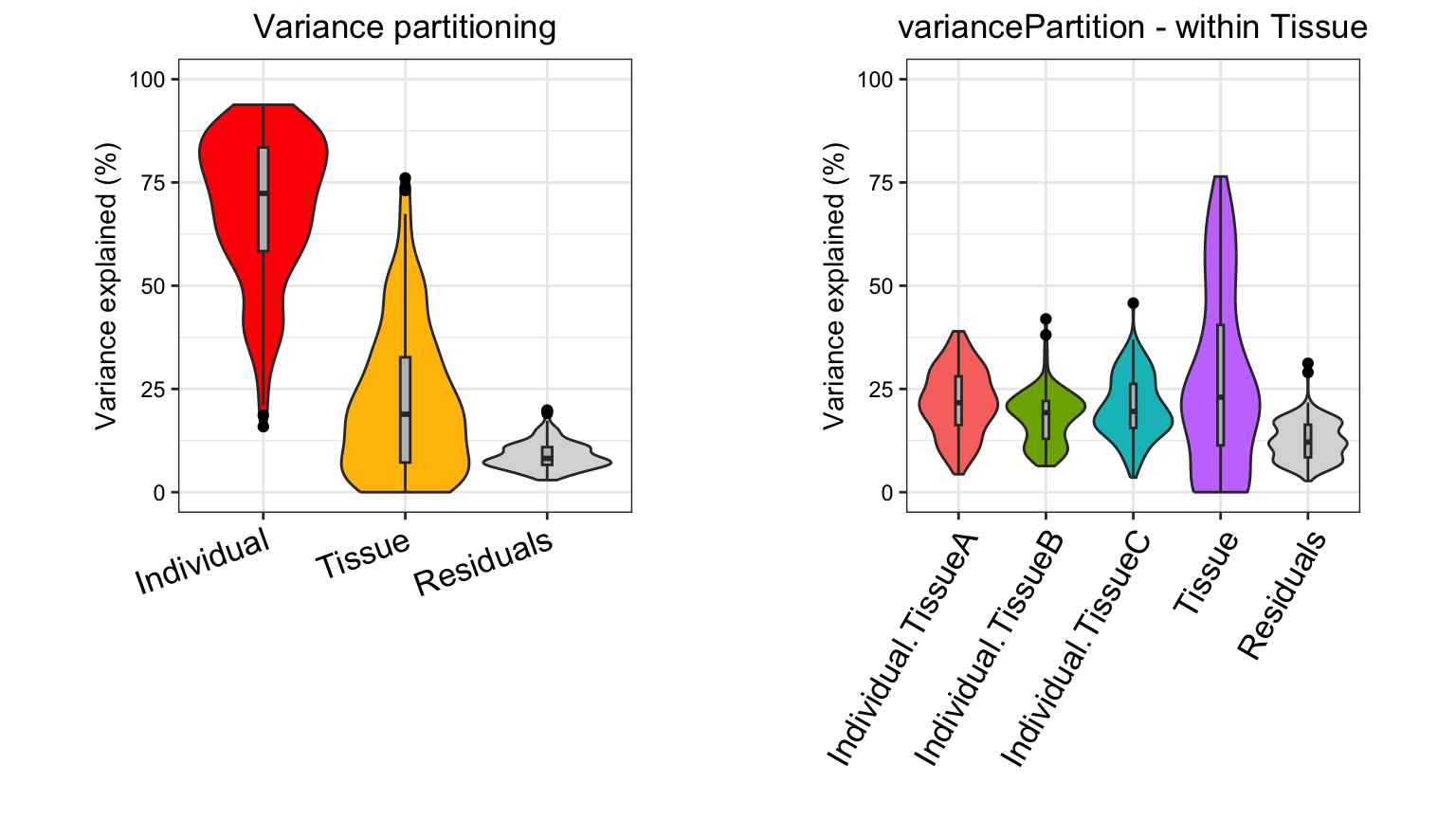
This calculation tells you what percentage of the total emotional variation is "explained" by stable differences between actors. The following short video provides a helpful visual recap of how variance is partitioned in mixed models.
Variance explained, ICC, Design Effect, and R Squared in Mixed Models
This video from the Simplistics (QuantPsych) channel provides a clear, animated explanation of variance partitioning and the Intraclass Correlation (ICC) in the context of mixed models.
Watch from the beginning to the end of the section on ICC. Pay attention to the distinction between "intercept variance" (variance between clusters/people) and "residual variance" (variance within clusters/people). In our SRM context, actor and partner variances are types of "between-person" variance, while relationship variance is a form of "within-person, between-dyad" variance.
This partitioning is the quantitative answer to questions like: "Is the wife's guilt primarily driven by her own personality, or is it a feature of her specific relationships?"
A Worked Example: Interpreting the Output
Let's now walk through how to interpret the output of a cross-classified model fitted to social interaction data. Since your work involves continuous emotional outcomes (e.g., on a validated scale) and you have a strong statistical background, we will examine an advanced application.
The following resources detail how to implement and interpret these models. The first, from Eastwick et al., shows the practical side using R's glmmTMB package. The second, from Gill and Swartz, presents a formal Bayesian model for triadic data, which aligns with your expertise in Bayesian methods.
The Social Relations Model for Asymmetric-Block-Design ...
This part of the tutorial provides a detailed walkthrough of interpreting the output from an SRM analysis, including the calculation of standardized variance components.
Focus on the section "Interpretation of the Results" and the subsequent tables. First, look at the initial output and how the author identifies the variance estimates in the random effects section. Next, review Table 9 and the accompanying text under The Random Effects (pp. 14-15). This is the most crucial part. Observe how the raw variance estimates (e.g., Men Actor variance = 1.03) are converted into standardized percentages (22.8%). The text explains exactly how this is calculated: the males’ actor variance accounts for ( 1.03 / (1.03+1.47+2.02)) of the males’ total variance, or 22.8%. Finally, examine Table 12 and its interpretation under the section for multi-item outcomes (p. 22). This demonstrates how the model separates true relationship variance from measurement error when multiple indicators are available, a design feature you'd likely use.
Now, let's consider a model specifically for triadic data, using a Bayesian approach.
A Bayesian Approach for the Analysis of Triadic Data in ...
This paper develops a hierarchical model for triadic data, which is conceptually equivalent to the cross-classified models we've discussed. It provides a sophisticated look at the variance components.
First, briefly review the model setup in the section on random effects (p. 6). Here, \sigma^2_{\alpha}, \sigma^2_{\beta}, and \sigma^2_{\gamma} represent the variance in actor (expansiveness), partner (attractiveness), and judge (perception bias) effects, respectively. Then, focus on Example 1: Who Likes Whom? (p. 13). Read the paragraph interpreting Table 2. Note the key observation: the standard deviations (σα, σβ, σγ) corresponding to the main effects are generally larger than the standard deviations (σαβ, σαγ) of the special adjustment (interaction) parameters. In our terms, this means individual differences (actor/partner effects) accounted for more variance than unique relationship adjustments. This is the kind of substantive conclusion you can draw.
Application to Your Research Question
Let's synthesize this for your study. Imagine you have collected repeated measures of guilt from the wife on a 1-10 scale. You fit a cross-classified model and obtain the following (hypothetical) variance components:
- Wife's Actor Variance (): 3.5
- Partner Variance (elicited from Husband, ): 1.0
- Partner Variance (elicited from Bull, ): 0.5
- Husband-Wife Relationship Variance (): 2.5
- Wife-Bull Relationship Variance (): 2.0
- Residual/Error Variance (): 1.5
Interpretation:
-
Calculate Total Variance:
-
Calculate Proportions (ICCs):
- Actor (Wife's trait): . A substantial portion of the variation in the wife's guilt is due to her stable, individual tendencies.
- H-W Relationship: . The unique dynamic of the marriage is a major contributor to her guilt, separate from her own traits or her husband's.
- W-B Relationship: . The dynamic with the bull is also a significant, independent source of guilt.
- Partner (Husband's effect): . Some variance is explained by the husband's general tendency to elicit guilt.
- Partner (Bull's effect): . The bull's general tendency to elicit guilt is a minor factor.
- Residual: . This is the unexplained, moment-to-moment fluctuation.
Substantive Conclusion: The wife's guilt appears to be primarily a function of her own disposition (32%) and the specific dynamics of her two key relationships (23% + 18% = 41%). The people themselves (as partners) play a smaller role. This suggests that interventions aimed at managing guilt should focus less on the people and more on the dynamics within each dyad.
Conclusion
In this lesson, we moved from the abstract specification of a cross-classified model to the concrete task of estimation and interpretation. You learned how to use the language of the Social Relations Model (actor, partner, relationship) to give theoretical meaning to the model's variance components. By calculating the proportion of total variance accounted for by each component, you can now quantitatively assess whether emotions in the triad are driven more by stable individual differences or by the unique chemistry of specific dyadic pairings.
Key Takeaways:
- A cross-classified model's primary output for this purpose is its variance components, which correspond to actor, partner, and relationship effects in the Social Relations Model.
- Standardizing these components into percentages of total variance (ICCs) is essential for interpreting their relative importance.
- The magnitude of each variance component provides a quantitative answer to whether emotional variation is primarily individual-driven or relationship-driven.
- This decomposition allows for targeted insights; for instance, discovering that jealousy is mostly a relationship effect suggests focusing on dyadic communication rather than individual therapy.
This lesson concludes our deep dive into advanced multilevel models. We now have a powerful tool for understanding the static structure of emotional influence. In our next module, we will formally adopt the Social Relations Model framework to explore more nuanced dynamic processes, such as reciprocity. We will move beyond asking "how much variance" to asking "is the unique feeling between two people mutual?" This will allow us to investigate the symmetry and mutuality of emotions within the triad's dyads.