In our last lesson, we constructed a within-triad factorial experiment, a design that leverages the unique dynamics of each triad as its own control. This repeated-measures approach is powerful, but it relies on a crucial assumption: that participation in one experimental condition does not unduly influence responses in a subsequent condition. Sometimes, this assumption is untenable. The experience of a "Full Disclosure" protocol, for instance, might permanently alter how a triad communicates, making it impossible to return to a true "Partial Disclosure" baseline.
This brings us to the focus of today's lesson, which directly addresses the learning outcome: to design a between-triad experiment comparing different jealousy and guilt management strategies across multiple triads. We will explore an alternative experimental architecture where, instead of exposing one triad to all conditions, we assign different triads to different conditions. This approach, known as a between-subjects or independent groups design, is your primary tool when the risk of such "carryover" effects is too high.
The Logic of a Between-Triad Design
In contrast to the repeated-measures design we discussed previously, a between-triad design involves assigning each participating triad to only one experimental condition. If you were testing two different jealousy management strategies, you would recruit a sample of triads, randomly assign half of them to Strategy A and the other half to Strategy B, and then compare the emotional outcomes between the two groups.
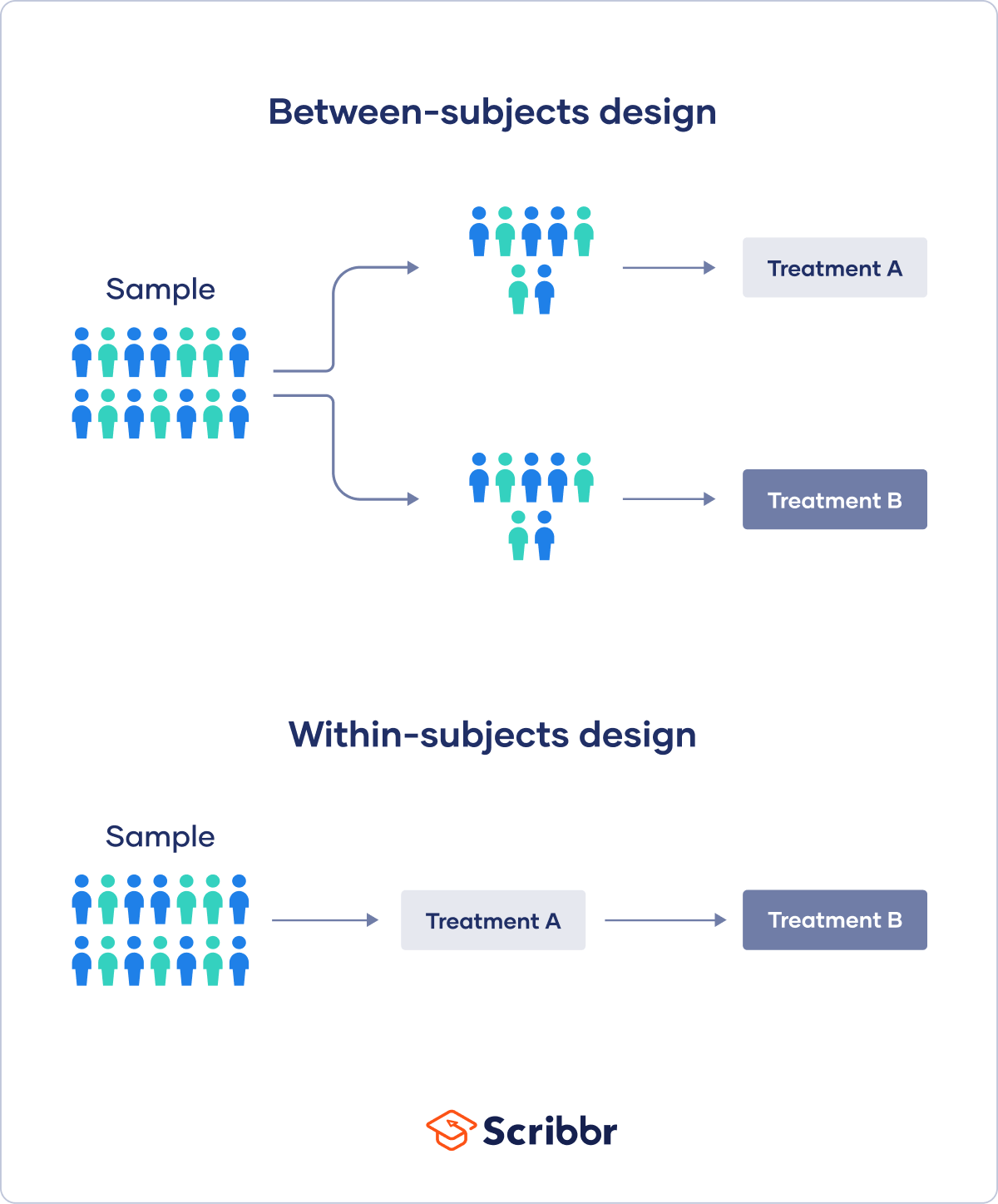
This structural difference carries significant trade-offs. The following video offers a clear conceptual overview of the advantages and disadvantages inherent in this choice.
Experimental Study Designs - Between & Within Subjects Design (and their Advantages & Disadvantages)
This video from BRAINPSYCHLOPEDIA provides a solid primer on the strategic considerations for choosing between experimental designs.
First, watch the section that defines a between-subjects design. This will formalize the concept in a general context. Next, focus on the advantages. Pay particular attention to the prevention of "learning or crossover effects," which is the primary motivation for choosing this design in your research. Finally, review the disadvantages. The points about requiring a larger participant pool and the challenge of "individual variability" are the most critical statistical hurdles you would face.
As the video highlights, the main strength of a between-triad design is the elimination of carryover effects. Triads assigned to a "Reassurance Protocol" are never exposed to the "Compersion Protocol," so there is no risk of one contaminating the other. The primary weakness is that the inherent, pre-existing differences between triads (their history, communication styles, personalities) are no longer controlled for by the design itself. This "individual variability" becomes a major source of error variance, making it harder to detect the true effect of your intervention.
A Between-Triad Experiment as a Cluster Randomized Trial
Your background in experimental design provides the vocabulary to classify this design with more precision. A between-triad experiment is a form of Cluster Randomized Trial (CRT), where the "cluster" is the triad. We randomize the cluster, not the individuals within it, primarily to avoid what is known as contamination.
The following video from the New England Journal of Medicine provides a concise and clear explanation of CRTs, their rationale, and their statistical implications.
How Cluster RCTs Work | NEJM Evidence
This video explains the core principles of Cluster Randomized Trials, which map perfectly onto our between-triad design.
Watch the introduction explaining how CRTs are used to prevent contamination. In our context, this would be one participant's experience with a management strategy influencing the others in a way that would be impossible to contain with individual-level randomization. The next segment discusses scenarios for CRTs, especially when interventions are logistical or system-wide. A jealousy management protocol applied to a triad fits this logic well. Pay close attention to the section on analytical complexity, which introduces the concept of the intracluster correlation coefficient (ICC). This is a critical statistical parameter for you. Finally, note the discussion on balancing baseline characteristics through stratification, a key technique for improving the robustness of your design.
The most important statistical consequence of clustering is that the observations within each cluster (i.e., the emotional responses of the husband, wife, and bull in a single triad) are not independent. The Intracluster Correlation Coefficient (ICC) quantifies this non-independence. It represents the proportion of total variance in an outcome (e.g., jealousy) that can be attributed to differences between triads.
A high ICC (e.g., 0.6) would mean that 60% of the variation in jealousy is due to which triad a person belongs to, implying that members within a triad are emotionally very similar to one another. This has a direct and negative impact on statistical power, as each additional member within a triad provides less new information than an individual from a new, independent triad. The effective sample size of your study becomes more a function of the number of triads than the total number of individuals.
Constructing a Between-Triad Experiment
Let's design a concrete experiment to compare two distinct guilt-management strategies for the wife.
- Hypothesis: A "Partner-Focused" strategy is more effective at reducing the wife's guilt than an "Experience-Focused" strategy.
- Intervention Arm 1 (Partner-Focused Strategy): A protocol guiding the post-encounter debrief to focus on the positive impact on the husband (e.g., his enjoyment, the strengthening of their bond).
- Intervention Arm 2 (Experience-Focused Strategy): A protocol guiding the debrief to focus on the wife's personal growth, self-discovery, and the quality of the experience itself.
- Control Arm (Optional but Recommended): A group of triads that continue with their existing, unstructured communication practices.
The Design:
- Recruitment: Recruit a sample of triads who consent to participate in the study. Let's say you recruit 60 triads.
- Baseline Measurement: Collect baseline data on all relevant covariates: relationship duration, lifestyle experience level, and pre-existing levels of jealousy and guilt using your validated scales.
- Randomization: Randomly assign each entire triad to one of the three arms (20 triads per arm).
- Stratification (Refinement): To improve balance, you can stratify the randomization. For example, you could first group the 60 triads into "new" (< 2 years experience) and "experienced" (> 2 years experience). Then, within each stratum, you would randomize triads to the three arms. This ensures that each arm has a similar mix of new and experienced triads, reducing the chance that "experience level" could confound your results.
- Intervention & Data Collection: Each triad implements its assigned strategy over a set number of encounters (e.g., the next 3-5 encounters). You would collect emotional data from all three participants using an Experience Sampling Method (ESM) before, during, and after each encounter.
- Analysis: Analyze the collected data to compare the average guilt levels (and other outcomes) across the three groups.
Analysis: Testing for Moderation with GAPIM
The experimental design dictates the analytical approach. A between-triad experiment is fundamentally a test of moderation. You are testing whether the type of management strategy (a between-triad variable) changes the strength or direction of the relationships within the triad.
In the language of the Actor-Partner Interdependence Model, the experimental condition acts as a between-group moderator. The following paper provides the formal language for this concept. While it discusses dyads, the logic extends directly to triads using the Group APIM (GAPIM) framework we encountered in the previous lesson.
A Primer Into Moderated Actor–Partner Interdependence ...
This paper by Chow et al. clearly explains how to incorporate moderators into APIM, which is precisely what's needed to analyze data from a between-triad experiment.
First, read the introduction and the definition of a between-dyads moderator. In our design, the "management strategy" (e.g., Partner-Focused vs. Experience-Focused) is a between-triad moderator. It is a characteristic that is constant for all members within a given triad but differs across triads. Next, read the section Importance of Between-Dyads Moderator. This reinforces the conceptual value of this approach: it allows you to test whether different types of triads (in our case, defined by the intervention they receive) experience different interpersonal processes.
Using a moderated GAPIM, you could test specific hypotheses such as:
- Does the effect of the wife's perception of the bull's attractiveness (an actor variable for her) on her own guilt (her outcome) differ between the "Partner-Focused" group and the "Experience-Focused" group?
- Does the effect of the wife's guilt (a partner variable for him) on the husband's jealousy (his outcome) differ across the experimental arms?
This approach models the experimental effect not as a simple difference in means, but as a change in the very causal fabric of the triadic emotional system. This is a far more sophisticated and informative way to analyze your results, and it aligns perfectly with your causal analysis expertise.
A Note on Power and Sample Size
As the resources suggest, the biggest practical challenge of a between-triad design is statistical power. Since the intervention is at the triad level, your power is primarily driven by the number of triads, not the total number of individuals.
[PDF] Using the Actor-Partner Interdependence Model to Study the Effects ...
This is the same GAPIM paper from our last lesson. We now revisit a different section that is highly relevant to the design we've just discussed.
Please read the section titled Number and Sizes of Groups. The authors explicitly state that because some effects vary at the group level, the effective sample size is the number of groups, and tests of these effects have less power.
This reading confirms the statistical reality: to detect a significant difference between your management strategies, you will likely need a substantially larger sample of triads than you would for a within-triad design, especially if the ICC for your outcomes is high. Designing an experiment without first estimating the required sample size is a serious methodological flaw.
Conclusion
Today, we have designed an experiment that stands as a robust alternative to the within-triad model. The between-triad, or cluster randomized, design is your method of choice when interventions are likely to have lasting or "contaminating" effects.
Key Takeaways:
- A between-triad experiment involves randomly assigning entire triads to different conditions (e.g., different management strategies).
- This design is a Cluster Randomized Trial (CRT), where each triad is a cluster. Its main advantage is preventing carryover and contamination effects.
- The primary disadvantages are the need for a larger sample of triads and the loss of statistical power due to intracluster correlation (ICC).
- Techniques like stratified randomization can be used to improve the balance of key characteristics across the experimental groups.
- The analysis for such a design involves testing for moderation using a multilevel framework like the Group Actor-Partner Interdependence Model (GAPIM), where the experimental condition is a between-group moderator.
In designing both within- and between-triad experiments, we have repeatedly touched upon the critical issue of statistical power and sample size. In our next lesson, we will tackle this head-on and learn how to conduct a power analysis to determine the required sample size for detecting the complex actor, partner, and relationship effects central to your research.