In our last session, we sharpened our focus from the vast landscape of relationship dynamics to a prioritized list of manipulable factors. By weighing expected effect size against feasibility, we identified two powerful "levers" for our research: Disclosure Level and Communication Protocol. Having chosen our tools, we are now ready to build the experimental machinery.
This lesson directly addresses the learning outcome: to design a within-triad factorial experiment to study the effects of lifestyle activities and communication strategies on jealousy and guilt. We will take our prioritized factors and construct a formal experimental plan where a single triad experiences every combination of our interventions. This approach, known as a within-subjects or repeated-measures design, is exceptionally powerful for your research context, as it uses the unique character of each triad as its own baseline, maximizing statistical power and efficiency.
The Logic of Factorial Design
At its core, a factorial design allows us to investigate the effects of two or more independent variables—or "factors"—simultaneously. More importantly, it allows us to examine the interaction between these factors: does the effect of one factor change depending on the level of another?
Your background in Design of Experiments makes you intimately familiar with this concept. In our case, the two factors we selected in the previous lesson are:
- Factor A: Disclosure Level
- Factor B: Communication Protocol
For a simple and powerful initial experiment, we can define two "levels" for each factor:
- Factor A (Disclosure):
- Level A1: Full Disclosure (The wife provides a comprehensive account of the encounter)
- Level A2: Partial Disclosure/DADT (e.g., "Don't Ask, Don't Tell," where only logistical information is shared, or no information is shared unless requested)
- Factor B (Communication):
- Level B1: Unstructured Communication (Post-encounter discussions are spontaneous)
- Level B2: Structured Debrief (A scheduled conversation following a specific protocol for emotional processing and information sharing)
Combining these factors in a 2x2 arrangement gives us four unique experimental conditions:
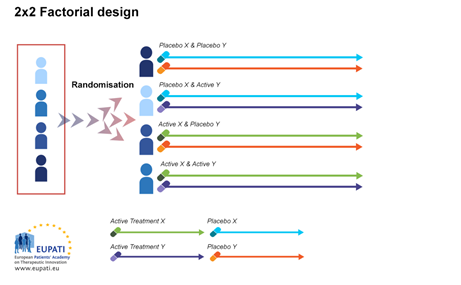
The four conditions for our experiment would be:
- Full Disclosure + Unstructured Communication
- Full Disclosure + Structured Debrief
- Partial Disclosure + Unstructured Communication
- Partial Disclosure + Structured Debrief
The critical question is how we assign participants to these conditions. This brings us to the distinction between between-subjects and within-subjects designs.
Within-Triad Design: The Power of Repetition
In a between-subjects design, different participants are assigned to each condition. In a within-subjects design, the same participants are exposed to all conditions. For our research, this means a single triad would experience all four of the conditions listed above. This is often called a repeated-measures design.
The following video provides a clear overview of the differences between between-subjects, within-subjects, and mixed factorial designs.
Factorial Designs: Between, Within and Mixed Designs - 4
This video from Dr. Kristin Atchison's channel clearly distinguishes between different types of factorial designs.
Pay close attention to the explanation of a within-subjects design, where the same participants experience every cell of the experiment. Then, watch the section on mixed designs, which combines between- and within-subjects factors. Our within-triad factorial experiment is a classic example of a repeated-measures (within-subjects) structure.
For your research, the within-triad approach offers a decisive advantage. The emotional dynamics and history of each triad are unique and complex. This pre-existing variation between triads can be a massive source of statistical "noise" in a between-triad study. By having each triad serve as its own control, you effectively partial out this variance, making it much easier to detect the true effect of your interventions (the disclosure and communication rules). This is a highly efficient design, a principle that aligns with your professional expertise.
Structuring the Experiment: A Practical Blueprint
A within-triad factorial experiment would unfold over time. For instance, you could assign one of the four conditions to each of the triad's next four encounters with a bull. The structure could look like this:
- Encounter 1: The triad operates under Condition 1 (Full Disclosure + Unstructured Communication). You collect emotional data (jealousy, guilt, etc.) from all three participants before, during, and after.
- Encounter 2: The triad switches to Condition 2 (Full Disclosure + Structured Debrief). You again collect emotional data.
- Encounter 3: The triad operates under Condition 3 (Partial Disclosure + Unstructured Communication).
- Encounter 4: The triad operates under Condition 4 (Partial Disclosure + Structured Debrief).
A critical element of this design is counterbalancing. The order in which the conditions are presented can influence the results (e.g., due to learning, fatigue, or habituation). Therefore, if you were running this experiment with multiple triads, you would vary the order of conditions. For example, Triad 1 might follow the 1-2-3-4 order, while Triad 2 follows 4-1-2-3, and so on. This ensures that any observed effects are not merely an artifact of the sequence.
From Design to Analysis: Repeated-Measures ANOVA
Your background in experimental design tells you that the structure of the experiment dictates the appropriate statistical analysis. A within-triad factorial design is a classic repeated-measures design. The following text provides a comprehensive overview of the statistical models used for these designs.
[PDF] CHAPTER FOURTEEN REPEATED-MEASURES DESIGNS
This chapter offers a technical but thorough look at the analysis of repeated-measures designs, which is precisely what we have constructed. Given your statistical background, the structural models and discussion of error terms will be quite familiar.
Begin by reading the introductory sections to understand how these designs reduce variability by partitioning out subject-specific differences. Next, study the section on designs with one between- and one within-subjects variable. In our case, the "triad" is the between-subjects unit, and our manipulated factors create the within-subjects conditions. Pay attention to how the summary table partitions variance into between-subjects and within-subjects components. Then, move to the section on designs with two within-subjects variables. This maps directly to our 2x2 design (Disclosure × Communication). Note the use of multiple error terms, which is a key feature of this analysis. Finally, briefly review the subsection on matched samples. This reinforces the idea that these methods apply to any data with correlated structures, not just the same person measured over time. The inherent interdependence of a triad makes this concept particularly relevant.
This reading clarifies how a Repeated-Measures ANOVA would be the traditional tool for analyzing the data from our design. It would allow you to test for:
- A main effect of Disclosure.
- A main effect of Communication.
- The crucial Disclosure × Communication interaction.
However, this traditional approach has a limitation: it treats the triad as a monolithic "subject" and doesn't fully model the interdependent processes within it.
A More Precise Lens: The Group Actor-Partner Interdependence Model (GAPIM)
To truly honor the triadic data structure, we can turn to a more advanced analytical model that you are well-equipped to handle: the Group Actor-Partner Interdependence Model (GAPIM). This model extends the APIM (which we discussed for dyads) to small groups—in our case, a group of three.
The GAPIM allows you to model how an individual's outcome (e.g., husband's jealousy) is a function of not only their own attributes but also the attributes and interactions of the other members of the group.
[PDF] Using the Actor-Partner Interdependence Model to Study the Effects ...
This paper by Kenny and Garcia provides the statistical framework for analyzing data from small groups like our triad. It directly connects our experimental design to a sophisticated analytical method that respects the interdependent nature of your data.
First, read the section on Individual Outcomes. In Equation (1), Yik would be an individual's emotional score (e.g., husband's jealousy). The X variables would represent the experimental conditions you manipulate (e.g., a dummy code for Disclosure Level or Communication Protocol). This model allows you to test for actor, others, and similarity effects of your interventions. Next, read the section on Dyad-Level Outcomes. This is essential for modeling the six relational perspectives. Here, Yijk could be an emotion reported within a dyad (e.g., wife's perception of the bull's excitement). Equation (4) provides a comprehensive model for dissecting how the experimental conditions (X variables) influence these dyadic perceptions.
By using the GAPIM framework, you can move beyond simply asking "Is there an interaction effect?" to asking more nuanced causal questions like:
- How does the wife being in a "Full Disclosure" condition (an actor effect for her) influence the husband's jealousy (a partner effect for him)?
- Does the effect of a "Structured Debrief" on the wife's guilt change if both the husband and bull share a similar personality trait (a similarity effect)?
- How does the emotional dynamic within the wife-bull dyad under a specific condition influence the husband's individual emotional state?
This approach seamlessly integrates your expertise in experimental design with advanced causal modeling, directly addressing the core challenges of your research goal.
Conclusion
In this lesson, we have translated our prioritized factors into a concrete and powerful experimental blueprint. We have designed a within-triad 2x2 factorial experiment that is both statistically efficient and highly relevant to the unique context of your research.
Key Takeaways:
- A within-triad factorial design exposes each triad to all combinations of your manipulated factors (e.g., Disclosure and Communication rules).
- This design is a form of repeated-measures experiment, which powerfully controls for the vast differences that exist between triads by using each triad as its own baseline.
- Practical implementation requires counterbalancing the order of conditions across different triads to avoid sequence effects.
- While Repeated-Measures ANOVA is the traditional analytical tool, modern methods like the Group Actor-Partner Interdependence Model (GAPIM) offer a more nuanced analysis that respects the interdependent, triadic structure of the data.
The within-triad design is powerful, but it's not always the right choice. Carryover effects between conditions can sometimes be too strong to manage. In our next lesson, we will explore the alternative: designing a between-triad experiment, where we compare different strategies by assigning entire triads to a single condition.