Welcome back. In our previous lesson, we established a comprehensive ethical framework for your research, balancing procedural rules, the relational autonomy of your participants, and the broader social equity concerns of studying a sensitive topic. We concluded that ethical integrity is not a constraint, but a prerequisite for valid and feasible research.
This lesson builds directly on that foundation, addressing the final learning outcome of this module: evaluating the trade-offs between experimental control and ecological validity when designing studies on intimate relationship behaviors. The choices you make here are profoundly influenced by the ethical principles we just discussed. Your goal is to design a study that is not only statistically powerful and ethically sound but also captures the authentic dynamics of the cuckold-hotwife lifestyle. This requires navigating the fundamental tension between the clean, controlled environment of a laboratory and the complex, "messy" reality of lived experience.
The Core Tension: Internal vs. External Validity
At the heart of experimental design lies a critical trade-off. On one hand, we want to be certain that our intervention caused the observed outcome. On the other, we want our findings to mean something in the real world. These two goals correspond to internal and external validity.
- Internal Validity is about control. It answers the question: "Did X cause Y in this specific study?" A study has high internal validity when you can confidently rule out alternative explanations (confounders) for your results.
- External Validity is about generalizability. It answers the question: "Can the results of this study be applied to other people, settings, and times?" A key component of this is ecological validity, which refers to how much the experimental setting resembles the real-world environment you want to understand.
The following table provides a succinct comparison of these two concepts.

To deepen this understanding, the following video offers a clear conceptual walkthrough.
What's the difference between INTERNAL and EXTERNAL VALIDITY?
This video from Psychology Unlocked, "What's the difference between INTERNAL and EXTERNAL VALIDITY?", provides concise definitions and examples that bring these abstract concepts to life.
Please watch these two key segments: First, the explanation of internal validity, which focuses on control over confounding variables. Next, the definition of external validity and its connection to ecological validity, which concerns the generalizability of the research environment.
For your research, this tension is paramount. A highly controlled lab experiment on jealousy might have excellent internal validity but tell you very little about how jealousy actually unfolds in the complex environment of a triadic relationship. Conversely, a purely observational study might be highly realistic but make it difficult to disentangle cause and effect with certainty.
A Spectrum of Research Designs
Instead of a simple either/or choice, think of research methods as lying on a spectrum from high control to high realism. Your task is to select the point on this spectrum that best fits your specific causal question.
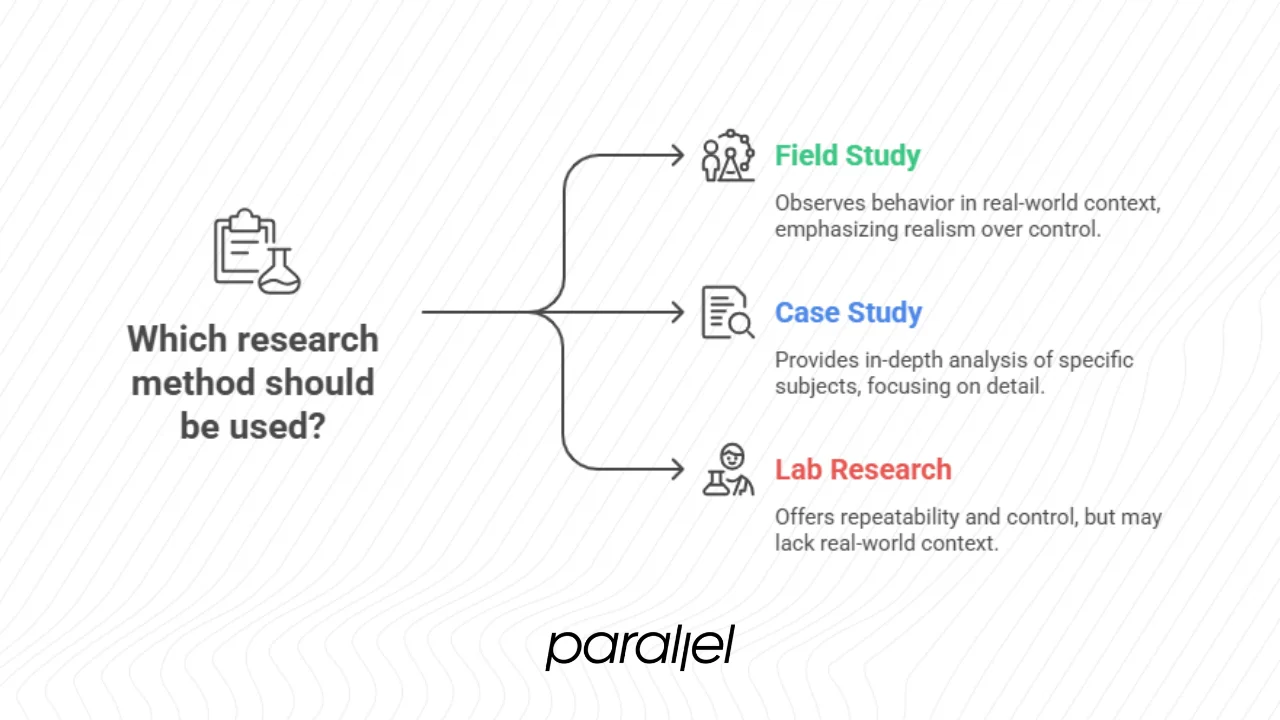
Let's apply this spectrum to your project:
- Lab Research (High Control, Low Realism): You could bring a triad into a university laboratory and have them perform a structured communication task after watching a video designed to elicit mild jealousy. This would allow you to control the stimulus precisely and eliminate distractions. However, the artificiality of the setting might suppress or alter the very emotional responses you want to study.
- Case Study (High Depth, Variable Control/Realism): You could conduct an in-depth, longitudinal study of a single triad, using interviews, diaries, and observation. This would provide unparalleled richness and context. While ecologically valid, generalizing from a single case is difficult, and causal claims remain tentative.
- Field Study (High Realism, Lower Control): You could conduct your experiment within the participants' natural environment, such as their home. For instance, in your within-triad factorial design, you could randomize the order of different "date night" protocols (e.g., varying communication before and after) and measure the emotional outcomes. This approach embraces the real-world context but also opens the door to confounding variables (a bad day at work, an argument about finances) that are outside your control.
Given your sophisticated background in experimental design and causal analysis, you'll recognize that the challenge is not to eliminate this trade-off, but to manage it intelligently.
Navigating the Trade-off: Beyond the "Gold Standard"
In many fields, the Randomized Controlled Trial (RCT) is held up as the "gold standard" for causal inference due to its high internal validity. However, for complex, real-world human behaviors—especially those involving intimate relationships—a rigid RCT can be impractical, unethical, and even misleading.
A paper by Sullivan et al. (2020) on evaluating interventions for survivors of intimate partner violence offers a powerful parallel to the challenges you face. They articulate why a conventional RCT was not the right choice for their work.
[PDF] Evaluation in the Real World
This paper from the American Journal of Community Psychology details the decision-making process behind designing a methodologically rigorous but ecologically valid study in a sensitive, real-world context. Its arguments are directly applicable to your own design challenges.
Please read the following sections: Start with the Introduction, focusing on the authors' argument for maximizing ecological validity. Next, read the section "Choosing the Most Appropriate Design for this Evaluation." Pay close attention to the specific reasons why an RCT was rejected. Note the overlap with the ethical concerns from our previous lesson (e.g., randomizing people into potentially harmful conditions). Finally, read the Conclusion, which argues that for real-world interventions, quasi-experimental designs can be more rigorous than RCTs because they embrace real-world complexity.
The authors' critique of RCTs—citing ethical problems, real-world unpredictability, and the high risk of randomization failure—is highly relevant to your work. You cannot, for example, ethically randomize one triad to a "high-conflict communication" condition and another to a "supportive communication" condition and watch what happens. The design must work with the participants in their own context.
Hybrid Solutions: Lab-in-the-Field and Advanced Measurement
So, how do we find the sweet spot? The solution lies in hybrid approaches that blend the strengths of different methods.
1. The Lab-in-the-Field Experiment
This approach combines the control of a lab experiment with the realistic context of a field experiment. You don't bring the participants to the lab; you bring the lab to the participants.
Lab-in-the-field experiments: perspectives from research on gender
This paper provides an excellent overview of lab-in-the-field experiments, which represent a powerful compromise between control and realism. It details their classification, application, and challenges.
To understand this methodology, please read these parts: First, read the section "What are field experiments?" to understand how they are classified. Focus on the discussion of how they differ from conventional lab experiments by using non-standard subjects and real-world context. Next, review the portion of the "Lab-in-the-field experiments" section that discusses how they are used as complements to RCTs and other field studies. This highlights their strength in uncovering causal mechanisms. Finally, quickly scan the section on "Challenges of lab-in-the-field experiments." The discussion of ethical concerns and recruitment connects directly to our previous lesson and your interest in data collection logistics.
For your research, a lab-in-the-field experiment could look like this: You visit the triad's home. You have them engage in a standardized, incentivized economic game designed to measure trust and cooperation (the "lab" component). Because this happens in their own environment with their actual partners (the "field" component), their behavior is likely to be far more ecologically valid than it would be in a university setting with strangers. This design gives you the causal leverage of an experiment while respecting the participants' natural context.
2. Ecological Momentary Assessment (EMA)
Another way to maximize ecological validity is through your measurement strategy. Rather than relying on retrospective surveys ("How jealous did you feel last week?"), you can capture emotions, thoughts, and behaviors as they happen. This is the goal of Ecological Momentary Assessment (EMA), also known as the Experience Sampling Method (ESM), which you've planned to use.
EMA is a powerful tool for bridging the gap between controlled experimentation and real-world validity. You can pair it with a field experiment: the wife and bull go on a date (a real-world event), and you use EMA to collect high-frequency data on jealousy, guilt, and communication from all three participants in the hours and days that follow.
The following presentation gives a detailed guide to designing an EMA study.
Ecological Momentary Assessment to Measure Emotion, Cognition, and Behavior in Daily Life | DIGIT-MI
This lecture from the Eisenberg Family Depression Center provides a comprehensive introduction to EMA, covering its rationale, design principles, and practical considerations.
Please watch the following segments carefully, as they are crucial for designing your data collection protocol: The Rationale for EMA: This introduction powerfully argues why studying behavior in the real world is essential. Key Features of EMA: Understand the core tenets of this method—real-world collection, focus on the present moment, and repeated assessments. The "Three D's" of Design: Pay close attention to the discussion of Density, Depth, and Duration. This is the central trade-off in EMA design: balancing data richness against participant burden. The various sampling schedules discussed (event-contingent, semi-random) are directly relevant to the randomization schemes you need to develop. Design Considerations: The speaker explains how your research question and population must drive your sampling strategy. This is key to making informed compromises.
For your triadic study, designing the EMA protocol will involve balancing these factors:
- Density: How many prompts per day? Enough to capture emotional fluctuations without causing burnout. Perhaps more frequent in the 24 hours after a significant event.
- Depth: How many questions per prompt? Keep it brief. A few core items on jealousy, guilt, and mood.
- Duration: For how many weeks? Long enough to capture multiple "events" (e.g., dates) for your within-triad experiment.
- Coordination: A unique challenge for you will be coordinating prompts across three people's schedules. A semi-random schedule within defined time blocks is likely the most practical approach.
By combining a field experiment with EMA, you create a design with strong ecological validity (real events, real environment, real-time emotions) and robust data for the sophisticated causal models (like the CLPM from Module 6) you plan to use.
Conclusion
This lesson marks the end of our module on experimental design. You are now equipped not only to design statistically powerful and ethically sound experiments but also to critically evaluate the unavoidable trade-offs between control and realism.
Key Takeaways:
- Designing research for intimate behaviors is a balancing act between internal validity (control needed for causality) and ecological validity (realism needed for relevance).
- The "gold standard" RCT is often ill-suited for sensitive, real-world topics. Quasi-experimental and field-based designs are often more rigorous because they embrace, rather than ignore, real-world complexity.
- Hybrid methods like lab-in-the-field experiments offer a compelling middle ground, bringing controlled tasks into naturalistic settings.
- Advanced measurement techniques like Ecological Momentary Assessment (EMA) are not just data collection tools; they are a core part of a strategy to maximize ecological validity, allowing you to capture rich, time-stamped data in the flow of daily life.
In our next module, we will confront a challenge that is inherent to the triadic data you'll be collecting. We will explore Causal Inference Under Interference, tackling the violation of the "Stable Unit Treatment Value Assumption" (SUTVA) that occurs when one person's experience directly impacts the outcomes of others in their group. This is the next critical step in moving from design to analysis.