Hello. In our last lesson, we concluded our module on experimental design by examining the crucial trade-off between experimental control and ecological validity. We established that for research into intimate relationships, field-based experiments and advanced measurement strategies like EMA are often superior to traditional lab-based RCTs. That discussion set the stage for a fundamental analytical challenge you will face.
This lesson begins a new module, "Causal Inference Under Interference." Our focus today is on the first step in tackling this challenge: to define causal estimands in the presence of interference using the potential outcomes framework in your triadic context. For the sophisticated experiments you've designed, standard causal estimands like the Average Treatment Effect (ATE) are insufficient. Because the husband, wife, and bull are interconnected, an action taken by one person inevitably influences the others. Our goal is to develop a formal language to precisely define and separate the effect of an action on the person taking it (a direct effect) from its effect on the other members of the triad (an indirect, or spillover, effect).
The Breakdown of a Core Assumption: SUTVA
Your background in causal analysis means you are well-acquainted with the potential outcomes framework. To briefly refresh these core ideas, the following video provides a concise overview of potential outcomes and the key assumptions that enable causal inference from observational data.
This segment from an MIT OpenCourseWare lecture on causal inference reviews the foundational concepts we will build upon.
Please watch two parts of this video: First, the introduction to potential outcomes, which defines the quantities Y_i(1) and Y_i(0) and the fundamental problem of causal inference. Next, review the discussion of the two critical assumptions, ignorability and common support. Pay attention to the graphical explanation of unobserved confounding. The lecturer also mentions a third assumption, SUTVA, which will be the focus of our lesson.
The video mentions the Stable Unit Treatment Value Assumption (SUTVA), which is typically presented as two sub-assumptions:
- Consistency: The potential outcome under a specific treatment value, , is the same as the outcome observed if that treatment is actually received. This implies there are no "multiple versions" of the treatment.
- No Interference: An individual's potential outcome responds only to their own treatment assignment, not the treatment assignments of others.
The "no interference" assumption is immediately and profoundly violated in your triadic research context. A short, clear explanation of this assumption will make the violation obvious.
2.8 - No Interference and Consistency
This video from Brady Neal's Causal Inference course offers a simple, graphical definition of the "no interference" assumption.
Please watch the segment from the beginning until the end of the explanation. The example of a friend's dog affecting one's own happiness is a perfect analogy for relational interference.
In the language of potential outcomes, the "no interference" assumption states that for any individual , their potential outcome is only a function of their own treatment, . So, we can write .
However, in the husband-wife-bull triad, this is clearly false. Consider an intervention where the wife and bull engage in a specific "intimacy-building" activity (treatment ). The husband's emotional outcome, let's say his level of jealousy (), is almost certainly a function of that activity, even if his own "treatment" status is unchanged (). Therefore, the husband's potential outcome is not just , but must depend on the full vector of treatments within the triad: .
This is interference. It's not a statistical nuisance to be "controlled for"; in your research, it is the central dynamic of interest. The goal is to measure these spillover effects, not assume them away.
Extending Potential Outcomes to Handle Interference
To formally define effects in the presence of interference, we must adapt the potential outcomes notation. For any individual in a group (in your case, a triad), their potential outcome must be written as a function of the entire treatment vector for their group, .
For your triad of Husband (H), Wife (W), and Bull (B), the treatment vector is . The potential outcome for the husband is thus written as . With binary treatments, each participant now has potential outcomes, corresponding to every possible combination of treatments in the triad. As you can appreciate from your operations research background, this combinatorial complexity makes this approach unwieldy for large groups but is perfectly manageable for a triad.
This framework allows us to ask precise causal questions. For example:
- What is the husband's jealousy level when no one is treated, ?
- What is his jealousy level when only the wife is treated, ?
- The difference between these two quantities is a causal effect—an indirect or spillover effect of the wife's treatment on the husband.
The following image provides a useful visualization of how a "treatment" applied to some nodes in a network can propagate and affect other nodes.
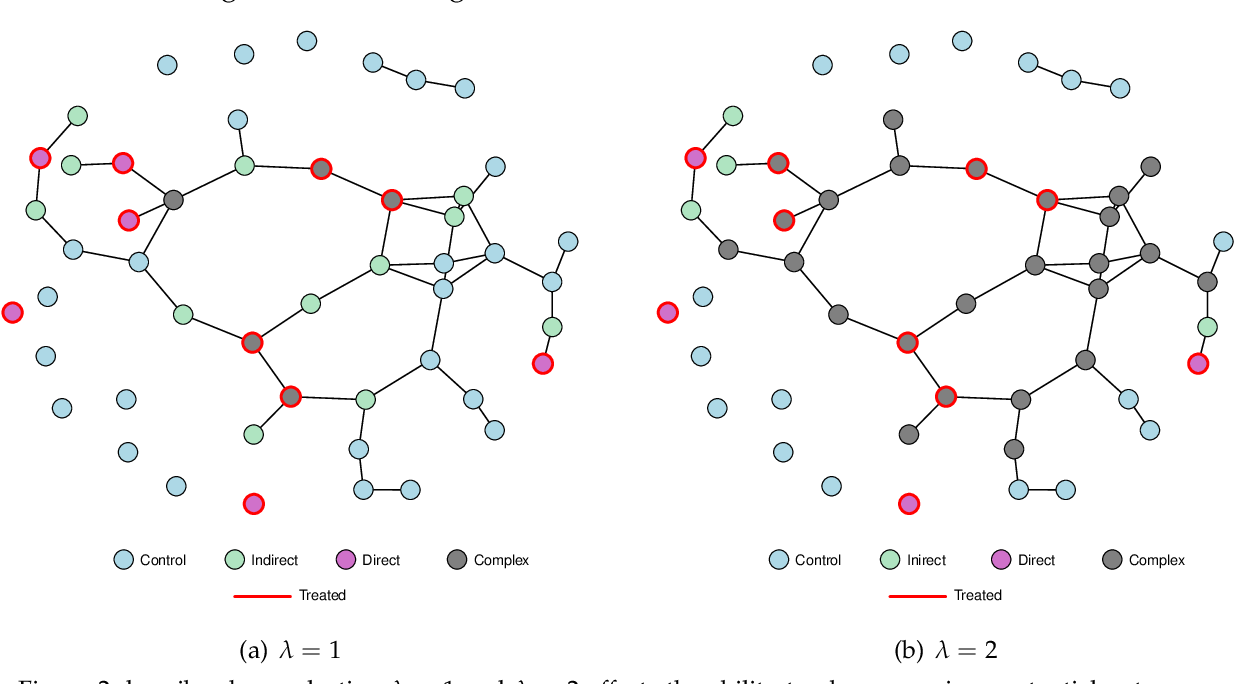
In your context, the wife and bull might be the "treated" nodes, and the husband would be an "indirectly" affected node. Our task is to formally define the estimands that capture these distinct effects.
Defining Direct, Indirect, and Total Causal Effects
The seminal paper by Hudgens and Halloran (2008) provides a clear set of definitions for causal estimands under interference. It introduces the key idea of a treatment strategy (denoted or ), which is a rule for assigning treatments to individuals within a group. For example, could be a strategy where the wife is assigned treatment with probability , and could be a benchmark strategy of no treatment for anyone. We then define causal effects by comparing outcomes under these different strategies.
The paper is mathematically dense, but it lays out the exact vocabulary you need.
Toward Causal Inference With Interference - PMC - NIH
This paper by Michael Hudgens and M. Elizabeth Halloran establishes a foundational framework for defining causal effects when SUTVA is violated. It is the primary reference for the estimands we will discuss.
Please read the following sections to understand how these estimands are constructed: First, read the background section (Section 2), starting from the first full paragraph. It provides context on the problem of interference and the challenge of defining potential outcomes when they depend on the entire group's treatment vector. Next, study Section 3, "CAUSAL ESTIMANDS," in detail. This is the most important part of the reading. Start with Section 3.1, "Average Potential Outcomes". Focus on how potential outcomes are averaged over the treatment assignments of others in the group under a given strategy \psi. The notation \bar{Y}_{ij}(z; \psi) represents the average potential outcome for individual j receiving treatment z, under the treatment strategy \psi. Now, read the definitions for the four key estimands. As you read each one, try to formulate a specific question for your triadic study that it would answer: Section 3.2, Direct Causal Effects: This is the effect of an individual's own treatment. The estimand is CE_{\text{D}}(\psi) \equiv \bar{Y}(0; \psi) - \bar{Y}(1; \psi). (Note the paper uses 0-1; often 1-0 is used). Your research question: "Under a specific relational strategy, what is the direct effect on the wife's guilt of her using a disclosure protocol versus not using it?" Section 3.3, Indirect Causal Effects: This is the effect of others' treatment on an individual whose own treatment is held constant. The estimand is CE_{\text{I}}(\phi, \psi) \equiv \bar{Y}(0; \phi) - \bar{Y}(0; \psi). Your research question: "Holding the husband's own actions constant, what is the indirect effect on his jealousy when the wife-bull dyad moves from a 'no-protocol' strategy (\psi) to an 'active-protocol' strategy (\phi)?" Section 3.4, Total Causal Effects: This measures the effect of an individual getting treated under one strategy versus not being treated under another. It is the sum of direct and indirect effects. The estimand is CE_{\text{T}}(\phi, \psi) \equiv \bar{Y}(0; \phi) - \bar{Y}(1; \psi). Your research question: "What is the total effect on the wife's guilt from using the protocol under strategy \phi compared to not using it under the baseline strategy \psi?" Section 3.5, Overall Causal Effect: This compares the average outcome in a group under one strategy versus another, without conditioning on individual treatment status. Your research question: "What is the overall effect on the average jealousy level within the triad when moving from strategy \psi to strategy \phi?" Finally, read Section 3.6, "No Interference". This section demonstrates how, if you assume no interference, the indirect effects go to zero and the total effect simply becomes the direct effect—the standard Average Causal Effect (ACE). This confirms that these new definitions are a generalization of the standard framework.
The Imai et al. (2021) paper you have also provides an excellent, more recent application of these ideas, referring to indirect effects as "spillover effects." The definitions in Section 3.2 of that paper, which you can review in your own time, directly correspond to the direct and indirect (spillover) effects defined by Hudgens and Halloran. The "Experimental design" image below also shows how different experimental conditions in a triad can be thought of as different treatment strategies ( or ) that you might wish to compare.

Conclusion
In this lesson, we have moved beyond the standard causal inference framework to one that accommodates the reality of your research context. Interference is not just a problem to be solved; it is the phenomenon you aim to understand.
Key Takeaways:
- The "no interference" component of the Stable Unit Treatment Value Assumption (SUTVA) is fundamentally violated in triadic or network settings.
- To account for this, potential outcomes must be defined as functions of the entire vector of treatments within the group (e.g., ).
- In the presence of interference, we can define a richer set of causal estimands:
- Direct Effect: The effect of one's own treatment.
- Indirect (Spillover) Effect: The effect of others' treatments.
- Total Effect: The combined direct and indirect effects.
- Overall Effect: The effect of changing the group's overall treatment strategy.
You have now established the formal, mathematical "what"—the quantities you seek to measure. In our next lesson, we will delve into the "how." We will describe the specific mechanisms and pathways through which one person's treatment can affect another's outcome in the cuckold-hotwife triad, setting the stage for building statistical models to estimate these effects from your data.