In our last lesson, we undertook the significant task of integrating individual and dyadic causal graphs into a single, comprehensive DAG for the entire triad. This integrated map makes your theoretical assumptions about the emotional dynamics explicit. Now, it is time to put this map to work as an analytical tool.
This lesson will equip you with the skills to read and interpret the pathways within your integrated DAG. We will focus on identifying and classifying three critical types of variables—confounders, mediators, and colliders. Understanding these structures is the cornerstone of causal inference from observational data, as it dictates which variables you must measure and include in a statistical model to isolate a specific causal effect. Your expertise in causal analysis will be invaluable as we move from the visual representation of the DAG to a formal strategy for statistical adjustment.
The Three Building Blocks of Causal Paths
Every path in a DAG, no matter how complex, is constructed from three basic three-variable structures. Correctly identifying these structures is the first step toward understanding the flow of association and causation in your model.

Let's briefly define these in the context of estimating the causal effect of a variable X on an outcome Y.
-
A) Confounder (Fork): A variable
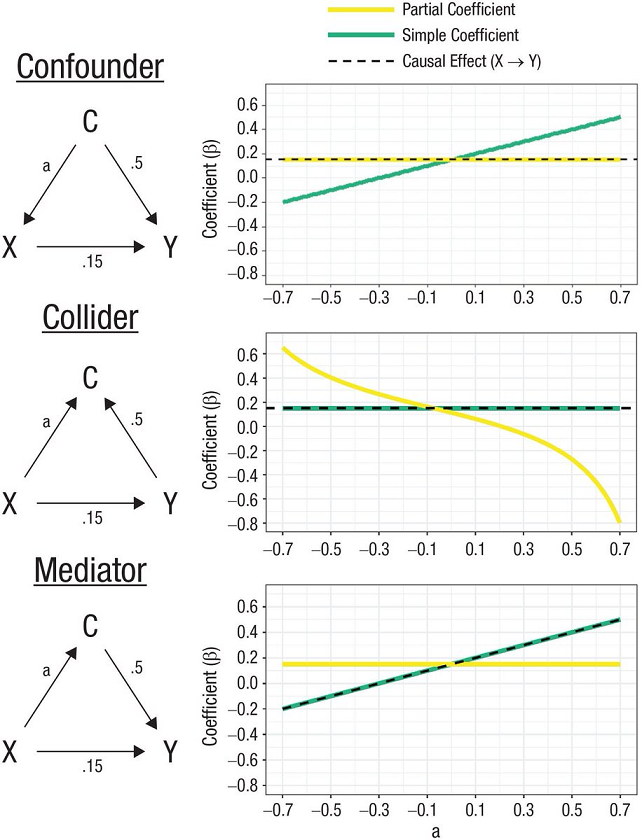
Cis a confounder if it is a common cause of bothXandY(X <- C -> Y). It creates a non-causal "backdoor" path betweenXandY, leading to a spurious association. As the image suggests, the standard strategy is to always include (i.e., condition on) a confounder in your model to block this spurious path. -
B) Collider: A variable
Cis a collider if it is a common effect ofXandY(X -> C <- Y). A collider naturally blocks the path betweenXandY. However, conditioning on a collider opens this path, creating a spurious association where none existed. Therefore, the rule is to always exclude a collider from your adjustment set. -
C) Mediator (Pipe): A variable
Cis a mediator if it lies on a causal path fromXtoY(X -> C -> Y). It does not create a spurious association, but rather represents a mechanism through whichXaffectsY. The decision to condition on a mediator depends on your research question: to estimate the total effect ofXonY, you exclude the mediator; to estimate the direct effect (not throughC), you include it.
To formalize these ideas, we need to understand the concepts of "blocked paths" and "d-separation."
3.8 - Blocked Paths and d-separation
The video "Blocked Paths and d-separation" by Brady Neal provides a concise, formal definition of these crucial concepts. It explains precisely when a path is blocked or unblocked by a set of conditioned variables.
Please watch the segment from the beginning to the end of the Global Markov Assumption section. Focus on the two conditions for a path to be blocked and how d-separation (all paths being blocked) implies conditional independence.
Closing Backdoor Paths
The practical goal of this analysis is to isolate the true causal effect of an exposure on an outcome. This means ensuring that the association we measure flows only through "frontdoor" paths—causal chains leading from the exposure to the outcome. Any association flowing through "backdoor" paths—non-causal paths containing forks—must be blocked.
The video "Causality: Closing Back Doors" offers an excellent intuitive explanation of frontdoor versus backdoor paths and the strategy of closing backdoors.
Watch the portion of the video from the explanation of frontdoor and backdoor paths to the summary of the path list. This will clarify the core strategy for identifying an adjustment set.
The central task is to choose a set of covariates to "condition on" (e.g., include in a regression model) that closes all backdoor paths without inadvertently opening a path via a collider or blocking a frontdoor path of interest.
Identifying Structures in the Triadic DAG
Let's now apply these principles to the integrated DAG we developed for your triadic research. We will examine the causal effect of a Wife-Bull Activity (our exposure, X) on the Husband's State Jealousy (our outcome, Y).
1. Confounders in the Triad
A confounder creates a fork (X <- C -> Y). It is a pre-existing variable that influences both the activity and the emotional outcome.
- Example: In our triadic DAG,
Triad's Relationship Rulesis a quintessential confounder. These pre-agreed rules (C) influence the nature of theWife-Bull Activity(X) and also shape theHusband's Cognitive Appraisalof that activity, which in turn affects hisState Jealousy(Y). - Path:
Wife-Bull Activity←Triad's Rules→Husband's Appraisal→Husband's Jealousy. - Analysis: This is an open backdoor path that creates a spurious association between the activity and jealousy. To get an unbiased estimate of the activity's effect, you must condition on
Triad's Relationship Rules. As seen in the "Confounder" panel of the image above, the simple coefficient (green line, not controlling for C) is biased, while the partial coefficient (yellow line, controlling for C) correctly estimates the true causal effect (dashed line).
2. Mediators in the Triad
A mediator forms a chain (X -> M -> Y), representing a mechanism through which the cause produces its effect.
- Example: One of the most interesting pathways in your model is mediated. The
Wife-Bull Activity(X) might cause theWife to experience State Guilt(M1), which then influences theH-W Post-Event Debrief(M2), which in turn affects theHusband's State Jealousy(Y). - Path:
Wife-Bull Activity→Wife's Guilt→H-W Debrief→Husband's Jealousy. - Analysis: This is a frontdoor path. If you want to estimate the total causal effect of the activity on the husband's jealousy, you should not condition on
Wife's Guiltor theH-W Debrief. Conditioning on a mediator, as shown in the "Mediator" panel of the image, would give you only the direct effect, blocking the indirect effect that flows through that mediator. This is a choice dictated by your research question.
The concept of mediation and its risks if handled improperly (pipe confounding) is critical.
Causal inference, confounding, and directed acylical graphs (DAGS)
This article provides a clear, practical discussion of these structures. The sections on mediation and pipe confounding are particularly relevant here.
Please read the sections Mediation and causation and Pipe confounding. Pay attention to why conditioning on a mediator blocks the path and why this is generally avoided when estimating the total causal effect.
3. Colliders in the Triad
A collider is a common effect (X -> C <- Y). Conditioning on it is a frequent and serious error in applied research.
- Example: Let's postulate a plausible collider. Suppose the
Wife's Sexual Motivation(X) and theBull's Trait Empathy(Y) are initially independent causes. Both likely contribute to theSuccess of the Encounter(C), a complex variable that could be measured by post-event ratings from both parties. - Path:
Wife's Motivation→Success of Encounter←Bull's Empathy. - Analysis:
Success of Encounteris a collider. If you were to conduct an analysis restricted to only "very successful" encounters, you would be conditioning on this collider. In that subgroup, you would likely find a spurious negative correlation between the wife's motivation and the bull's empathy. Why? Because if an encounter was successful despite low motivation from the wife, it implies the bull's empathy must have been exceptionally high to compensate, and vice-versa. Conditioning on the collider opens a non-causal path between two previously independent variables. This is a form of selection bias.
This error is subtle but critical to avoid.
Causal inference, confounding, and directed acylical graphs (DAGS)
This resource offers one of the clearest explanations of collider bias available.
Please read the entire section on Collider Confounding. The example of grant proposals is a classic illustration of Berkson's paradox. Focus on understanding why selecting on a common outcome induces a spurious correlation between its causes.
A Workflow for Causal Identification
We can now summarize these rules into a systematic workflow for identifying a valid adjustment set for estimating the causal effect of an exposure X on an outcome Y:
- List all paths between
XandYin your integrated DAG, ignoring the direction of arrows for a moment. - Classify each path as either a "frontdoor" path (all arrows flow away from
XtowardsY) or a "backdoor" path (it contains an arrow pointing intoX). - Identify open backdoor paths. A path is open unless it contains a collider. Any open backdoor path will create confounding.
- Select an adjustment set. Choose a set of variables to condition on that will:
- Block all open backdoor paths (typically by conditioning on a confounder in that path).
- Not block any frontdoor paths (unless you specifically want to estimate a direct effect by conditioning on a mediator).
- Not open any new paths by conditioning on a collider or its descendant.
This workflow, derived directly from the logic of your DAG, is the bridge between your causal theory and your statistical model.
Conclusion
In this lesson, we have dissected the complex structure of your integrated triadic DAG to identify its fundamental components: confounders, mediators, and colliders. You have learned how to use the graphical rules of d-separation to determine which paths are open or closed and how to distinguish between causal frontdoor paths and non-causal backdoor paths.
Key Takeaways:
- Confounders (Forks) create spurious associations via open backdoor paths; you must condition on them to close these paths.
- Mediators (Chains) represent causal mechanisms; conditioning on them blocks the flow of causation and should only be done if you specifically want to isolate a direct effect.
- Colliders are common effects that naturally block paths; conditioning on them is a major error that opens spurious pathways and introduces bias.
- The goal of causal inference with a DAG is to select a statistical "adjustment set" that blocks all backdoor paths without inadvertently blocking frontdoor paths or opening paths via colliders.
You are now equipped with the principles to design a statistically valid analysis based on your causal theory. In our next lesson, we will begin to put this into practice by specifying our first statistical model for the triad: the Actor-Partner Interdependence Model (APIM). We will start with the husband-wife dyad and use the principles from today to decide how to model the effects of each person's traits on their own and their partner's emotional outcomes.