In our last lesson, we began the important work of translating your research questions into a formal causal language by constructing our first Directed Acyclic Graph (DAG). We focused on a single perspective, modeling the intricate psychological pathway leading to the husband's experience of jealousy. This exercise established a systematic process for building DAGs: starting with a focal relationship, adding mediators, and recursively including common causes.
Today, we will expand our view from the individual to the dyad. This is a crucial step toward capturing the full complexity of the triadic system. Our objective is to construct a DAG for the wife-bull dyad, modeling the causal paths that connect their shared activities, their communication, and their distinct emotional outcomes. This will require us to think not only about each person's internal process but also about how they mutually influence one another—the very essence of a dyadic relationship.
From Individual to Dyadic Causal Structures
A dyadic DAG differs from an individual one in a fundamental way: it must explicitly represent two parallel causal streams (one for each person) and the causal arrows that cross between them. These "cross-partner" or "partner" effects are what define the interdependence of the dyad.
A clear illustration of this is a dyadic model exploring how intimacy and coping strategies influence mental health.
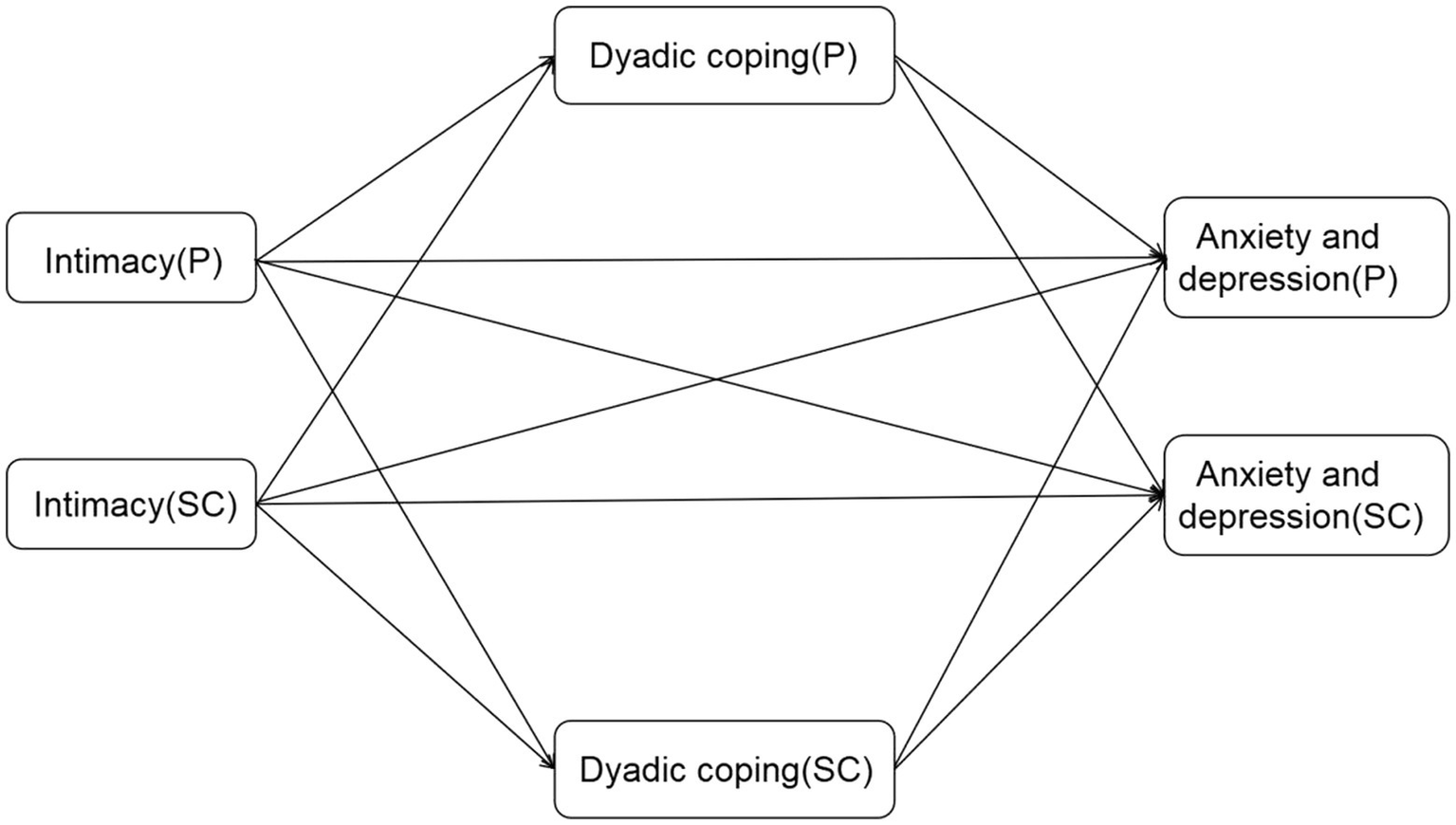
This structure, where one person's attributes or behaviors are causally linked to their partner's outcomes, is the foundational template we will use to model the wife-bull dyad. Our task is to populate this template with theoretically meaningful variables relevant to your research.
A Theoretical Framework for the Dyad: Self-Determination Theory
To build a meaningful DAG, we need a theoretical scaffold to guide our choice of variables and the direction of our causal arrows. For understanding the motivations and emotional consequences of a sexual encounter, Self-Determination Theory (SDT) provides a robust and well-validated framework. It is particularly well-suited for our purposes as it has been applied specifically to consensually non-monogamous (CNM) relationships.
[PDF] Reasons for sex and relational outcomes in consensually ...
This paper by Wood et al. (2018) uses SDT to investigate how sexual motivations affect satisfaction in CNM and monogamous relationships. It provides the core building blocks for the internal causal pathway of each person in our dyad.
Please read the following sections: Start with the section on SDT and need satisfaction. Focus on the definitions of the three core psychological needs (competence, autonomy, relatedness) and the different types of sexual motivation (e.g., intrinsic, introjected). Next, read the section on SDT and CNM relationships. This directly connects the theory to our context. Review the study's hypotheses. These explicitly state the proposed causal pathways: Motivation -> Need Satisfaction -> Relational Outcomes. Finally, look at Figures 3 and 4 in the results, which are under the subheading Mediational analyses. These diagrams represent the core mediation model that we will use as the backbone for each person in our DAG.
The key takeaway from this paper is the causal chain it proposes: an individual's Motivation for a sexual activity influences the degree to which that activity provides Sexual Need Fulfillment (autonomy, competence, relatedness), which in turn drives their ultimate Relational and Sexual Satisfaction. This mediation pathway will form the central "actor" effect for both the wife and the bull in our DAG.
Formalizing the Diagram: Path Analysis and Latent Variables
The mediation models you just examined in the Wood et al. paper are a form of path analysis. A DAG is a conceptual blueprint, while a path model is its statistical implementation. Since we are dealing with complex, unobservable psychological concepts like 'motivation' or 'need fulfillment', it's useful to formalize our DAG notation to distinguish between these latent constructs and their measurable indicators. Structural Equation Modeling (SEM) provides the language for this.
Let's watch a short introduction to the core components of SEM. Given your background, the concepts will be familiar, but the video provides a standardized visual language that is invaluable for building complex causal models.
Structural Equation Modeling: what is it and what can we use it for? (part 1 of 6)
This video from the National Centre for Research Methods offers a clear introduction to latent variables and path analysis, which are the two key components of SEM.
Please watch two segments: First, the section explaining what latent variables are. Pay close attention to the distinction between a latent construct (unobservable) and its indicators (observable), and the introduction of standard notation: an ellipse/circle for a latent variable. Next, watch the explanation of what path analysis is. This section formalizes the diagrammatic notation we have been using, particularly the use of rectangles for observed variables and arrows for causal paths (regression coefficients).
From now on, we will adopt this standard notation:
- Ellipse/Circle: A latent (unobserved) variable, such as
Sexual Motivation. - Rectangle: An observed (measured) variable, such as a specific answer on a questionnaire.
- Single-headed arrow: A direct causal effect.
- Curved double-headed arrow: A non-causal correlation (often between exogenous variables).
Constructing the Wife-Bull Dyadic DAG
We can now assemble our DAG for the wife-bull dyad using this formal notation and the systematic process from our previous lesson.
Step 1: Define the Actor Pathways
We begin by mapping the internal causal chain for both the wife and the bull, based on the SDT framework.
- For the Wife: We have a causal chain of latent variables:
Wife's Sexual Motivation→Wife's Sexual Need Fulfillment→Wife's Emotional Outcome(e.g., Guilt, Satisfaction). - For the Bull: We have a parallel chain:
Bull's Sexual Motivation→Bull's Sexual Need Fulfillment→Bull's Emotional Outcome(e.g., Satisfaction, Connection).
These are the "actor" effects—how each person's own cognitions influence their own outcomes.
Step 2: Add Shared Context and Dyadic Variables
The wife and bull are not in a vacuum; they share an experience.
- Wife-Bull Activity (WBA): This is the central event. We model it as an exogenous variable (a starting point) that causally influences both partners' experiences. For instance, the nature of the
Activity(e.g., its duration, setting) will affect bothWife's Need FulfillmentandBull's Need Fulfillment. - Communication During Activity: This is an inherently dyadic process. It is influenced by both partners' motivations and, in turn, is a primary driver of need fulfillment for both. The image you saw at the beginning of this course, reproduced below, provides a good template for this part of the structure.

Step 3: Add Partner Effects and Interdependence
This is where the model becomes truly dyadic. We need to add arrows that cross from one person's causal stream to the other's. The concept of "emotional resonance" from dyadic coping literature provides an excellent guide.
Associations Between Vocal Arousal and Dyadic Coping ...
This paper by Kuhn et al. (2023) uses DAGs to model dyadic interdependence explicitly. It provides a concrete example of how one partner's state can causally influence the other's behavior and, ultimately, their own satisfaction.
Please read these sections: The proposed hypotheses, which outline the "Paraverbal Stress Communication" and "Emotional Resonance" pathways. The description of the DAG in Figure 1. This is a perfect illustration of a causal chain that crosses between partners: Person A's state -> Person B's behavior -> Person A's satisfaction. Finally, read the discussion of the Paraverbal Stress Communication Hypothesis and the Emotional Resonance Hypothesis to see how these cross-partner effects are interpreted.
Applying this logic to our wife-bull dyad, we can hypothesize several partner effects:
Wife's Need Fulfillment→Bull's Emotional Outcome: The bull's satisfaction may be directly influenced by his perception that the wife's needs are being met.Bull's Motivation→Wife's Need Fulfillment: If the bull's motivation is highly relational (e.g., focused on her pleasure), this will directly impact her sense of relatedness and competence.Communicationacts as a mediator for many of these effects. For example, the bull's empathic communication (behavior) can directly increase the wife's need fulfillment (outcome).
Step 4: Add Confounders
Finally, we add pre-existing variables that are common causes of other variables in the graph.
- Latent Dispositions (Confounders):
Wife's Trait Guilt: Influences her motivation to engage in the activity and her final emotional outcome.Bull's Trait Empathy: Influences his motivation and his communication style.Both partners' Attachment Styles: Affects communication patterns and how they interpret the activity.
- Relationship Context (Confounder):
Wife-Bull Relationship Quality: The pre-existing level of trust and rapport between them influences their motivations, communication, and interpretation of the entire event.
The Resulting Dyadic DAG
Assembling these components gives us a comprehensive DAG for the wife-bull dyad.
The graph would contain two main parallel pathways, one for the wife and one for the bull, each following the Motivation -> Need Fulfillment -> Outcome structure. These pathways would originate from pre-existing confounders (Trait Guilt, Relationship Quality, etc.). The central Wife-Bull Activity and Communication nodes would link the two pathways, with causal arrows pointing from them to variables in both streams. Finally, crucial "partner effect" arrows would cross between the streams, representing the core interdependence, such as an arrow from Bull's Motivation to Wife's Need Fulfillment. All psychological constructs would be represented by ellipses (latent variables).
This DAG now serves as an explicit, testable model of the hypothesized causal dynamics within the wife-bull dyad.
Conclusion
In this lesson, we have successfully expanded our causal modeling from an individual to a dyadic perspective. By leveraging Self-Determination Theory and principles of dyadic coping, we constructed a sophisticated DAG for the wife-bull dyad. This process required us to map not just individual psychological processes but also the interdependent links—the actor and partner effects—that define the relationship.
Key Takeaways:
- A dyadic DAG models two parallel causal streams (one for each partner) linked by shared variables and cross-partner causal effects.
- Self-Determination Theory provides a powerful framework (
Motivation → Need Fulfillment → Satisfaction) for modeling the internal experience of each participant in a sexual encounter. - We adopted the standard notation of path analysis, using ellipses for latent constructs and rectangles for observed measures, bridging our conceptual DAG to its statistical implementation in SEM.
- The final dyadic DAG incorporates actor effects, partner effects, shared dyadic variables (like communication), and pre-existing confounders.
The DAG we built today and the one we built for the husband in the previous lesson are crucial components of the larger triadic system. In our next lesson, we will undertake the final task of this module: integrating these individual and dyadic DAGs into a single, comprehensive causal graph that represents the interdependencies across all six perspectives of the triad.