Welcome to the first lesson of our module on modeling dyadic dynamics. In our previous work, we constructed an integrated Directed Acyclic Graph (DAG) for the entire triad and learned how to use it to identify confounders, mediators, and colliders. This gave us a powerful theoretical map for identifying valid causal pathways. Now, we begin the process of translating that map into a formal statistical model.
This lesson focuses on the husband-wife dyad, a core component of your triadic system. We will introduce a fundamental tool for analyzing such interdependent data: the Actor-Partner Interdependence Model (APIM). By the end of this lesson, you will be able to specify an APIM for the husband-wife dyad, setting the stage to model how each person's characteristics and traits predict not only their own emotional outcomes but also their partner's.
The Challenge of Dyadic Data: Non-Independence
Before we define the model, let's briefly revisit a concept from our first module: non-independence. The husband and wife in your research are not independent units. They share a history, a living environment, and a complex relational context. Their emotions, attitudes, and behaviors are intertwined. This statistical non-independence means that standard regression models, which assume independent observations, would produce biased standard errors and lead to incorrect conclusions.
The APIM is designed specifically to address this challenge. It provides a framework to simultaneously model the influence that dyad members have on themselves and on each other.
The Core of APIM: Actor and Partner Effects
The power of the APIM lies in its ability to parse the relational dynamic into two distinct pathways:
- Actor Effect: This is an intrapersonal effect. It represents the impact of an individual's predictor variable on their own outcome variable. For example, how a husband's level of attachment security predicts his own level of jealousy.
- Partner Effect: This is an interpersonal effect. It captures the impact of an individual's predictor variable on their partner's outcome variable. For example, how a husband's level of attachment security predicts his wife's level of guilt.
By estimating both effects simultaneously, we can begin to untangle the complex web of influence within the dyad. Let's look at a visual representation of this structure.
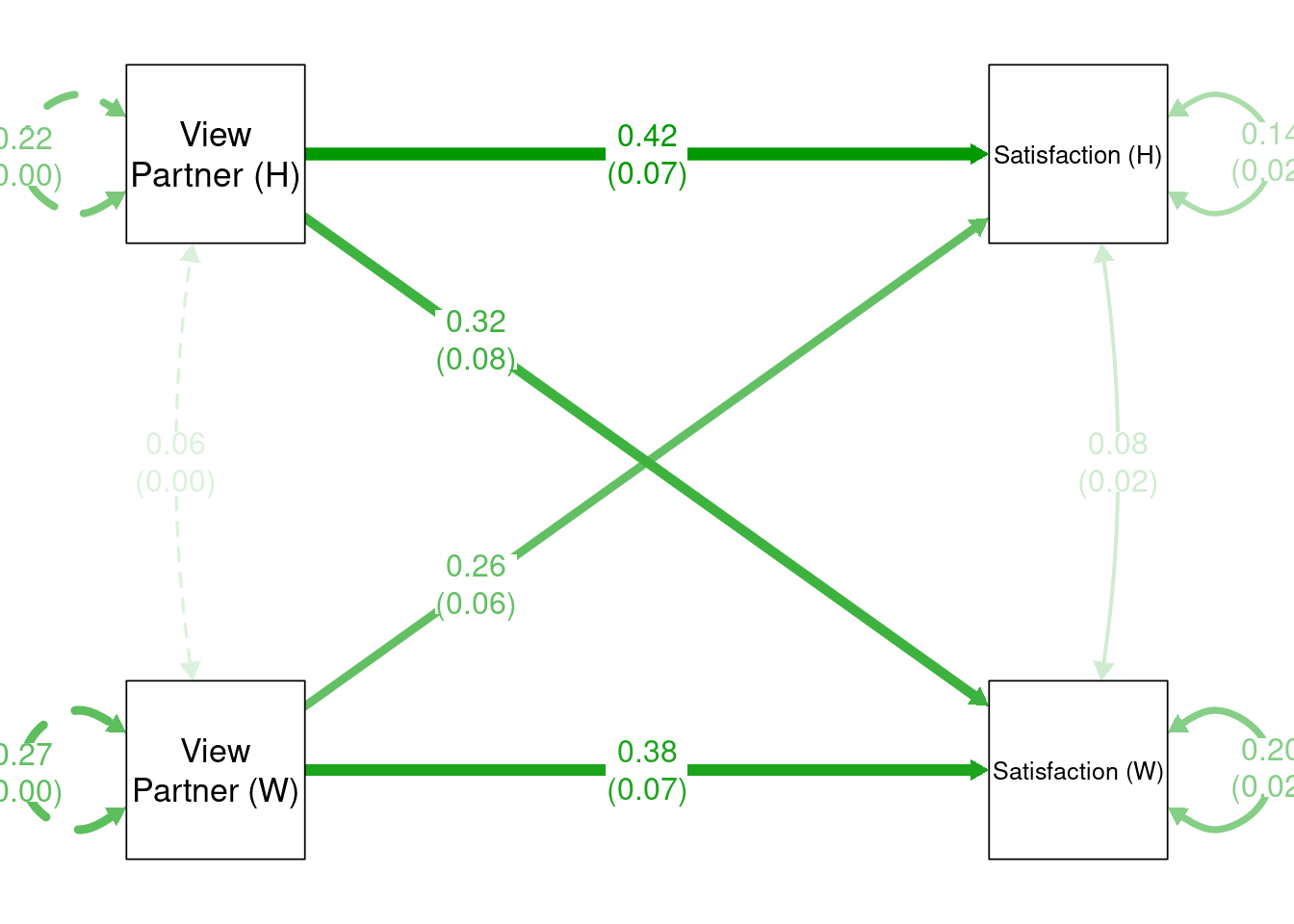
In this diagram, you can clearly see the four primary effects:
- Husband's Actor Effect: The path from the husband's predictor ("View Partner (H)") to his own outcome ("Satisfaction (H)").
- Wife's Actor Effect: The path from the wife's predictor ("View Partner (W)") to her own outcome ("Satisfaction (W)").
- Husband's Partner Effect: The path from the husband's predictor ("View Partner (H)") to the wife's outcome ("Satisfaction (W)").
- Wife's Partner Effect: The path from the wife's predictor ("View Partner (W)") to the husband's outcome ("Satisfaction (H)").
Specifying the APIM for a Distinguishable Dyad
The husband-wife dyad is considered distinguishable because the members can be differentiated by a non-arbitrary variable—in this case, their role as "husband" or "wife." This is a key theoretical distinction, as it implies that the actor and partner effects may not be the same for both individuals. For instance, the way a husband's anxiety affects his jealousy (actor effect) might be different from how a wife's anxiety affects her guilt (actor effect). Similarly, the effect of his anxiety on her guilt (partner effect) may differ from the effect of her anxiety on his jealousy (partner effect).
Given your background, you can think of specifying the APIM as defining the parameters of a system of two simultaneous linear equations, one for the husband's outcome and one for the wife's. Let's make this concrete with an example relevant to your research.
Suppose we want to model how each partner's Trait Openness (predictor) influences their Post-Event Guilt (outcome).
- Let be the Husband's Openness and be the Wife's Openness.
- Let be the Husband's Guilt and be the Wife's Guilt.
The two equations for the outcomes would be:
Here:
- is the husband's actor effect.
- is the wife's partner effect on the husband.
- is the wife's actor effect.
- is the husband's partner effect on the wife.
To fully specify the model within a structural equation modeling (SEM) framework, we must define all parameters to be estimated. For a distinguishable dyad, we allow all parameters to be freely estimated initially:
- Means: The mean of and .
- Intercepts: The intercepts for the outcome equations, and .
- Variances: The variances of the predictors, and .
- Covariances:
- The covariance between the predictors, .
- The covariance between the residuals (errors) of the outcomes, . This parameter is crucial as it captures any remaining non-independence in the outcomes not explained by the actor and partner paths.
- Regression Paths: The four actor and partner effects ().
This initial, unconstrained model serves as a baseline. The formal statistical procedure, which we will cover in the next lesson, involves testing whether a more parsimonious model—for example, one where the actor effects are constrained to be equal ()—fits the data just as well.
To formalize these concepts, let's turn to a foundational text on the topic.
[PDF] Analyzing Mixed-Dyadic Data Using Structural Equation Models
Now that we have established the conceptual framework of the APIM, let's delve into a more formal description. This paper by Peugh et al. provides a rigorous yet clear tutorial on specifying these models, grounding our discussion in the formal language of SEM.
Please read the following sections from the paper: The introduction (first three paragraphs on pp. 314–315), which defines dyadic dependence and distinguishability. This reinforces why specialized models are necessary. The first paragraph under "CROSS-SECTIONAL DYADIC DATA ANALYSES" (p. 318), which formally introduces the APIM and its purpose. The section "Distinguishable Dyads" (p. 319). Pay close attention to the list of parameters to be estimated and how the model handles intrapersonal and interpersonal dependence. This section directly corresponds to the model specification we just discussed.
Integrating APIM with Your Causal DAG
It is critical to see the APIM not as an isolated technique, but as a tool for testing a specific part of your larger causal theory. The husband-wife dyad is a subsystem within the integrated triadic DAG you developed. The APIM provides the statistical machinery to estimate the causal paths within that subsystem.
The choice of predictors and outcomes for your APIM is not arbitrary; it should be directly informed by your DAG. For example, if your DAG hypothesizes that a husband's Trait Neuroticism is a direct cause of both his own and his wife's emotional responses after an event, then Trait Neuroticism becomes a predictor in your APIM.
Furthermore, the principles from our last lesson on causal identification remain paramount. If your DAG indicates that a variable (e.g., Years in Lifestyle) is a common cause of both the husband's and wife's neuroticism, it acts as a confounder. To get an unbiased estimate of the actor and partner effects, you would need to include Years in Lifestyle as a covariate in your APIM equations. This is how the theoretical work of building a DAG directly informs the practical work of specifying a statistical model.
Conclusion
In this lesson, we have laid the groundwork for analyzing dyadic data from the husband-wife perspective. We introduced the Actor-Partner Interdependence Model as a solution to the problem of non-independence, defining its core components and visualizing its structure. Most importantly, you have learned how to formally specify an APIM for a distinguishable dyad, defining the full set of parameters that need to be estimated.
Key Takeaways:
- Dyadic data are inherently non-independent, requiring specialized models like APIM to avoid biased results.
- The APIM deconstructs dyadic influence into actor effects (the effect of X on one's own Y) and partner effects (the effect of X on the partner's Y).
- For a distinguishable dyad like a husband-wife couple, we begin by specifying a model where all parameters—including separate actor and partner effects for each member—are freely estimated.
- The specification of an APIM is directly guided by the causal pathways hypothesized in your broader DAG, including the need to control for identified confounders.
You are now prepared to move from specification to application. In our next lesson, we will focus on the practical steps of estimating an APIM with data. We will interpret the resulting actor and partner coefficients and learn how to formally test for differences in these effects between the husband and wife.