Introduction
Welcome back! In our previous lesson, we established the theoretical groundwork for the Spring Framework by exploring three critical concepts: the Dependency Inversion Principle (DIP), Inversion of Control (IoC), and Dependency Injection (DI). You learned that by depending on abstractions (DIP) and delegating object creation to a framework (IoC) via a specific pattern (DI), we can build highly decoupled, testable, and maintainable systems.
Now, we will move from theory to practice. This lesson addresses the learning outcome: "Describe the role of the Spring IoC container and the ApplicationContext." We'll introduce the heart of the Spring Framework—the component that actually implements the IoC principle. This component is known as the Spring IoC container. We will focus on its most common and powerful representation: the ApplicationContext interface.
By the end of this lesson, you will understand what the Spring IoC container is, what its core responsibilities are, and how it works behind the scenes to assemble your application.
The Spring IoC Container: Your Application's Architect
At its core, the Spring IoC container is a framework component responsible for managing the lifecycle of your application's objects. Instead of you writing code to create and wire objects together, you delegate this work to the container. You simply provide it with two things:
- Your business objects (plain Java objects, or POJOs).
- Configuration metadata that tells the container how to assemble them.
The container then takes these inputs and produces a fully configured and ready-to-use application.
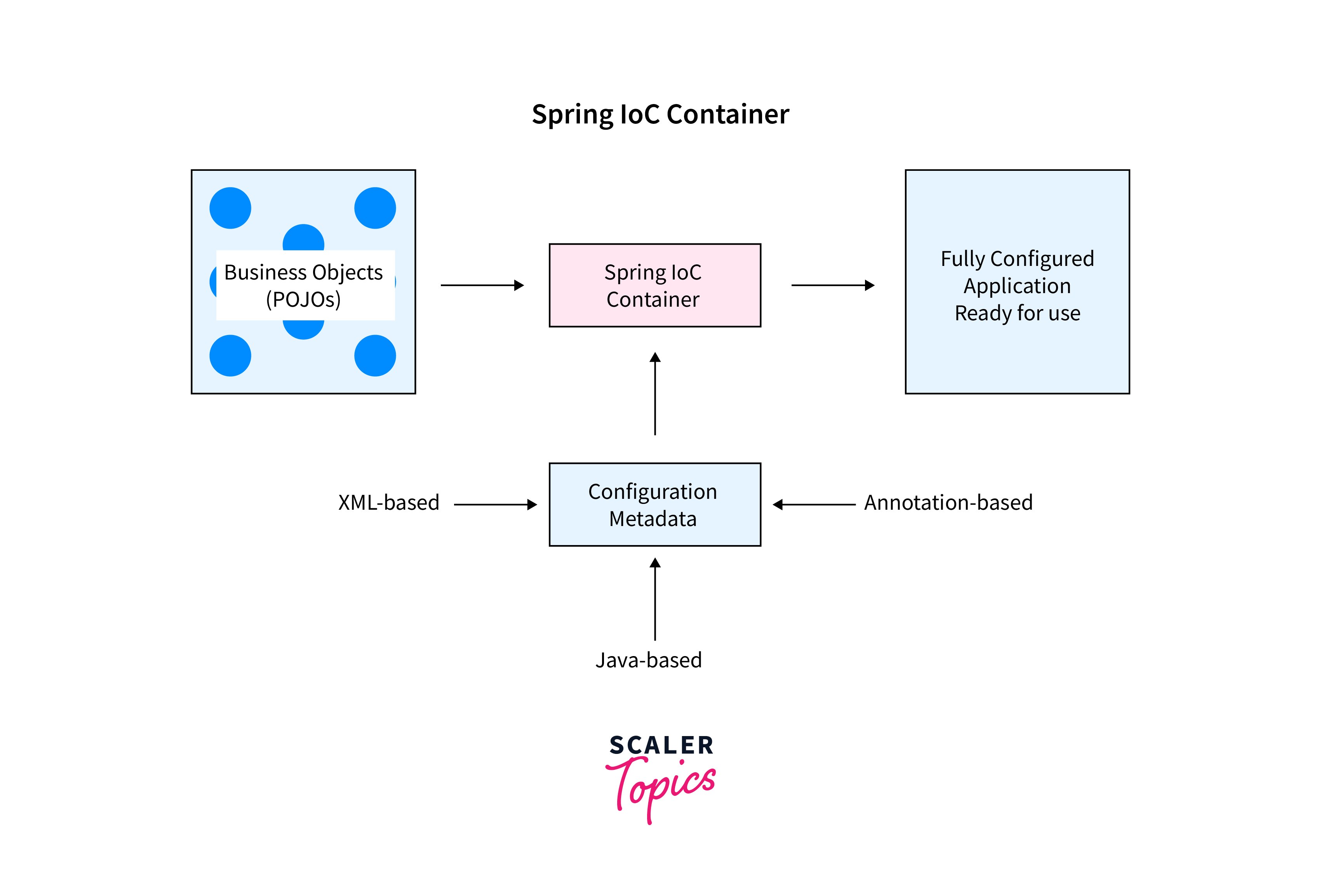
The objects that are instantiated, assembled, and managed by the Spring IoC container are called Spring Beans.
Before we go further, it's important to have a clear definition of what a 'bean' is in this context. This brief section from a Baeldung article provides a concise explanation.
Read the short section titled '3. What Is a Spring Bean?'. The key takeaway is that a bean is simply an object managed by the Spring container.
In essence, the container acts as a central factory and registry for your application's components. Your experience with system design highlights the value of such a centralized mechanism for managing object composition, especially in complex applications.
The Core Interfaces: BeanFactory and ApplicationContext
The functionality of the IoC container is represented by two main interfaces in the Spring Framework. Understanding their relationship is key to understanding Spring's architecture.
-
BeanFactory: This is the root interface. It provides the fundamental mechanics of an IoC container, including the ability to retrieve beans by name (getBean()) and the basic mechanisms for dependency injection. Think of it as the low-level engine of the container. -
ApplicationContext: This is a sub-interface ofBeanFactory. It inherits all the capabilities ofBeanFactoryand adds more advanced, enterprise-specific features that are essential for most modern applications.
The Baeldung article, 'The Spring ApplicationContext,' clearly explains the distinction between these two interfaces.
Read section '2. The ApplicationContext Interface'. Focus on understanding that ApplicationContext is a more feature-rich version of BeanFactory and is the standard choice for most applications.
Because ApplicationContext includes all the functionality of BeanFactory and adds crucial features like event publishing, message internationalization, and easier integration with web applications, it is the recommended container to use. For the remainder of this course, when we refer to the "IoC container," we are generally talking about an ApplicationContext.
The UML diagram below visualizes this relationship. You can see ApplicationContext extending other interfaces, including those from the BeanFactory hierarchy, to provide a richer set of features.

The Responsibilities of the ApplicationContext
So, what does the ApplicationContext actually do? Its role can be broken down into several key responsibilities that collectively manage your application's components.
Understanding Inversion of Control (IoC) in Spring - NashTech Blog
This article from the NashTech Blog provides a superb, detailed breakdown of the IoC container's main jobs. It's written from a perspective that will resonate with an experienced engineer.
Read section '4. IoC Container (ApplicationContext) Deep Dive'. Pay close attention to the five main responsibilities listed: Component scanning, Bean instantiation, Dependency Injection, Lifecycle management, and Caching & Scoping.
Let's summarize these crucial tasks:
-
Bean Definition and Discovery: The container first needs to know what beans to manage. It does this by reading configuration metadata. In modern Spring, this usually means scanning your project's classpath for classes marked with special annotations like
@Component,@Service, or@Repository. Each discovered component results in a Bean Definition, which is essentially a blueprint or recipe for creating the actual bean instance. -
Bean Instantiation: Using the bean definitions, the container instantiates the bean objects. It handles creating the object, typically by calling its constructor.
-
Dependency Injection: This is where the magic happens. If a bean requires another bean to function (a dependency), the container automatically provides it. For example, if your
OrderServiceneeds anOrderRepository, the container will ensure an instance ofOrderRepositoryis created and "injected" into theOrderService, usually via its constructor. -
Lifecycle Management & Scoping: The container manages the entire lifecycle of a bean, from its creation to its destruction. It also manages the scope of a bean. By default, all beans are singletons, meaning the container creates only one instance of that bean for the entire application.
This last point is a powerful feature. The following video gives a practical demonstration of the default singleton behavior and how it differs from manually creating objects.
Dependency Injection & Inversion of Control in Spring Tutorial #DI #IOC #Spring #SpringBoot #Java
In this video, Cameron McKenzie provides a simple, compelling demonstration of the container managing a bean's lifecycle and scope.
Watch from 08:42 to 15:40. First, you'll see how to create a simple AnnotationConfigApplicationContext and retrieve a bean from it. Then, the video contrasts running code that manually creates a new object in a loop versus asking the container for the bean in a loop. The difference in the output powerfully illustrates the singleton scope managed by the container.
The ApplicationContext in Action: A Deeper Look
Now that we know the container's responsibilities, let's look at how it executes them during application startup. We'll use a conceptual walkthrough to see how dependencies are resolved.
The core of the ApplicationContext is often an implementation of BeanFactory called DefaultListableBeanFactory. This object holds the registry of all the bean definitions. When the application starts, the ApplicationContext goes through a sophisticated process to build a graph of dependencies and create the beans in the correct order.
This video from the SpringDeveloper channel gives an excellent 'under the hood' look at how Spring's container works. It walks through the process of component scanning, creating bean definitions, and resolving dependencies.
Please watch these three segments: Bean Definitions (06:05 - 08:27): This explains what a BeanDefinition is—the blueprint for a bean. ApplicationContext vs. BeanFactory (10:30 - 12:30): This reinforces the relationship between the two and introduces the different implementations like AnnotationConfigApplicationContext. Dependency Resolution (15:38 - 17:36): This is the key part. It visually walks through how the container resolves the dependency graph for a controller, its service, and its configuration, showing how it works backward from the required bean to create all necessary dependencies first.
This process of creating bean definitions and then recursively resolving dependencies is fundamental to how Spring works. By managing this complexity, the container allows you to focus on writing your business logic in simple, decoupled classes.
There are several implementations of the ApplicationContext for different scenarios, such as AnnotationConfigApplicationContext for standalone applications using Java configuration, ClassPathXmlApplicationContext for older XML-based setups, and AnnotationConfigWebApplicationContext for web applications. You'll primarily work with AnnotationConfigApplicationContext or its web equivalent, which is automatically configured for you in Spring Boot.
Conclusion
In this lesson, we demystified the core of the Spring Framework: the IoC container, represented by the ApplicationContext. We moved beyond the theory of IoC and DI to see the concrete component that puts these principles into practice.
Here are the key takeaways:
- The Spring IoC container is responsible for instantiating, configuring, and assembling objects known as Spring Beans.
- The
ApplicationContextis the central interface for the container, providing advanced features on top of the basicBeanFactory. - The container's primary roles include:
- Discovering components via scanning and creating bean definitions.
- Instantiating beans based on these definitions.
- Injecting dependencies to wire the application together.
- Managing the bean lifecycle and scope (e.g., as singletons by default).
By taking on these responsibilities, the ApplicationContext frees you from the complex and error-prone task of manual object management, allowing you to build applications from a set of loosely coupled, declarative components.
In our next lesson, we will get hands-on and learn how to tell the container about our components. You will learn to define Spring beans using component scanning annotations like @Component, @Service, and @Repository.