Introduction
Welcome to the second module of our course! In the previous module, we established the necessary Java fundamentals. You learned how to use features like annotations and lambda expressions, which are the building blocks for much of Spring's functionality.
We now move from the "how" of Java syntax to the "why" of the Spring Framework's design. This lesson begins our exploration of the Spring Core by focusing on the two foundational principles that make the framework so powerful for building robust, scalable applications: Inversion of Control (IoC) and the Dependency Inversion Principle (DIP).
Your goal for this lesson is to explain these two concepts. Understanding them is crucial, as they form the philosophical basis for how Spring manages components and their relationships. Given your extensive background in system design and microservices, you've likely encountered the problems these principles solve—namely, tight coupling and the challenges it poses to testing, maintenance, and flexibility. This lesson will formalize the solution that Spring provides.
We will also touch upon a related term, Dependency Injection (DI), and clarify the distinct roles these three concepts play.
The Problem: Tightly Coupled Components
In any non-trivial application, objects need to collaborate. The simplest way to achieve this is for an object to create the other objects it needs to do its job. Let's examine why this straightforward approach can become problematic as a system grows.
Dependency Injection & Inversion of Control
This video from Ryan Schachte's channel introduces the core problem using a simple Java example: a User class that needs to talk to a database. It perfectly illustrates the concept of a dependency and the issue of tight coupling.
Watch from 00:16 to 01:00. Pay close attention to how the User class directly creates an instance of a MySQL database. This is the classic example of tight coupling.
When the User class directly instantiates MySQL with new MySQL(), it becomes permanently and concretely tied to that specific database implementation. This creates several challenges that you've probably faced in large-scale systems:
- Rigidity: What if you need to switch to a different database, like Oracle or PostgreSQL? You would have to find and change every place where
new MySQL()is called. - Testability: How can you unit test the
Userclass in isolation? Since it creates its own database connection, any test of theUserclass becomes an integration test that requires a running MySQL database. You can't easily substitute a "mock" or "fake" database for testing purposes. - Reusability: The
Userclass is not reusable in any context that doesn't have aMySQLdatabase.
This direct dependency, where a high-level component (User service logic) depends on a low-level component (MySQL data access logic), is what we want to avoid.
The Solution, Part 1: The Dependency Inversion Principle (DIP)
The Dependency Inversion Principle, the 'D' in the SOLID design principles, provides a direct solution to this problem.
The principle is formally stated in two parts:
- High-level modules should not depend on low-level modules. Both should depend on abstractions (e.g., interfaces).
- Abstractions should not depend on details. Details (concrete implementations) should depend on abstractions.
In simpler terms: don't depend on concrete things; depend on abstract concepts.
Let's see how to apply this to our User and MySQL example. The key is to introduce an interface that represents the concept of a database.
Dependency Injection & Inversion of Control
This segment of the same video demonstrates the refactoring process to apply the Dependency Inversion Principle. It introduces a Database interface and modifies the User class to depend on this abstraction instead of the concrete MySQL or Oracle classes.
Watch from 02:38 to 06:50. This is a practical, code-level demonstration of DIP. Notice how the User class now only knows about the Database interface, and the choice of MySQL or Oracle is made outside of it. This 'inverts' the dependency.
By making the User class depend on the Database interface, we have successfully decoupled it from any specific implementation. The User class (the high-level module) no longer depends on the MySQL class (the low-level module). Instead, both now depend on the Database abstraction. This is the "inversion" in the principle's name—we've inverted the direction of the dependency away from concrete details and towards an abstraction.
This small change brings significant benefits:
- Flexibility: We can now pass in any class that implements the
Databaseinterface (MySQL,Oracle, aMockDatabasefor testing) without changing theUserclass at all. - Testability: Unit testing the
Userclass is now simple. We can create aMockDatabaseimplementation and pass it to theUser's constructor.
For a deeper perspective, Martin Fowler's work provides excellent insights. The following reading explains the relationship between DIP, IoC, and DI, and frames dependencies as manageable risks.
In his article 'DIP in the Wild', Martin Fowler provides a concise and powerful explanation of these concepts. This section clarifies what DIP is and how it differs from DI and IoC.
First, read the section titled 'You mean Dependency Inversion, Right?'. It offers a brilliant summary: 'DI is about wiring, IoC is about direction, and DIP is about shape.' Then, read the section 'Why care about dependencies?' to understand the motivation from a system design perspective.
The Solution, Part 2: Inversion of Control (IoC)
In the video example, after refactoring, we still had a line of code somewhere that looked like this:
User user = new User(new MySQLDatabase());
While the User class itself is now decoupled, some part of our application is still responsible for creating the MySQLDatabase instance and "injecting" it into the User. The application is still in control of creating and wiring its objects.
Inversion of Control (IoC) is a broader design principle that flips this responsibility. With IoC, you delegate the control of object creation and lifecycle management to an external container or framework.
- Traditional Control: Your code creates its dependencies and calls a framework's code.
- Inverted Control: A framework creates objects, wires them together, and calls your code when needed.
The classic analogy is the difference between a command-line application and a GUI application.
Dependency Inversion Principle vs Inversion of Control vs ...
This article from Caizin provides an excellent analogy to understand Inversion of Control. It contrasts a command-line application (where your code controls the flow) with a UI application (where the framework controls the flow and calls your code in response to events).
Read the section 'Inversion Of Control' and its subsections 'Why is it important?' and 'What is IOC?'. Focus on the core idea of giving up control to a framework.
In the context of Spring, your application code doesn't create and manage objects like services or repositories. Instead, you define your classes (e.g., as @Components), and the Spring IoC container reads this configuration, instantiates the objects, and manages their entire lifecycle. Your code is then "called back" by the framework—for example, when a web controller method is invoked to handle an HTTP request.
The How: Dependency Injection (DI)
So, if you give up control to a framework (IoC), and you've designed your components to depend on abstractions (DIP), how do the concrete implementations get to where they're needed?
Dependency Injection (DI) is the pattern that makes this happen. It is the primary mechanism for implementing IoC. DI is the process whereby the framework (the IoC container) "injects" the dependencies (the concrete objects) into your components.
There are a few common ways to perform DI, which you'll use constantly in Spring:
- Constructor Injection: The dependencies are provided as arguments to the class's constructor. This is the most common and recommended approach.
public class User { private final Database database; // The dependency is "injected" through the constructor public User(Database database) { this.database = database; } } - Setter Injection: The dependencies are provided through public setter methods.
public class User {
    private Database database;

    // The dependency is "injected" through a setter method
    public void setDatabase(Database database) {
        this.database = database;
    }
}
The following video gives a clear, language-agnostic definition of DI as the pattern used to implement IoC.
Dependency injection fundamentals in C# - DI vs IoC vs DIP
This brief clip from Amichai Mantinband clarifies the relationship between IoC and DI.
Watch from 06:34 to 08:25. The key takeaway is that IoC is the principle of giving control to a framework, and DI is the pattern of how the framework provides dependencies to your objects.
Tying It All Together
It's easy to confuse these three terms, but they represent different levels of abstraction.
- Dependency Inversion Principle (DIP): A high-level software design principle from SOLID. It guides your code's structure: depend on abstractions, not concretions. It's about the "shape" of your code.
- Inversion of Control (IoC): A broad programming paradigm. It describes the design where a framework controls the program's flow and object creation, not your custom code. It's about the "direction" of control.
- Dependency Injection (DI): A specific design pattern used to implement IoC. It's the mechanism by which the framework provides objects with their dependencies. It's about the "wiring".
This diagram provides a clear visual summary of their relationship.
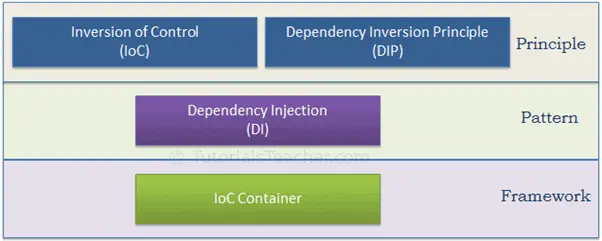
In the Spring universe, you apply DIP by defining your services and repositories with interfaces. The Spring framework acts as an IoC container, and it uses DI (typically via @Autowired on a constructor) to wire the concrete implementations of those interfaces together at runtime.
Conclusion
In this lesson, we've explored the foundational theory behind the Spring Framework. Your experience with complex systems gives you a first-hand appreciation for why these principles are not just academic exercises but essential tools for building maintainable and scalable software.
Here are the key takeaways:
- Tight Coupling, where a class creates its own dependencies, makes code rigid, hard to test, and difficult to reuse.
- The Dependency Inversion Principle (DIP) solves this by mandating that high-level and low-level modules should both depend on abstractions (interfaces), not on concrete implementations.
- Inversion of Control (IoC) is a paradigm where you delegate object creation and lifecycle management to a framework or container, inverting the typical flow of control.
- Dependency Injection (DI) is the primary pattern for implementing IoC. It's the process of the container passing dependencies into an object, typically through its constructor.
These concepts are the "magic" behind Spring. By letting the framework manage object creation and wiring, you are free to focus on writing business logic within well-defined, decoupled components.
In our next lesson, we will make this theory concrete by exploring the heart of the Spring framework: the Spring IoC container and the ApplicationContext. You'll learn how Spring actually discovers, creates, and manages the objects in your application.