Introduction
Hello! In our last lesson, we focused on the service layer, mastering how to use the @Transactional annotation to declaratively manage database transactions. This provided a powerful abstraction over the complexities of manual transaction control.
Today, we'll drill down into the persistence layer itself. While our previous lesson's conclusion mentioned moving to the web layer next, we're first going to solidify our understanding of data access, as it's a critical foundation for almost any service you'll build. This lesson directly addresses the learning outcome: Explain the purpose of JPA and how Spring Data JPA simplifies data access.
We will trace the evolution of data access in Java. Starting with the foundational but cumbersome JDBC, we'll explore why Object-Relational Mapping (ORM) was introduced, what role the Java Persistence API (JPA) plays as a standard, and finally, how Spring Data JPA provides a final, powerful layer of simplification. This historical and architectural perspective will give you the "why" behind the tools you'll be using.
The Starting Point: The Problem with Raw JDBC
In any programming language, interacting with a relational database requires a specific driver or API. In Java, the foundational API for this is JDBC (Java Database Connectivity). Think of it as the low-level bridge between your Java code and the database, allowing you to execute raw SQL queries.
While fundamental, working directly with JDBC for anything beyond simple examples is tedious. It involves a lot of repetitive, "boilerplate" code:
- Manually opening and closing database connections.
- Creating
PreparedStatementobjects. - Manually setting each parameter for a query.
- Executing the query and iterating through a
ResultSet. - Manually mapping each column from the
ResultSetto the fields of a Java object. - Meticulously handling
SQLExceptionand ensuring resources are always closed.
For a seasoned programmer, this pattern of writing repetitive, error-prone code is a clear signal that a better abstraction is needed.
To see just how verbose this can be, let's look at an article from Vlad Mihalcea, a leading expert in the Java persistence world.
Why and when you should use JPA
The article 'Why and when you should use JPA' provides excellent code examples that vividly illustrate the boilerplate associated with raw JDBC.
Please read the section 'Why and when JDBC was created'. Pay close attention to the code snippets for inserting and fetching data. You don't need to understand every Java-specific syntax detail; focus on the overall number of steps and the manual nature of the process, especially the mapping from the ResultSet to a Post object.
This verbosity not only slows down development but also tightly couples your business logic to your database schema. Changing a column name in the database could require finding and updating multiple string-based SQL queries and manual mapping logic throughout your application. This issue is often called the Object-Relational Impedance Mismatch: the paradigm of objects and methods in your code doesn't naturally align with the paradigm of tables and rows in a relational database.
The Solution: ORM and the JPA Standard
The software engineering solution to the impedance mismatch is Object-Relational Mapping (ORM). An ORM framework provides a layer of abstraction that automatically handles the translation between your application's objects and the database's tables. You work with objects and their properties, and the ORM framework generates and executes the appropriate SQL behind the scenes.
In the early 2000s, Hibernate emerged as a very popular open-source ORM framework for Java, solving the problems of JDBC's verbosity. Learning from its success, the Java community decided to create a standard API for persistence, leading to the Java Persistence API (JPA).
Here's the crucial distinction:
- JPA is a specification, not a product. It is a collection of interfaces and annotations (like
@Entity,@Id) that define a standard for how ORM should work in Java. - Hibernate is an implementation of the JPA specification. It's the engine that does the actual work. Other implementations exist (like EclipseLink), but Hibernate is the most common and is the default used by Spring Boot.
This is analogous to the JDBC Driver interface being a standard, while the MySQL or PostgreSQL driver is the concrete implementation. By coding against the JPA standard, you gain portability; you could, in theory, swap out the Hibernate implementation for another JPA provider with minimal code changes.
This video from Telusko does a great job of explaining the core concept of ORM and the relationship between JPA and Hibernate.
This video visually explains the motivation for ORM and clarifies the roles of JPA and its implementations.
Please watch from 04:04 to 10:00. Object Relational Mapping (04:04 - 07:50): Focus on the explanation of how an object in Java (with its fields) is conceptually mapped to a row in a database table (with its columns). JPA vs. Hibernate (08:40 - 10:00): Pay attention to the analogy of driving a car—JPA provides the standard controls, and Hibernate is the specific car you are driving. This section clearly defines JPA as a standard.
With JPA, you define your data model as simple Java classes annotated to describe how they map to the database.
For example, from the Baeldung article "Difference Between JPA and Spring Data JPA" (which we will read more of shortly), this is all it takes to map an Employee class to an employee table:
@Entity
@Table(name = "employee")
public class Employee implements Serializable {
    @Id
    @GeneratedValue
    private Long id;

    @Column(nullable = false)
    private String firstName;

    // other fields, setters, and getters
}
All the messy JDBC code for saving, updating, or retrieving an Employee object is now handled by the JPA provider (Hibernate).
The Simplification: Spring Data JPA
While JPA and Hibernate solve the core problem of object-relational mapping, you still need to write a fair amount of code for the Data Access Object (DAO) or Repository layer. This layer is responsible for encapsulating all storage and retrieval logic. Using plain JPA, you'd have to write a class for each entity that interacts with the EntityManager (JPA's primary interface for persistence operations) to perform CRUD (Create, Read, Update, Delete) operations.
This is where Spring Data JPA comes in. It is not a JPA implementation itself but a project within the larger Spring ecosystem that sits on top of JPA. Its goal is to make data access layers incredibly easy to build.
Spring Data JPA's main feature is the Repository abstraction. To create a fully functional DAO for your Employee entity, you simply define an interface:
public interface EmployeeRepository extends JpaRepository<Employee, Long> {
    // That's it!
}
By extending JpaRepository, your EmployeeRepository interface automatically inherits a complete set of CRUD methods like save(), findById(), findAll(), and deleteById(). You don't have to write a single line of implementation code. Spring Data examines the interface at runtime and provides the implementation for you.
To see this progression from JPA to Spring Data JPA in more detail, let's return to the Baeldung article.
Difference Between JPA and Spring Data JPA - Baeldung
The article 'Difference Between JPA and Spring Data JPA' clearly contrasts the standard JPA approach with the simplified Spring Data JPA approach.
Please read sections 3 ('JPA') and 4 ('Spring Data JPA'). In the JPA section, notice how you need to get an EntityManager and manually call methods like persist() or build a CriteriaQuery. In the Spring Data JPA section, see how this is replaced by simply declaring a Repository interface. The contrast between the code required in each section highlights the simplification Spring Data provides.
The Big Picture: Putting the Layers Together
It's helpful to visualize how these technologies stack up. Each layer provides a higher level of abstraction, hiding the complexity of the layer below it.
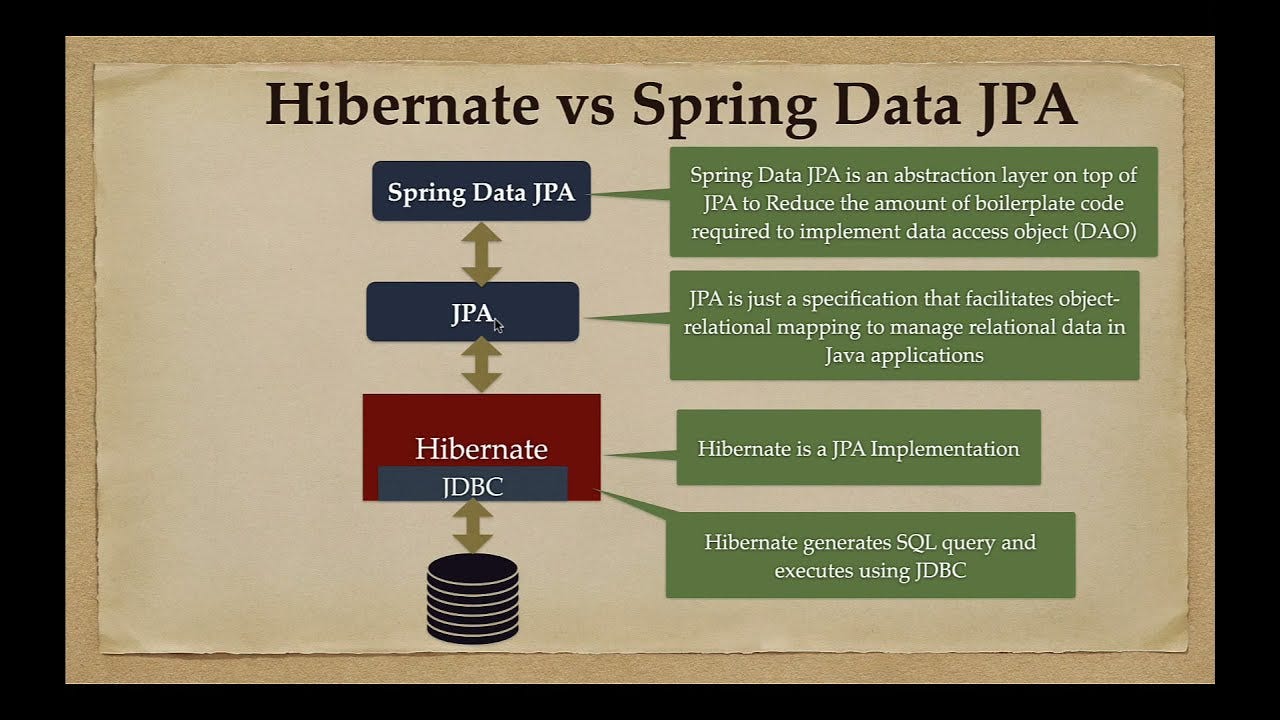
Let's trace a typical save operation through these layers:
- Your Service Layer: Calls
employeeRepository.save(newEmployee);. - Spring Data JPA: Intercepts this call. Since it's a standard method, Spring's
SimpleJpaRepositoryimplementation invokes the JPAEntityManager. - JPA (Hibernate): The
EntityManagerreceives theEmployeeobject. Hibernate analyzes its state, generates the appropriateINSERTSQL statement, and gets a connection. - JDBC: Hibernate uses a JDBC
PreparedStatementto execute theINSERTstatement against the database.
This layered approach is a classic example of good system design, allowing you to focus on your business logic at the top layer, confident that the lower layers are handling the complex implementation details.
For a final, quick summary of how all these pieces relate, this short video is an excellent resource.
JDBC vs JPA vs Hibernate vs Spring Data JPA in 9 minutes
This video, 'JDBC vs JPA vs Hibernate vs Spring Data JPA in 9 minutes', provides a concise recap of the entire technology stack we've discussed.
Watch the full video (it's short!). It walks through each layer—JDBC, JPA, Hibernate, and Spring Data JPA—reinforcing the purpose and benefits of each step in the evolution of Java data access.
Conclusion
In this lesson, we deconstructed the layers of the Java persistence stack to understand not just what they do, but why they exist.
Key Takeaways:
- JDBC is the low-level, foundational API for database access in Java, but it's verbose and requires significant boilerplate code.
- JPA (Java Persistence API) is a standard specification for Object-Relational Mapping (ORM). It allows you to map Java objects to database tables, solving the object-relational impedance mismatch. Hibernate is the most popular implementation of this standard.
- Spring Data JPA is an abstraction layer on top of JPA. Its primary purpose is to dramatically simplify the creation of the data access layer by providing
Repositoryinterfaces that automatically get CRUD and query method implementations at runtime.
You now have a solid conceptual model of how Spring Boot applications interact with databases. In our next lesson, we'll put this knowledge into practice by learning how to configure a datasource to connect a Spring Boot application to a relational database. We'll see how Spring Boot's auto-configuration makes this process straightforward.