Hello! Welcome to your sixth lesson on artificial intelligence.
In our last lesson, we witnessed the birth of AI as a formal discipline at the 1956 Dartmouth Conference. This event kicked off a period of intense optimism, with founders believing that intelligent machines were just around the corner. However, the path of progress is rarely a straight line. The initial excitement was followed by periods of major disappointment and funding cuts, which are now famously known as "AI winters."
Today, we'll explore these fascinating boom-and-bust cycles in AI history. Your learning outcome for this lesson is to explain the historical 'AI winters' and the factors that led to the modern AI boom (data, compute, and algorithms).
We will investigate why the early promises of AI failed to materialize, leading to these "winters," and then uncover the powerful combination of forces that thawed the ice and ignited the explosive growth in AI we see today.
The Cycles of Hype and Disappointment
The history of AI can be seen as a series of springs and winters: periods of great excitement and funding ("springs") followed by disillusionment and budget cuts ("winters").
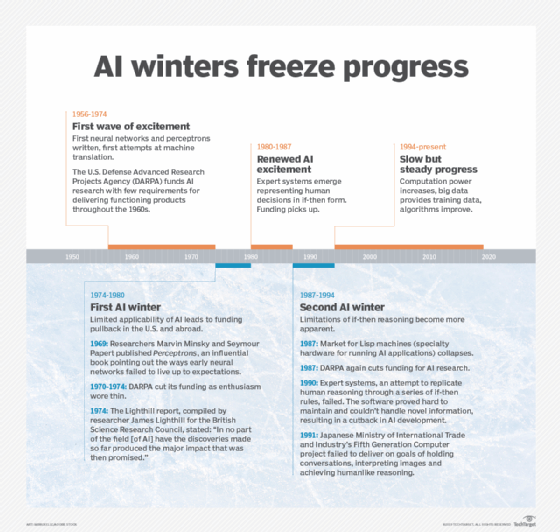
An AI winter is a sustained period of declining funding, reduced research, and diminished public confidence in the field. This pattern has happened twice. Let's explore why.
AI Winter: What It Was and Why It Happened
To get a clear definition of an AI winter and a high-level overview of the two major occurrences, please read this brief introduction from the Teachfloor Blog.
Read the section titled 'What Is an AI Winter?'. Focus on understanding the core pattern: over-promising leads to disappointment, which then leads to a collapse in funding and interest.
The First AI Winter (approx. 1974–1980)
The "golden years" following the Dartmouth Conference (1956-1974) produced impressive-looking demos. Programs could solve algebra word problems and prove geometric theorems. Researchers, buoyed by this success, made extremely optimistic predictions. However, these programs worked in highly simplified "toy" worlds and broke down when faced with real-world complexity.
Two key areas highlight these failures:
-
Machine Translation: A major Cold War goal was to automatically translate Russian documents into English. Early systems seemed promising, but they lacked any real understanding of language. A famous, though possibly apocryphal, story tells of the phrase "The spirit is willing, but the flesh is weak" being translated into Russian and back into English, coming out as "The vodka is good, but the meat is rotten." This captured the essence of the problem: without common sense knowledge, translation was brittle and unreliable.
-
The Perceptron: The perceptron, an early type of artificial neuron, generated immense excitement. This likely resonates with your interest in neuroscience. Researchers hoped that by connecting perceptrons into networks, they could simulate the learning processes of the brain. However, in 1969, the influential book Perceptrons by Marvin Minsky and Seymour Papert proved mathematically that a single-layer perceptron was fundamentally limited and could not even learn simple logical functions. While more complex, multi-layered networks were theoretically more powerful, nobody at the time knew how to train them effectively.
These technical failures, combined with the unmet optimistic promises, led government agencies to slash funding.
For a more detailed account of these events, let's turn to the Wikipedia article on the topic. It provides excellent specifics on the reports and decisions that triggered the first winter.
First, read the subsection 'Machine translation and the ALPAC report of 1966'. Then, read the subsection 'The failure of single-layer neural networks in 1969'. Finally, browse the section 'The setbacks of 1974' to see how the Lighthill Report in the UK and DARPA's funding cuts in the US made the winter official.
The Second AI Winter (approx. 1987–1994)
The field thawed in the early 1980s with the rise of expert systems. These were commercially successful programs that captured the knowledge of human experts in a set of "if-then" rules. For a time, it seemed AI had found its killer application. Corporations invested billions, and a specialized hardware market for LISP machines (computers designed to run the AI programming language LISP) boomed.
But history repeated itself.
- Expert systems were expensive to build and even more expensive to maintain. They were "brittle" — they couldn't handle situations outside their specific programmed knowledge.
- Simultaneously, standard desktop computers became powerful enough to run AI programs, making the specialized, expensive LISP machines obsolete. The LISP machine market collapsed almost overnight in 1987.
Once again, the hype outran the reality, and a second, longer winter began.
The Thaw: Ingredients for the Modern AI Boom
So, what ended the winters and led to the current "AI spring" we are living in? It wasn't one single breakthrough, but a powerful convergence of three factors that had been developing in the background.

-
Data: The rise of the internet and the digitization of society created an unfathomable amount of data (text, images, videos). This data became the "fuel" or training material for a new generation of AI models. Massive, curated datasets like ImageNet, which contains millions of labeled images, were crucial.
-
Compute: For decades, Moore's Law described the steady doubling of computer power. But the real game-changer was the repurposing of Graphics Processing Units (GPUs). Originally designed for rendering video game graphics, researchers discovered that their architecture was perfectly suited for the parallel computations needed to train large neural networks. This provided an enormous boost in processing power.
-
Algorithms: While neural networks were an old idea, algorithmic breakthroughs made them truly effective. The most important was backpropagation, a method for efficiently training multi-layered networks by allowing the network to learn from its errors. This algorithm, combined with new network designs like Convolutional Neural Networks (CNNs) for images and later Transformer architectures for language, unlocked the potential of "deep learning"—neural networks with many layers.
The video below tells the story of how these three ingredients came together, culminating in a watershed moment in 2012 that is often called the "Big Bang" of modern AI.
The Entire History of Artificial Intelligence (Last 100 Years)
This video from the Putchuon channel provides a fantastic narrative of how hardware advancements, the data explosion from the internet, and new algorithms reignited the field of AI.
Please watch from 11:51 to 17:38. This segment starts by introducing the backpropagation algorithm. It then brilliantly explains how the internet (Data), the rediscovery of neural networks via Deep Learning (Algorithms), and the power of GPUs (Compute) all converged to create the modern AI boom with the 'AlexNet' model in 2012.
As the video highlights, the success of the AlexNet model in the 2012 ImageNet competition was a wake-up call. It drastically outperformed all other approaches and proved that deep learning, fueled by big data and massive compute, was the future.
Conclusion
In this lesson, we've journeyed through the turbulent history of AI, from periods of unbridled optimism to the harsh reality of AI winters, and finally to the key ingredients that sparked the modern AI revolution.
Key Takeaways:
- AI history has been marked by cycles of hype and disappointment. AI winters are periods of reduced funding and interest caused by the failure to meet overly optimistic promises.
- The first AI winter (mid-1970s) was triggered by the limitations of early approaches to machine translation and neural networks (perceptrons), leading to major funding cuts.
- The second AI winter (late 1980s) followed the collapse of the commercial market for brittle expert systems and the specialized LISP machines they ran on.
- The current AI boom was not caused by a single invention, but by the convergence of three essential factors:
- Data: Massive datasets generated by the internet.
- Compute: The immense parallel processing power of GPUs.
- Algorithms: Breakthroughs in training deep neural networks, such as backpropagation and new architectures.
Preview of the next lesson:
This powerful combination of data, compute, and algorithms has led to a series of astonishing accomplishments that were once considered science fiction. In our next lesson, we will examine some of these landmark achievements, exploring the significance of Deep Blue's victory over a chess grandmaster, Watson's triumph on Jeopardy!, and AlphaGo's defeat of the world's best Go player. These milestones will provide concrete examples of the AI boom in action.