Hello! Welcome to the fifth lesson in your journey into the world of Artificial Intelligence.
In our last lesson, we explored Alan Turing's 1950 paper and his famous "Imitation Game." Turing gave us a profound philosophical and practical framework for thinking about machine intelligence, but he did so before AI even existed as a formal field of study.
Today, we'll journey to the moment of creation—the event that gave the field its name and its official start. We will investigate a pivotal summer workshop that brought together the founding figures of AI and set the agenda for decades of research.
Your learning outcome for this lesson is to outline the key events of the 1956 Dartmouth Conference. We'll uncover who the organizers were, their ambitious vision, what actually transpired during the workshop, and why this event is considered the "Big Bang" of artificial intelligence.
The Organizers and their Audacious Proposal
By the mid-1950s, several researchers across different fields were independently exploring ideas that we would now recognize as AI. A young mathematician at Dartmouth College, John McCarthy, decided it was time to bring these scattered efforts together.
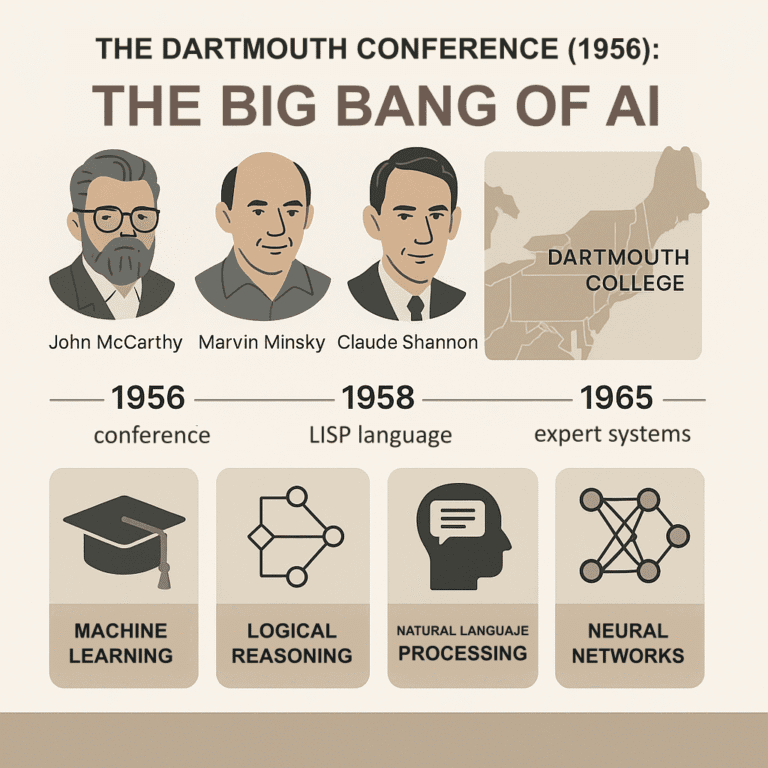
McCarthy, along with three other brilliant minds—Marvin Minsky, Nathaniel Rochester, and Claude Shannon—became the chief organizers of this historic gathering.

To hear directly from John McCarthy about how the idea for the workshop came together, please watch the following interview clips.
In this oral history from the Computer History Museum, John McCarthy himself recounts the origins of the Dartmouth Conference. Listening to a primary founder provides a unique and personal perspective.
Please watch the segment from 04:21 to 05:44, where McCarthy discusses the initial inspiration. Then, watch from 16:04 to 18:12, where he explains how he brought the organizing team together and formulated the idea for the summer workshop.
As you heard, McCarthy was inspired by earlier symposiums but felt they didn't go far enough in exploring how computers could behave intelligently. He collaborated with pioneers from academia (Minsky), industry (Rochester at IBM), and the prestigious Bell Labs (Shannon) to draft a proposal for a "2 month, 10 man study of artificial intelligence."
This proposal, written in 1955, is where the term "artificial intelligence" was first coined. Let's examine the original document to understand the incredible ambition of its authors.
A PROPOSAL FOR THE DARTMOUTH SUMMER RESEARCH PROJECT ON ARTIFICIAL INTELLIGENCE
This document is the original 1955 funding proposal for the workshop. Reading its introduction is like looking at the birth certificate of AI.
Please read the first few paragraphs, starting from 'We propose that a 2 month, 10 man study...' down to the end of the sentence '...work on it together for a summer.' Pay close attention to the central conjecture.
The core of the proposal is its stunningly bold conjecture:
"...that every aspect of learning or any other feature of intelligence can in principle be so precisely described that a machine can be made to simulate it."
This statement laid down the fundamental philosophical assumption of the entire field of AI. The organizers weren't just proposing to build clever programs; they were suggesting that intelligence itself was, at its core, computable.
The proposal went on to list specific areas for study. Your interest in neuroscience and computer science will make these topics feel remarkably prescient.
A PROPOSAL FOR THE DARTMOUTH SUMMER RESEARCH PROJECT ON ARTIFICIAL INTELLIGENCE
Let's look at the specific research areas the organizers wanted to tackle. You'll see many topics that are still central to AI today.
Read the list of seven 'aspects of the artificial intelligence problem', starting with '1. Automatic Computers' and ending with '7. Randomness and Creativity'.
Notice the topics they identified:
- Language: How can machines use language? This is the foundation of Natural Language Processing (NLP).
- Neuron Nets: How can we arrange hypothetical neurons to form concepts? This directly connects to your interest in the brain and is the intellectual ancestor of modern neural networks.
- Self-Improvement: How can a machine learn to get better on its own? This is the core idea behind machine learning.
- Abstractions: How can machines form abstract concepts from sensory data? This is a key part of perception and reasoning.
The proposal envisioned an intense, collaborative summer where the brightest minds would focus on these problems and, hopefully, achieve a major breakthrough.
The Workshop: Vision vs. Reality
The grand vision of a two-month, fully-attended, collaborative think tank didn't quite materialize as planned. To understand what actually happened, we can turn to another account from John McCarthy, written 50 years after the event.
The Dartmouth Workshop--as planned and as it happened
In this retrospective article, 'The Dartmouth Workshop--as planned and as it happened,' McCarthy reflects on the differences between the proposal and the actual event.
Please read the section that begins 'While at IBM, Rochester and I got Minsky and Shannon...'. Pay attention to the three reasons McCarthy gives for why the workshop 'didn't work that way'.
As McCarthy explains, a funding shortfall and, more importantly, the fact that the attendees were established researchers with their own agendas meant that people came and went throughout the summer. There was no single moment when all ten were in the same room working together.
Despite this, the workshop was far from a failure. It served as a venue for participants to present their groundbreaking work and exchange ideas that would shape the future. The most significant presentation came from Allen Newell and Herbert Simon, who arrived with a running program that could prove mathematical theorems.
Let's hear McCarthy describe the key presentations.
Returning to the oral history, McCarthy describes the research that was actually presented during the summer of 1956.
Watch the segment from 18:12 to 20:03. Focus on what Newell and Simon presented, and the new ideas (like list processing) that were discussed.
Here's a summary of the key technical ideas shared at Dartmouth:
- The Logic Theory Machine: Presented by Newell and Simon, this was arguably the first true AI program. It was designed to prove theorems from Whitehead and Russell's Principia Mathematica, demonstrating that a machine could perform tasks previously thought to require human intellect.
- List Processing: To create their Logic Theorist, Newell and Simon developed a way to represent symbolic information in the computer's memory called "list processing." This was a fundamental breakthrough in programming, as it allowed for more flexible and complex data structures than the purely numerical calculations computers were used for. Given your background in Python, you can think of this as an early conceptual ancestor to data structures like linked lists.
- Theorem Proving in Geometry: Marvin Minsky presented ideas for a program that could solve geometry problems by using a diagram to guide its search for a proof, a clever way to reduce the number of possibilities it had to check.
The workshop wasn't about one single discovery. It was about a collection of powerful new ideas—symbolic reasoning, heuristic search, and new programming paradigms—all coming together under the new banner of "Artificial Intelligence."
The Lasting Legacy
If the workshop didn't produce the immediate breakthrough the organizers had hoped for, what makes it so important? The answer lies not in a specific technology, but in the creation of a scientific community.
The Dartmouth Workshop--as planned and as it happened
Let's read the conclusion of McCarthy's retrospective article to understand the true outcome of the conference.
Read the section titled 'What came out of Dartmouth?'.
As McCarthy states, "the main thing was the concept of artificial intelligence as a branch of science."
Before 1956, there were disparate researchers working on automata theory, cybernetics, and information theory. After Dartmouth, there was a unified, named field. It gave researchers a shared identity, a common vocabulary, and a set of foundational problems to pursue. It inspired a generation of students and scientists to take the idea of thinking machines seriously.
Conclusion
In this lesson, we pinpointed the exact moment Artificial Intelligence was launched as a formal field.
Here are your key takeaways:
- The Dartmouth Summer Research Project on Artificial Intelligence was a 1956 workshop conceived by John McCarthy and organized with Marvin Minsky, Nathaniel Rochester, and Claude Shannon.
- The project's 1955 proposal coined the term "Artificial Intelligence" and was based on the bold conjecture that every aspect of intelligence can be simulated by a machine.
- The workshop's ambitious goal of a two-month collective effort was not fully realized, but it served as a crucial forum for sharing pioneering research, most notably Newell and Simon's Logic Theory Machine.
- The primary legacy of the Dartmouth Conference was not a single technological invention, but the establishment of AI as a legitimate, named field of science, creating a community with a shared research agenda.
Preview of the next lesson: The Dartmouth Conference kicked off a period of intense optimism and rapid progress in AI, known as the "golden years." However, this initial enthusiasm eventually met with harsh reality, leading to periods of disillusionment and funding cuts known as "AI winters." In our next lesson, we will explore these historical cycles and discuss the key factors—massive data, powerful compute, and advanced algorithms—that ultimately led to the modern AI boom we are witnessing today.