Hello! Welcome to your fourth lesson on the fundamentals of Artificial Intelligence.
In our last session, we categorized AI into three levels: the task-specific Narrow AI (ANI) that we have today, the human-level Artificial General Intelligence (AGI) that is still theoretical, and the world-changing Artificial Superintelligence (ASI). This naturally leads to a profound question: If we ever did create an AGI, how would we know? What would be the test?
This question wasn't lost on the pioneers of computing. Long before the field of AI even had a name, the brilliant British mathematician and computer scientist Alan Turing proposed a famous and influential answer.
Today, we will explore this answer. Your learning outcome for this lesson is to describe the Turing Test and its significance in the history of AI. We will examine what the test is, why Turing proposed it, the debates it has sparked for over 70 years, and why it remains a cornerstone of AI philosophy.
The Imitation Game
Alan Turing was a visionary. In his 1950 paper, "Computing Machinery and Intelligence," he sidestepped the vague and philosophical question, "Can machines think?" He found it too ambiguous, dependent on how we define "machine" and "think." Instead, he proposed replacing it with a concrete, observable test he called the "Imitation Game," now famously known as the Turing Test.
To start, let's watch a short video that provides an excellent overview of the test's setup and purpose.
The Turing test: Can a computer pass for a human? - Alex Gendler
The TED-Ed video, 'The Turing test: Can a computer pass for a human?', offers a clear and engaging introduction to the concept.
Please watch from the beginning until 01:12. Focus on Turing's core question and the mechanics of the game he proposed.
As the video explained, the setup is simple but ingenious:
- There are three participants: an interrogator (a human), a human respondent, and a computer respondent.
- The interrogator is in a separate room from the other two and does not know which is which.
- The interrogator communicates with both respondents through text only (e.g., a computer terminal). This is crucial because it removes any biases based on physical appearance or voice. The test is about intellectual capacity, not physical imitation.
- The interrogator can ask any questions they like to try and determine which respondent is the computer and which is the human.
- If the interrogator cannot reliably tell the computer apart from the human, the computer is said to have passed the Turing Test.
Here is a simple diagram illustrating the setup:
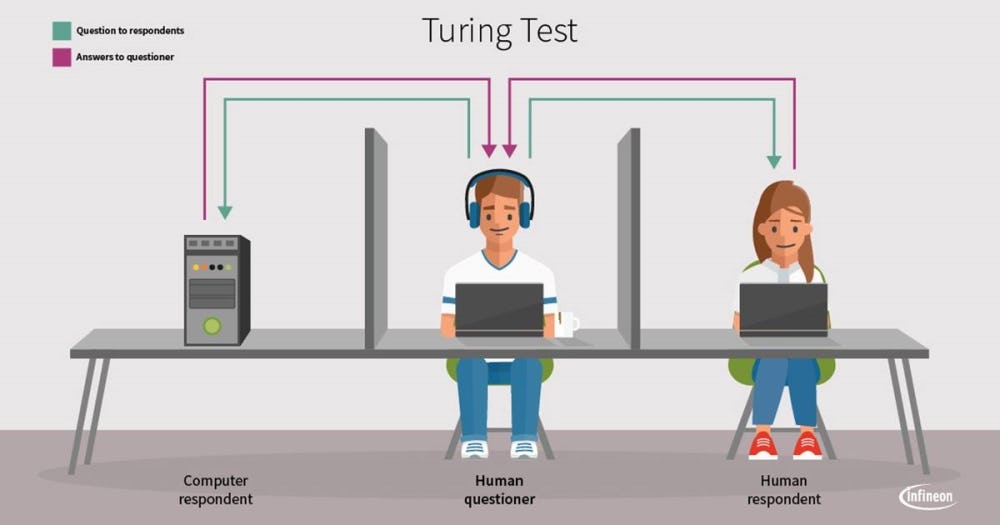
Turing's brilliant move was to shift the focus from an internal, unobservable state (thinking) to an external, observable behavior (conversation). The test doesn't ask if a machine is conscious; it asks if a machine's conversational behavior is indistinguishable from a human's.
For a deeper look into Turing's original formulation, let's read the first two sections of a detailed analysis of his paper.
On Turing’s “Computing Machinery and Intelligence”
The article 'On Turing’s “Computing Machinery and Intelligence”' by Ozaner Hansha breaks down Turing's seminal 1950 paper. Reading the first parts will give you a sense of Turing's original reasoning.
Please read the sections titled '§1. The Imitation Game' and '§2. Critique of the New Problem'. This will clarify how Turing framed the problem and why the text-based interface is so important.
The Significance of the Turing Test
The Turing Test is significant not because it's a perfect measure of intelligence, but because of the profound impact it has had on philosophy and AI research for over 70 years.
A Philosophical Catalyst
Turing's proposal was a major philosophical event. It provided a pragmatic, operational way to approach the question of machine intelligence. Before Turing, the debate was stuck in abstract arguments about souls, consciousness, and the definition of "thought." The test grounded the conversation in observable performance.
This challenged the "anthropocentric" or human-centered view of intelligence. By suggesting that intelligence could be defined by behavior, Turing opened the door to considering non-biological forms of thinking.
The Turing Test at 75: Its Legacy and Future Prospects
A recent article in 'IEEE Computer' magazine reflects on the test's 75th anniversary. It does an excellent job of summarizing its enduring significance.
Please read the sections titled 'Reflections and Significance' and 'Does the Turing Test Still Matter?'. Pay attention to how the test changed the conversation around intelligence.
Driving Research in AI
The test also set a concrete, albeit distant, goal for a new field of research. The challenge of creating a machine that could hold a coherent, wide-ranging conversation spurred the development of Natural Language Processing (NLP), a major subfield of AI dedicated to enabling computers to understand and generate human language.
Early programs, while simple by today's standards, were created with this kind of human-computer interaction in mind.
The Turing test: Can a computer pass for a human? - Alex Gendler
Let's return to the TED-Ed video to see examples of early chatbots and the clever, but limited, strategies they used.
Watch the rest of the video from 01:12 to the end. Notice the difference between programs that use simple tricks (like ELIZA) and modern approaches that analyze vast amounts of data.
As the video highlights, early chatbots like ELIZA (which mimicked a psychologist by reflecting questions back at the user) and PARRY (which simulated a paranoid individual) could fool some people for a short time. However, they relied on clever psychological tricks and pre-programmed scripts, not genuine understanding. They highlight a key weakness in the test: it can sometimes be "gamed."
Criticisms and Counterarguments
The Turing Test is perhaps most famous for the intense debate it has generated. The central criticism is that it's a test of imitation, not genuine intelligence or understanding. A system could be programmed with countless rules and a massive database of conversational tricks to pass the test without having any "mind" at all.
The Chinese Room Argument
The most famous objection is philosopher John Searle's "Chinese Room" thought experiment, proposed in 1980. It goes something like this:
- Imagine a person who doesn't speak Chinese is alone in a room.
- The room contains a giant rulebook written in English.
- Chinese characters are passed into the room through a slot.
- The person uses the rulebook to find which Chinese characters to pass back out in response. The rules are so good that to an outsider, it looks like a native Chinese speaker is inside the room.
Searle argues that even though the room (the system) passes a "Chinese Turing Test," the person inside doesn't understand a word of Chinese. They are just manipulating symbols. By analogy, a computer passing the Turing Test is just manipulating symbols according to its program, without any real understanding or consciousness.
Turing's Own Rebuttals
What's fascinating is that Turing anticipated many of these objections in his original paper. He considered and refuted nine potential arguments against the possibility of "thinking machines." Let's examine two of the most relevant ones.
On Turing’s “Computing Machinery and Intelligence”
We'll return to Ozaner's analysis of Turing's paper to see how Turing himself addressed some of the most common objections, long before they became famous.
Please navigate to '§6. Contrary Views on the Main Question'. Read his introductions to rebuttals #4 'The Argument from Consciousness' and #6 'Lady Lovelace's Objection'. These two address the ideas that machines can't feel or be original, which are still common arguments today.
As you read, Turing's response to the "Argument from Consciousness" is essentially a polite version of "How do you know anyone else is conscious?" We assume other people think and feel because they act like we do. If a machine could act with the same emotional and intellectual depth, why wouldn't we extend it the same courtesy?
His rebuttal to "Lady Lovelace's Objection"—the idea that a computer can only do what it's programmed to do and can't be original—is that human ideas are also built on what we've learned. With modern machine learning, where systems learn patterns from data rather than being explicitly programmed for every step, this argument has become even more complex.
The Turing Test Today
So, has any computer passed the test? In 2014, a chatbot named Eugene Goostman famously convinced 33% of judges that it was a 13-year-old Ukrainian boy. However, this "success" was widely criticized. By pretending to be a non-native-speaking teenager, the program had a built-in excuse for grammatical errors and knowledge gaps—a clever trick, but not a demonstration of true AGI.
With the rise of Large Language Models (LLMs) like those powering ChatGPT, the test has become both more relevant and more complicated. These models can hold remarkably human-like conversations, but researchers still debate whether this constitutes genuine intelligence or just extremely sophisticated mimicry—a high-tech version of Searle's Chinese Room.
The test's true legacy is not as a definitive benchmark but as a profound thought experiment. It forced us to ask difficult questions and continues to shape our discussions about AI's ultimate potential.
The Turing Test at 75: Its Legacy and Future Prospects
To conclude, let's read about the lasting impact of the test from the 'IEEE Computer' article.
Please read the section 'The Legacy of the Turing Test'. It provides a final perspective on why this 75-year-old idea is still so important.
Conclusion
In this lesson, we've explored one of the most iconic concepts in the history of artificial intelligence.
Here are your key takeaways:
- The Turing Test, originally called the "Imitation Game," was proposed by Alan Turing in 1950 as a practical way to address the question, "Can machines think?"
- It is a behavioral test where a human judge must distinguish between a human and a computer based on text-based conversations. If the judge can't, the machine passes.
- Its historical significance lies in shifting the debate from abstract philosophy to observable performance and in catalyzing research in areas like Natural Language Processing.
- The test has been heavily criticized for measuring only the ability to imitate human conversation, not genuine understanding or consciousness, as highlighted by Searle's "Chinese Room" argument.
- Today, the Turing Test remains a powerful philosophical tool for framing our questions about the nature of intelligence, both human and artificial.
Preview of the next lesson: Turing's paper was a foundational philosophical idea. But when did "Artificial Intelligence" become a formal scientific field? In our next lesson, we will travel to 1956 for the Dartmouth Conference, the pivotal event where the term "artificial intelligence" was coined and the key researchers who would define the field for decades first came together.