Hello! Welcome to your seventh lesson on artificial intelligence.
In our last lesson, we saw how the "AI winters" gave way to the modern AI boom, driven by the powerful combination of massive Data, powerful Compute (especially GPUs), and sophisticated Algorithms like backpropagation. You learned that these three ingredients together unlocked the era of deep learning.
Today, we'll examine the spectacular results of this boom by looking at three landmark AI achievements. Your learning outcome for this lesson is to describe the significance of Deep Blue, Watson, and AlphaGo as AI milestones.
These three systems are not just famous for winning games; they are crucial case studies that reveal the evolution of AI itself. We will trace the path from brute-force computation to nuanced language understanding, and finally to a form of machine creativity, setting the stage for the more advanced topics we'll cover later in the course.
Let's begin by placing these achievements on a timeline.
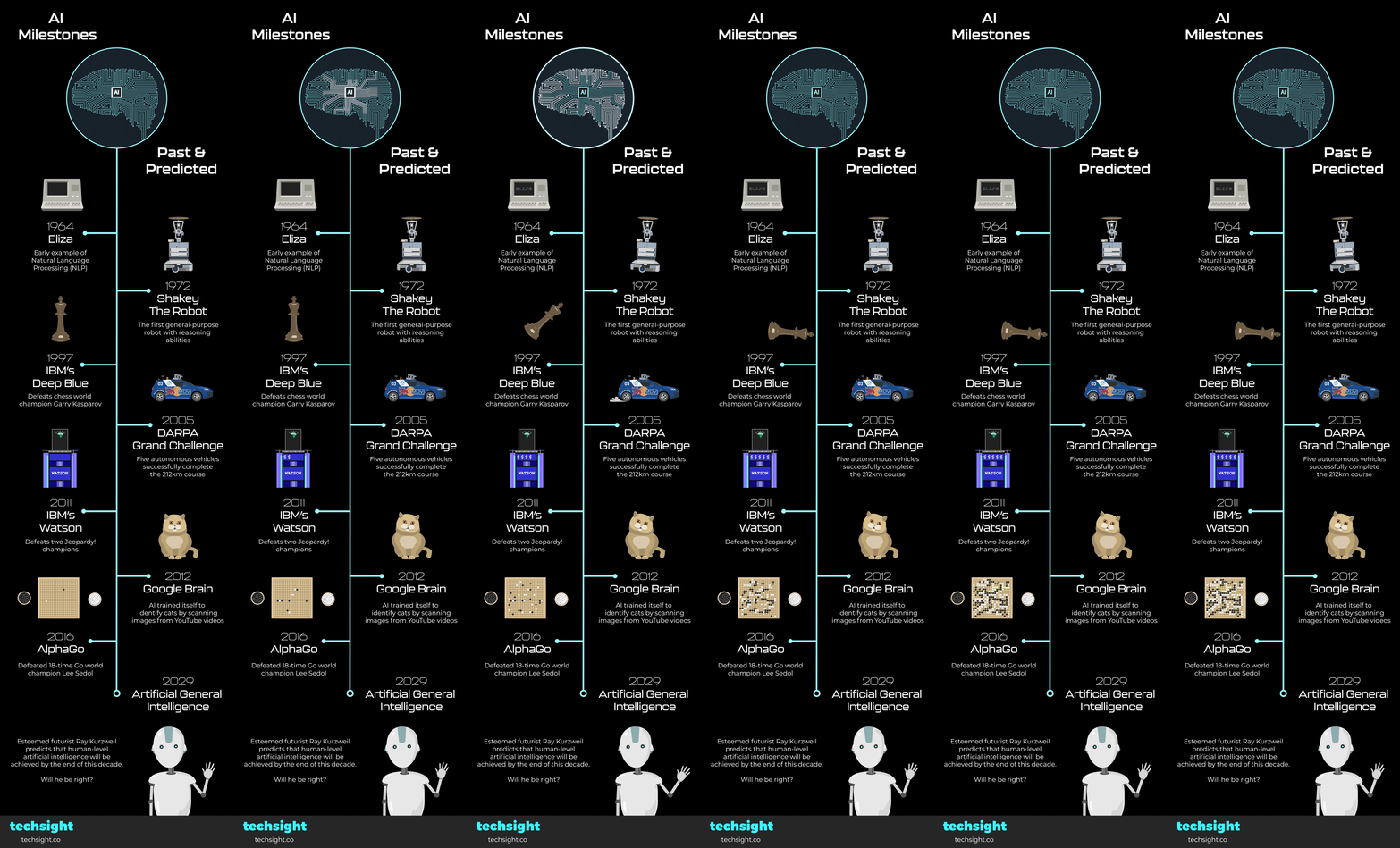
1. Deep Blue: The Brute-Force Champion (1997)
The first major milestone we'll explore is IBM's Deep Blue, a chess-playing computer that took on the reigning world champion, Garry Kasparov.
In 1997, Deep Blue defeated Kasparov in a six-game match. This was a monumental event. For centuries, chess was seen as a pinnacle of human intellect, requiring strategy, intuition, and foresight. Deep Blue's victory was the first time a machine officially defeated a sitting world champion in a standard tournament match, sending shockwaves through the public and the AI community.
But how did it win?
Deep Blue was a marvel of "Good Old-Fashioned AI" (GOFAI). Its power came not from human-like intuition, but from specialized hardware and raw computational muscle.
- Brute-Force Search: Deep Blue could evaluate around 200 million chess positions per second. This allowed it to use a brute-force search algorithm, looking many moves ahead to find the optimal path.
- Programmed Knowledge: Its intelligence was programmed by humans. It had a vast database of opening moves and endgame scenarios, and its core logic was a complex evaluation function, hand-crafted by chess grandmasters and programmers, to determine how "good" a particular board position was.
Deep Blue was an incredible engineering achievement, but it didn't learn. It played chess exactly as it was programmed to. To understand this distinction, let's watch a short video segment.
A Brief History of Artificial Intelligence: From Deep Blue to ChatGPT
The following clip from the Go Magic channel explains the nature of Deep Blue's victory and, importantly, highlights its limitations in terms of learning.
Watch the segment from 07:43 to 08:15. Pay close attention to the narrator's explanation of why Deep Blue was powerful and the description that it 'didn't really learn to be a better chess player as it played'.
Deep Blue's success demonstrated that for a well-defined game like chess, sheer computational power could overcome the best human strategic thinking. However, it also showed the limits of this approach. What about problems that are too complex for brute force, or that involve the messiness of human language?
2. Watson: The Language Master (2011)
Our next milestone, IBM's Watson, tackled a very different kind of challenge: the game show Jeopardy!.

In 2011, Watson competed against and defeated two of the show's greatest all-time champions. This was significant because Jeopardy! isn't a structured game of logic like chess. Winning requires understanding subtle, ambiguous, and often pun-filled human language—a task that had long stumped AI systems.
How did Watson master language?
Watson's approach was fundamentally different from Deep Blue's. It couldn't rely on brute-force search because the "rules" of language are not fixed. Instead, it represented a major leap in Natural Language Processing (NLP) and statistical reasoning.
To explore this, we'll dive into an article that breaks down how Watson worked.
IBM Watson on Jeopardy! - Historic AI Victory That Demonstrated ...
The following article, 'IBM Watson on Jeopardy!', provides a fantastic deep dive into the system's architecture and the challenges it overcame. We'll focus on a few key sections.
Please read the following two sections: Start at the heading 'The Challenge of Jeopardy!' and read until the heading 'Watson's Architecture'. This explains why the game was so difficult for an AI. Next, read the section titled 'Watson's Architecture'. Focus on the concept of generating multiple hypotheses (candidate answers) and then using scoring algorithms to rank them by confidence. \nThis should take about 10-15 minutes.
As you've read, Watson's core strategy can be summarized as follows:
- Parse the Clue: It analyzed the linguistic structure of the Jeopardy! clue to figure out what was being asked.
- Generate Hypotheses: It didn't search for a single right answer. Instead, its massively parallel architecture generated hundreds of possible answers (hypotheses) from its vast internal knowledge base (containing encyclopedias, books, articles, etc.).
- Gather Evidence & Score: For each hypothesis, it searched for evidence to support or refute it. Machine learning algorithms then calculated a confidence score based on the quantity and quality of evidence found.
- Buzz In: If the top-scoring hypothesis passed a certain confidence threshold, Watson would buzz in.
Watson's victory showed that AI could handle the ambiguity of natural language and reason with uncertainty. It wasn't just executing pre-programmed rules; it was using statistical evidence to make its best guess, much like a human might.
3. AlphaGo: The Creative Learner (2016)
While Watson conquered language, the ancient game of Go remained an "unsolvable" grand challenge for AI. In 2016, that changed when DeepMind's AlphaGo defeated Lee Sedol, one of the world's top Go players.
Why was Go so much harder than chess?
- Immense Complexity: The Go board is larger (19x19 vs. 8x8). The number of possible board configurations in Go is greater than the number of atoms in the known universe. A brute-force approach like Deep Blue's was mathematically impossible.
- Intuitive Strategy: Evaluating who is winning in Go is incredibly subtle and is often described by human players in terms of "intuition" or "feel."
AlphaGo's victory represented a new paradigm, perfectly illustrating the power of the modern AI boom's key ingredients: data, compute, and algorithms. Its approach was based on deep learning and reinforcement learning.
AI and Play, Part 2: Go and Deep Learning - CHM
The article 'AI and Play, Part 2: Go and Deep Learning' from the Computer History Museum explains this milestone beautifully. We will read the sections that detail why Go was so difficult and how AlphaGo's architecture worked.
Please read the following two sections: Start under the heading 'AI and Play, Part 2...' with the paragraph that begins 'As we saw in Part 1, traditional symbolic AI...'. Read until you reach the heading 'The Deep Learning Revolution'. This section details the immense complexity of Go. Next, find the paragraph under 'The Deep Learning Revolution' that starts with 'Being a system that plays a board game, AlphaGo still uses...'. Read this single, long paragraph to the end of the section. It explains AlphaGo's use of neural networks and reinforcement learning. \nThis should take about 10 minutes.
As the article described, AlphaGo's "brain" consisted of two deep neural networks:
- Policy Network: This network looked at the board and proposed a selection of the most promising next moves, dramatically narrowing the search space from astronomical to manageable.
- Value Network: This network evaluated a board position and estimated the probability of winning from that state.
Crucially, AlphaGo learned through a combination of methods:
- Supervised Learning: It first studied a database of 30 million moves from human expert games to learn what good moves look like.
- Reinforcement Learning: This was the key breakthrough. AlphaGo then played millions of games against itself. Every time it won, it would "reinforce" the decisions that led to the victory. This allowed it to discover strategies far beyond what it was shown in the human data.
This ability to self-teach and discover novel strategies relates directly to your interest in the connection between AI and neuroscience. Reinforcement learning is conceptually similar to how animals, including humans, learn from trial and error based on rewards and punishments.
The most famous demonstration of AlphaGo's power was "Move 37" in its second game against Lee Sedol. The move was so unusual that human commentators first dismissed it as a beginner's mistake. But it turned out to be a brilliant, creative move that was central to AlphaGo's victory. The machine had discovered a strategy that was outside the realm of human Go theory for thousands of years.
Conclusion
In this lesson, we've examined three pivotal moments in AI history that each signify a different era of AI development.
Key Takeaways:
- Deep Blue (1997) represented the peak of Good Old-Fashioned AI. It demonstrated that massive brute-force computation and programmed expert knowledge could defeat the best human player in a complex, logical game like chess.
- IBM Watson (2011) was a breakthrough in Natural Language Processing. It showed that an AI could understand ambiguous human language by using statistical methods, generating many hypotheses, and evaluating evidence to determine confidence.
- AlphaGo (2016) marked the triumph of modern deep learning and reinforcement learning. It mastered a game too complex for brute force by learning from data and then teaching itself, even discovering novel, "creative" strategies beyond human expertise.
The progression from Deep Blue to Watson to AlphaGo is a story of increasing abstraction and autonomy—from being explicitly programmed, to reasoning with statistical evidence, to learning on its own.
Preview of the next lesson:
To truly understand how a system like AlphaGo's neural networks "learns" or how Watson represents knowledge, we need to speak their language: mathematics. In the next module, we will begin building our mathematical foundations. We'll start with the very basics, exploring how AI systems represent data—from a simple data point to a complex image—using fundamental structures like vectors and matrices. This will be our first step toward demystifying what really happens inside these incredible models.