Hello. Welcome to your fourth lesson in our course on the foundations of psychology.
In our last lesson, we traced the birth of psychology as a science, culminating in Wilhelm Wundt's Leipzig laboratory in 1879. We saw how Wundt's goal was to build a "periodic table of the mind" by analyzing immediate conscious experience into its most basic elements. This approach, brought to America and championed by his student E.B. Titchener, became the first formal "school of thought" in psychology.
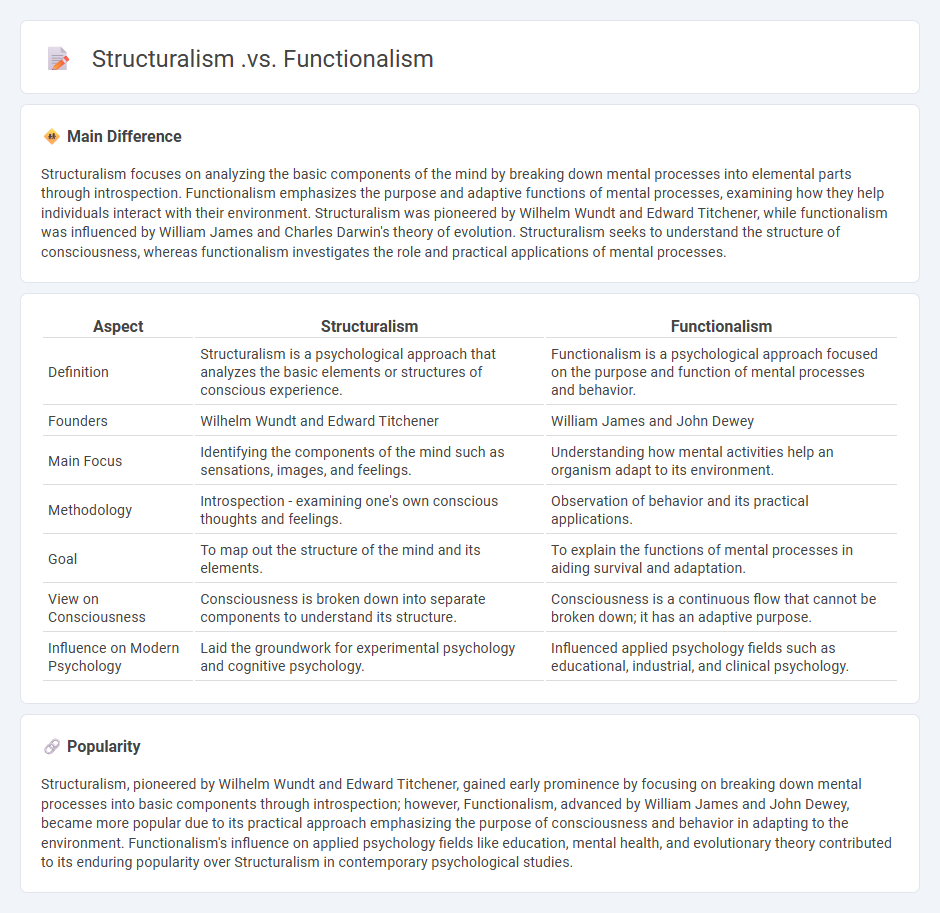
Today, we will critically examine this first school, Structuralism, and its two major early rivals: Functionalism and Psychoanalysis. These three schools offered competing visions for what psychology should study and how it should be studied, setting the stage for the major debates that would shape the field for the next century.
This lesson will address the learning outcome: Critically compare the core tenets, methods, and limitations of structuralism, functionalism, and psychoanalysis.
1. Structuralism: The "What" of the Mind
As we discussed, the first school of psychology grew directly out of Wundt's laboratory work. Its American proponent, Edward Bradford Titchener, named it Structuralism. The core idea was that psychology's task was to discover the basic structure of conscious experience by breaking it down into its constituent components.
To get a quick overview of structuralism, its methods, and its immediate successor, please watch the following short segment.
A Brief History of Psychology: From Plato to Pavlov
This video from Professor Dave Explains provides a concise introduction to Structuralism, founded by Titchener, and Functionalism, which arose in response to it.
Please watch from 04:08 to 06:00. Focus on how structuralists aimed to identify the 'basic elements' of psychological processes and the method they used, called introspection.
As the video explained, Structuralism had a clear, if narrow, agenda:
-
Core Tenets: The goal was to create a comprehensive inventory of the elements of consciousness, much like a chemist identifies the elements in the periodic table. Titchener believed these elements could be classified into three types:
- Sensations (the basic elements of perception)
- Images (the elements of ideas)
- Affections (the elements of emotion)
The structuralist task was to identify the attributes of these elements (e.g., quality, intensity, duration, clarity) and discover how they combined to form complex mental phenomena.
-
Method: The sole method was experimental introspection. This was a highly rigorous and demanding technique. Trained observers were presented with controlled stimuli (e.g., a specific color, a metronome's tick) and had to provide a detailed report of their raw, moment-to-moment sensations and feelings. A critical rule was to avoid the "stimulus error"—reporting the name of the object ("I see an apple") instead of the pure sensory qualities ("redness, roundness, smoothness").
-
Limitations: Despite its rigor, Structuralism was short-lived, largely due to its profound limitations:
- Unreliable & Subjective: Introspection depended on the unique conscious experience of each individual. When trained observers in different labs introspected on the same stimulus and reported different experiences, there was no objective way to resolve the disagreement.
- Limited Scope: The method was useless for studying subjects who could not be trained to introspect, such as animals, children, and individuals with mental disorders. It also couldn't access unconscious processes.
- Artificiality: The act of analyzing a conscious experience may fundamentally change it. As the functionalists would argue, our mental life is a continuous, flowing stream, not a collection of static, brick-like elements.
2. Functionalism: The "Why" of the Mind
As Structuralism was establishing itself in America, a distinctly American counter-movement emerged: Functionalism. Spearheaded by thinkers like William James and John Dewey, functionalists were less interested in the static contents of the mind and far more interested in its purpose.
The following video lecture provides a clear explanation of Functionalism's origins, its core ideas, and its connection to evolutionary theory.
Origins of Psychology: Functionalism
This video from ProfHahn's channel details the functionalist school of thought, highlighting William James's role and the profound influence of Charles Darwin's theories.
Please watch from the beginning to 03:17. Pay close attention to the contrast with structuralism, the focus on the 'why' of consciousness, and the role of natural selection in shaping psychological traits.
Drawing on the video and moving toward a more advanced analysis, we can contrast functionalism with structuralism directly.
Conceptual Foundations: Teaching the Historical Development of ...
This academic article provides a detailed comparison between structuralism and functionalism, framing the latter as a pragmatic, American response to the 'ivory tower' nature of the former.
Please read the two paragraphs that start with 'However, as the 19th century drew to a close...'. Focus on how functionalism prioritized practical applications and asked 'Why?' questions about adaptation, in direct contrast to structuralism's focus on 'How?' questions about structure.
This contrast highlights the core differences:
-
Core Tenets: Influenced by Charles Darwin's theory of evolution, functionalists argued that psychological characteristics must have an adaptive purpose. Consciousness, thinking, emotions—these traits exist because they help us survive, adapt to our environment, and thrive. William James famously described consciousness not as a set of discrete elements but as a "stream of consciousness"—a continuous, ever-changing flow of thoughts, feelings, and sensations. The key question was not "What is consciousness made of?" but "What is consciousness for?"
-
Method: Functionalists were methodologically eclectic and pragmatic. They were not bound to a single method. They used introspection but also embraced objective measures like:
- Questionnaires and mental tests
- Observations of behavior
- Physiological measurements
Their interest in adaptation naturally led them to study a wider range of populations, including animals, children, and individuals with different abilities, pioneering the fields of educational psychology and individual differences.
-
Limitations:
- Vague Concepts: The term "function" was often used loosely and was difficult to define precisely, making some functionalist theories hard to test rigorously.
- Post-Hoc Explanations: As the ProfHahn video hints, evolutionary explanations can sometimes be difficult to test empirically because we cannot run evolutionary experiments. Explanations for why a trait is adaptive can sometimes be constructed "after the fact" to fit the observed data, a criticism that continues to be leveled at some work in modern evolutionary psychology.
3. Psychoanalysis: The Unseen Depths
While structuralists and functionalists debated the nature of consciousness in university labs, a third, radically different perspective was emerging from a neurologist's clinic in Vienna. Psychoanalysis, developed by Sigmund Freud, largely ignored the study of conscious experience and argued that our behavior is dominated by powerful forces of which we are completely unaware.
Given your medical background, you may find it interesting that this school of thought originated not in academic psychology but in clinical practice, as Freud sought to understand and treat patients with neurological symptoms that had no apparent physical cause.
Let's begin with a brief introduction to Freud's model of the mind.
A Brief History of Psychology: From Plato to Pavlov
The same video from Professor Dave Explains introduces the basics of Freudian psychoanalysis, including the concept of the unconscious and the structure of the psyche.
Please watch from 05:53 to 07:57. Focus on the role of the unconscious and the functions of the id, ego, and superego.
Freud's theory was a departure from the academic psychology of his time:
-
Core Tenets: The central tenet is the existence of a vast unconscious mind containing repressed memories, forbidden desires, and instinctual drives (primarily sexual and aggressive) that dictate our personalities and behaviors. Freud proposed a tripartite structure of the psyche:
- Id: The primitive, instinct-driven part, operating on the pleasure principle.
- Superego: The internalized moral conscience, representing societal rules and ideals.
- Ego: The mediator, operating on the reality principle, trying to satisfy the id's desires in a way that is acceptable to the superego and the external world.
For Freud, psychological health was a matter of dynamic balance between these three components. Neurosis arose from unresolved conflicts, often rooted in early childhood experiences.
-
Method: Psychoanalysis is not an experimental science. Its methods are clinical and interpretive, aimed at making the unconscious conscious. Key techniques include:
- Case Studies: In-depth analysis of individual patients.
- Free Association: Patients say whatever comes to mind, allowing unconscious material to slip past the ego's defenses.
- Dream Analysis: Freud called dreams the "royal road to the unconscious," believing their content represented symbolic wish-fulfillments.
-
Limitations: The scientific status of psychoanalysis has been fiercely debated since its inception. This is where we can engage in a more advanced, PhD-level critique.
[PDF] thoughts on the science of psychoanalysis
To understand the fundamental challenges to psychoanalysis as a science, we will read the introduction to a paper on its epistemology (the theory of knowledge). This reading discusses whether psychoanalysis is a natural science, an objective discipline, or something else entirely, like an interpretive or 'hermeneutic' science.
Please read the 'INTRODUCTION' section (the first three paragraphs of the article). Focus on the core problem: psychoanalytic concepts are about subjective, private experiences that are not easily testable or measurable in the way a natural science requires.
The primary limitations, as the reading suggests, are epistemological:
- Unfalsifiability: This is the most significant criticism. A scientific theory must be falsifiable—that is, there must be a way to prove it wrong. Many psychoanalytic concepts are constructed in a way that they can explain any outcome. For example, if a patient accepts an interpretation about their unconscious hostility toward a parent, it's seen as a successful insight. If they vehemently reject it, it's interpreted as "resistance," which also confirms the unconscious conflict. The theory is protected from being proven wrong.
- Lack of Empirical Evidence: The theory was built on a small number of case studies of Freud's own patients, who were not representative of the general population. Its core concepts (like the id, psychic energy, or psychosexual stages) are difficult to operationalize and test in controlled experiments.
- Overemphasis on Sex and Aggression: Many critics, even within the psychodynamic tradition, felt Freud's focus on sexual and aggressive drives as the primary human motivators was too narrow and ignored other important influences.
Conclusion: A Comparative Synthesis
Structuralism, Functionalism, and Psychoanalysis were the foundational pillars of early psychology. Each offered a radically different answer to the question of what psychology should be.

Here is a table summarizing their critical differences:
| Feature | Structuralism | Functionalism | Psychoanalysis |
|---|---|---|---|
| Main Goal | Analyze consciousness into its basic structural elements. | Understand the adaptive purpose/function of mental processes. | Uncover and resolve unconscious conflicts. |
| Focus | The "what" of the mind; static structure of conscious thought. | The "why" of the mind; adaptation to the environment. | Unconscious drives, motives, and early childhood experiences. |
| Key Figure(s) | E.B. Titchener, Wilhelm Wundt | William James, John Dewey | Sigmund Freud |
| Methodology | Experimental Introspection | Eclectic (introspection, observation, questionnaires, tests) | Clinical Case Study (free association, dream analysis) |
| Core Flaw | Subjective & Unreliable: Reports could not be publicly verified. | Vague Concepts: "Function" was an imprecise and hard-to-test concept. | Unfalsifiable: Key concepts could not be scientifically tested or proven wrong. |
Key Takeaways:
- Structuralism gave psychology its start as a science by emphasizing rigorous laboratory methods but ultimately failed because its subject matter (private experience) was not verifiable.
- Functionalism broadened psychology's scope to include behavior, practical applications, and a wider range of subjects, paving the way for fields like evolutionary and educational psychology.
- Psychoanalysis revolutionized thinking about the mind by introducing the unconscious and pioneering psychotherapy, but its resistance to scientific validation has kept it on the periphery of academic psychology.
While none of these schools exists today in its original form, their questions and influences are woven into the fabric of modern psychology.
Preview of the Next Lesson:
The intense debates between these schools, particularly the perceived flaws of subjective introspection (Structuralism) and unscientific interpretation (Psychoanalysis), created a demand for a truly objective psychology. The next major school of thought would propose a radical solution: abandon the study of the mind altogether and focus only on what can be seen and measured—behavior. In our next lesson, we will evaluate the Behaviorist Revolution.