Hello! Welcome to your fifth lesson in our course on the foundations of psychology.
In our last lesson, we examined the first three major schools of thought: Structuralism, Functionalism, and Psychoanalysis. We concluded that while each was influential, they all faced significant critiques. Structuralism's method of introspection was deemed too subjective and unreliable, while Psychoanalysis, with its focus on the unobservable unconscious, was criticized for being unscientific and unfalsifiable. This created an intellectual void and a demand for a new approach that could place psychology on a firm scientific footing.
Today, we explore the radical answer to that demand: the Behaviorist Revolution. Behaviorism proposed to solve the problems of subjectivity and unfalsifiability by making a clean break from the past. It argued that if you can't see it and measure it, it has no place in science. The "mind," "consciousness," and "unconscious" were to be abandoned in favor of studying the only thing that could be objectively observed: behavior.
This lesson directly addresses the learning outcome: Evaluate the behaviorist revolution, analyzing the contributions of Watson and Skinner and the shift towards observable behavior. We will dissect this pivotal movement by examining its two main architects and the profound shift in perspective they championed.
1. John B. Watson and the Birth of Behaviorism
The behaviorist revolution was formally launched by an American psychologist named John B. Watson. Frustrated with the endless, unresolvable debates of the introspectionists, Watson published an article in 1913 that would become known as the "Behaviorist Manifesto." He argued that for psychology to be a true natural science, it must model itself after physics and chemistry, focusing exclusively on publicly observable and measurable phenomena.
To get an overview of Watson's role and his core principles, please watch this short video.
Watson’s Theory of Behaviorism: Key Concepts (John B. Watson Behavioral Theory)
This video from PHILO-notes introduces John B. Watson as the champion of the behaviorist movement and outlines the central goal of his new psychology.
Please watch the first two minutes of the video (00:00 to 02:18). Focus on how Watson defined behaviorism as an objective, experimental science with the goal of predicting and controlling behavior.
As the video explains, Watson's vision was uncompromising:
"Psychology as the behaviorist views it is a purely objective experimental branch of natural science. Its theoretical goal is the prediction and control of behavior." (Watson, 1913)
This was a complete redefinition of the field. Let's break down the core components of Watson's contribution.
The Shift to S-R Psychology
Watson proposed that all behavior, no matter how complex, could be broken down into a chain of stimulus-response (S-R) connections. The environment presents a stimulus (S), which elicits a response (R) from the organism. For Watson, the job of a psychologist was to understand these connections. The "black box" of the mind—containing thoughts, feelings, and consciousness—was deemed irrelevant because it was unobservable.
To understand how Watson put this idea into practice, we'll examine his most famous and controversial experiment: the "Little Albert" study.
Watson’s Theory of Behaviorism: Key Concepts (John B. Watson Behavioral Theory)
This segment of the PHILO-notes video describes the 'Little Albert' experiment, which is a classic demonstration of Watson's principles.
Please watch from 02:18 to 04:03. Pay attention to how a previously neutral stimulus (a white rat) was paired with an unconditioned stimulus (a loud noise) to create a conditioned emotional response (fear).
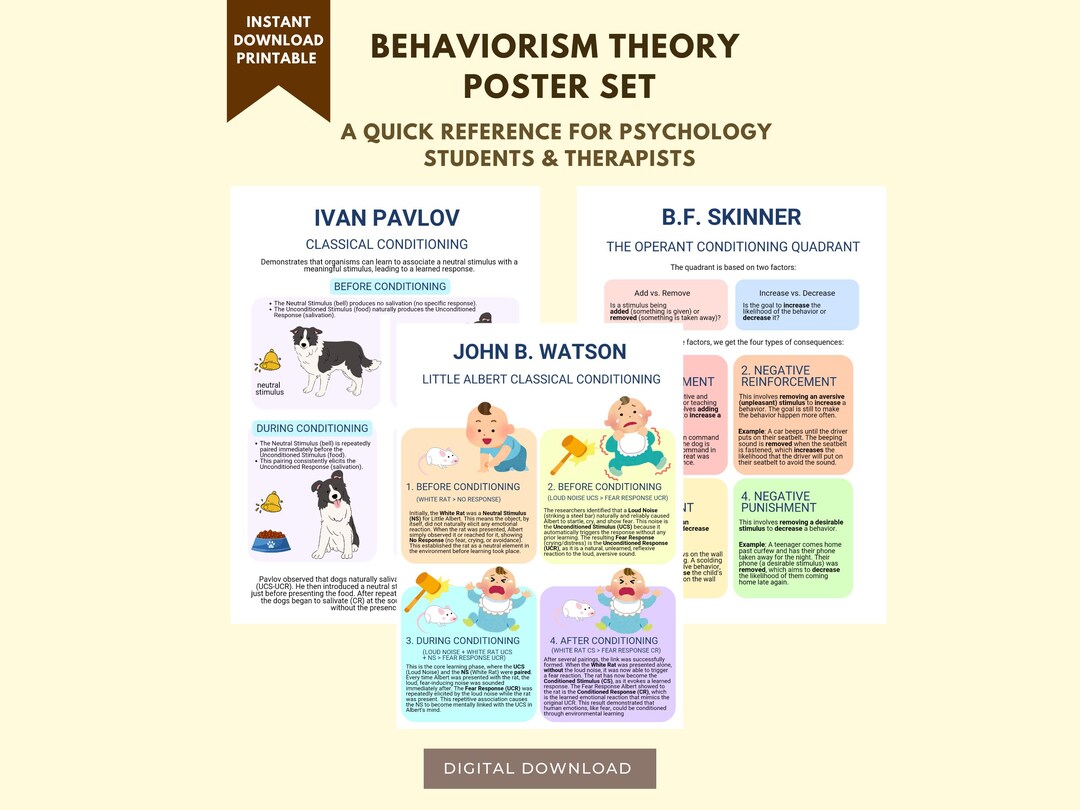
The Little Albert experiment was crucial for Watson because it demonstrated that a complex human emotion like fear could be created—or conditioned—through simple, observable environmental manipulations.
- Before conditioning: Albert saw a white rat (Neutral Stimulus) and showed no fear. He heard a loud steel bar clang (Unconditioned Stimulus) and naturally became afraid (Unconditioned Response).
- During conditioning: Watson presented the rat and then immediately made the loud noise.
- After conditioning: The sight of the rat alone (now a Conditioned Stimulus) was enough to make Albert cry and show fear (now a Conditioned Response).
Watson argued this proved that our deep-seated fears and other emotional responses were not the product of unconscious conflicts, as Freud would say, but were learned through conditioning.
Watson's Legacy
Watson's early behaviorism, often called classical S-R behaviorism, established the movement's core tenets: a focus on observable behavior, an emphasis on learning and environmental determinism, and a rejection of mentalistic concepts. It promised a psychology that was objective, practical, and scientific.
2. B. F. Skinner and Radical Behaviorism
While Watson lit the revolutionary fire, it was Burrhus Frederic (B.F.) Skinner who developed behaviorism into a comprehensive and rigorous philosophy of science known as Radical Behaviorism. Skinner took Watson's ideas a step further. Where Watson chose to ignore the mind, Skinner argued that mental events like thoughts and feelings are simply more behaviors—covert (private) behaviors—that are themselves caused by environmental factors, not the other way around.
To understand Skinner's philosophy in his own words, we will watch a few key segments from an interview he gave in 1988. This will provide a direct, PhD-level insight into his thinking.
B. F. Skinner - Philosophy of Behaviorism (1988)
In this first clip from a 1988 interview, B. F. Skinner explains his fundamental view that concepts like 'mind' are verbal constructs that we developed to talk about behavior, not pre-existing entities that cause behavior.
Please watch from 00:31 to 02:41. Focus on his argument that behavior is the result of 'genetic and personal history' and that 'mind' is something we talk about, not something that initiates action.
Skinner's core argument is that we don't need to look inside the organism for causes. Once we have a complete science of how the environment selects and shapes behavior, the need for internal explanations disappears.
Operant Conditioning
Skinner's primary scientific contribution was the experimental analysis of operant conditioning. While classical conditioning (Watson/Pavlov) deals with how existing responses are triggered by new stimuli (S-R), operant conditioning deals with how new, voluntary behaviors are acquired and maintained based on their consequences.
The basic principle is simple:
- Behavior followed by a reinforcing consequence is more likely to be repeated.
- Behavior followed by a punishing consequence is less likely to be repeated.
This is different from Watson's model. In the operant framework, the organism operates on its environment, and the consequences of that action feed back to change the likelihood of future actions. Skinner and his students meticulously studied how different schedules of reinforcement (e.g., reinforcing a behavior every time vs. intermittently) produced distinct and predictable patterns of behavior.
Radical Behaviorism: Rejecting the Inner "Self"
Skinner's philosophy becomes "radical" when he applies this logic to all human activity, including thinking, feeling, and decision-making. For Skinner, a "thought" is not the cause of an action; both the thought and the action are products of the same environmental history.
Let's watch another clip where Skinner elaborates on this, rejecting the idea of an inner self or agent that originates behavior.
B. F. Skinner - Philosophy of Behaviorism (1988)
Here, Skinner explains his statement 'the speaker is a locus,' arguing that an individual is simply a place where genetic and environmental histories converge to produce behavior. This is a direct challenge to our common-sense notions of free will and personal responsibility.
Please watch from 14:06 to 18:37. Listen to his argument that nothing truly 'originates' within us and his explanation for why people resist this idea—it seems to take away credit for good deeds and blame for bad ones.
Skinner's position is a form of scientific determinism: behavior is determined by an organism's genetic endowment and its history of reinforcement. What we call "choice" is simply a moment where the variables controlling our behavior lead to one response over another.
3. Evaluating the Behaviorist Revolution
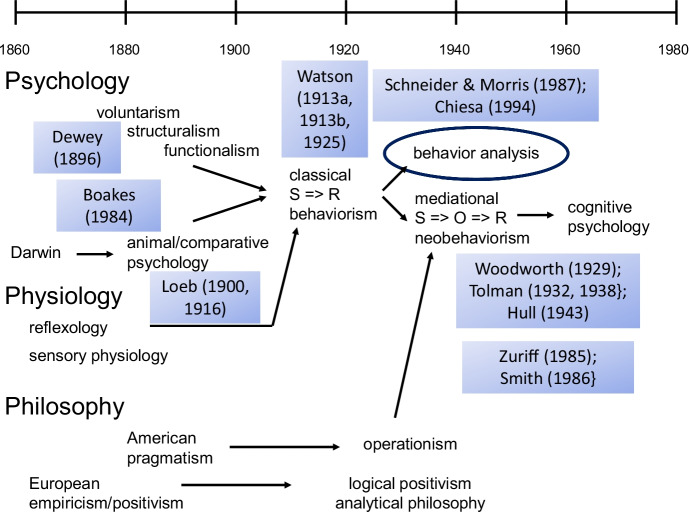
Behaviorism dominated American academic psychology for roughly four decades (from the 1920s to the 1960s). To evaluate this revolution, we must weigh its significant contributions against its profound limitations.
To ground our evaluation, let's turn to an academic source that summarizes the behaviorist movement and its philosophical underpinnings.
Behaviorism | Internet Encyclopedia of Philosophy
The Internet Encyclopedia of Philosophy provides a scholarly overview of Behaviorism. The sections we will read summarize the contributions of Watson and Skinner and set the stage for later criticisms.
Please read the two subsections titled 'John B. Watson: Early Behaviorism' and 'B. F. Skinner: Radical Behaviorism'. These sections will reinforce and add detail to what we've just covered, positioning Watson as the revolutionary founder and Skinner as the developer of a radical, comprehensive system.
Contributions and Strengths
- Scientific Rigor: Behaviorism's greatest contribution was its insistence on objective, replicable, and rigorous experimental methods. It moved psychology away from private speculation and toward public data.
- Focus on Learning: It provided powerful and elegant principles of learning (classical and operant conditioning) that remain fundamental concepts in psychology today.
- Practical Applications: Behaviorist principles have given rise to a host of effective technologies, including:
- Behavior Therapy: Highly effective treatments for phobias, anxiety disorders, and addictions (e.g., systematic desensitization).
- Applied Behavior Analysis (ABA): A widely used intervention for autism spectrum disorder.
- Education: Principles of reinforcement are used in classroom management and instructional design.
Criticisms and Limitations
Despite its successes, behaviorism was ultimately overthrown because its refusal to look inside the "black box" was seen as intellectually crippling.
- Neglect of Cognitive Processes: By the 1950s and 60s, a growing number of psychologists argued that complex human behaviors like problem-solving, planning, and language could not be explained by S-R chains or reinforcement histories alone. This dissatisfaction led to the Cognitive Revolution, which sought to scientifically study internal mental processes.
- Inability to Explain Language: In a landmark 1959 review, linguist Noam Chomsky delivered a devastating critique of Skinner's book Verbal Behavior. Chomsky argued that behaviorist principles could not account for the creativity and generativity of language—for example, how young children produce entirely novel sentences they have never heard or been reinforced for saying.
- Rejection of Consciousness: For many, behaviorism's most glaring flaw was its denial of what it means to be human: our subjective experiences, thoughts, feelings, and intentions. Critics joked that behaviorists pretended to be under "general anesthesia" or that when two behaviorists greet each other, one says, "You're fine. How am I?"
To explore this central criticism in more depth, please read the following short section from our previous resource.
Behaviorism | Internet Encyclopedia of Philosophy
This section of the 'Behaviorism' article from the Internet Encyclopedia of Philosophy directly addresses the primary objection to the movement: its denial of consciousness.
Please read the section titled 'b. The Ur-Objection: Consciousness Denied'. This will summarize the core philosophical and common-sense objections to the behaviorist worldview.
Conclusion
The behaviorist revolution was a necessary and corrective force in the history of psychology. It forced the field to adopt rigorous scientific methods and provided powerful insights into how behavior is shaped by the environment.
Key Takeaways:
- The behaviorist revolution was a reaction against the subjectivity of introspection and the unfalsifiability of psychoanalysis, proposing that psychology should be the science of observable behavior.
- John B. Watson initiated the movement, defining psychology as an objective science of stimulus-response (S-R) connections, with the goal of prediction and control.
- B.F. Skinner developed Radical Behaviorism, a comprehensive philosophy that explained behavior through operant conditioning (reinforcement and punishment) and argued that "mental states" are not causes but are themselves private behaviors to be explained.
- Behaviorism's legacy includes a commitment to scientific rigor and a host of effective therapeutic applications. However, its dominance ended due to its inability to account for complex cognitive functions like language and its complete rejection of consciousness and internal mental life.
Preview of the Next Lesson:
The perceived shortcomings of both psychoanalysis (too unscientific) and behaviorism (too mechanistic and dismissive of human experience) led to two major counter-movements. The first, Humanistic Psychology, rebelled against the deterministic views of both schools, championing free will and human potential. The second, the Cognitive Revolution, rebelled against behaviorism's "black box," seeking to open it and study the mind scientifically. In our next lesson, we will explore these two powerful reactions.