Hello. Welcome to your third lesson in our course on the foundations of psychology.
In our previous lesson, we examined the foundational philosophical debates—mind vs. body, and innate knowledge vs. experience—that set the stage for psychology. For centuries, these questions were the domain of philosophers. Today, we witness a pivotal moment in intellectual history: the transition from asking these questions in an armchair to answering them in a laboratory.
This lesson will address the learning outcome: Trace the emergence of psychology as a science from 19th-century physiology and psychophysics to Wundt's laboratory. We will follow the intellectual breadcrumbs that led from the study of the body's mechanics to the quantitative measurement of the mind, culminating in the establishment of psychology as an independent, scientific discipline.
1. The Physiological Revolution: Measuring the Speed of Mind
By the mid-19th century, particularly in Germany, a philosophy of Wissenschaft (a unified approach to scholarship and science) fueled rapid advances in physiology. Scientists were beginning to unravel the mysteries of the nervous system, and their discoveries directly challenged the idea that the mind was a non-physical, unknowable entity.
Three key physiological discoveries laid the foundation for an experimental psychology:
- The Bell-Magendie Law (c. 1822): This law demonstrated that sensory nerves and motor nerves are separate. Sensory information flows from the body to the brain via one set of pathways (dorsal roots of the spinal cord), and motor commands flow from the brain back to the body via another (ventral roots). This was a crucial first step in mapping function onto the structure of the nervous system.
- Müller's Doctrine of Specific Nerve Energies (c. 1838): Johannes Müller proposed that the quality of our sensory experience depends not on the stimulus itself, but on the specific nerve that is stimulated. For example, you experience "light" whether your optic nerve is stimulated by a photon or by direct physical pressure (which is why you "see stars" when you rub your eyes). This radical idea located experience squarely within the nervous system, making the brain the direct organ of the mind.
- Helmholtz's Measurement of Nerve Conduction (c. 1850): Perhaps the most critical breakthrough came from Hermann von Helmholtz. Previously, it was assumed that nerve impulses were instantaneous, as fast as the speed of light, placing them beyond measurement. Helmholtz, using a frog's leg muscle, demonstrated that nerve conduction was a relatively slow, measurable physical process (about 25-40 meters per second). This was revolutionary: it proved that mental processes, which rely on nerve impulses, are not instantaneous. They take time, and therefore, their duration can be measured.
These discoveries transformed the study of the mind. If mental events were physical and took a measurable amount of time, they could, in principle, be studied scientifically. This set the stage for the first attempts to quantify mental experience.
2. Psychophysics: A Science of Mental Life
The first discipline to systematically explore the mathematical relationship between the physical world and our psychological experience of it was psychophysics. It sought to answer questions like: How much brighter does a light need to get before we notice a change?
To understand the birth of this field, please read the following section from a chapter on German psychology.
[PDF] WUNDT AND GERMAN PSYCHOLOGY
This reading, from the text 'WUNDT AND GERMAN PSYCHOLOGY', details the crucial contributions of Ernst Weber and Gustav Fechner, the founders of psychophysics. It explains how they developed methods to quantify sensory experience.
Please read the section titled 'ON THE THRESHOLD OF EXPERIMENTAL PSYCHOLOGY: PSYCHOPHYSICS' (starts on page 86). Focus on the contributions of Ernst Weber (two-point thresholds, Weber's Law) and Gustav Fechner (his philosophical goal, reformulation of Weber's law, and his three key methods).
As you have read, Weber and Fechner were the key figures in this movement:
-
Ernst Weber, a physiologist, developed precise techniques like the two-point threshold to map skin sensitivity. His most important contribution was discovering that the just noticeable difference (jnd)—the smallest change in a stimulus that can be detected—is not a fixed amount but a constant proportion of the original stimulus. This relationship became known as Weber's Law:
Where is the intensity of the standard stimulus, is the change needed to produce a jnd, and is a constant (Weber's fraction). -
Gustav Fechner, a physicist and philosopher, had a more ambitious goal. He wanted to solve the mind-body problem by finding a precise mathematical relationship between the physical (stimulus) and the mental (sensation). He reformulated Weber's law into a logarithmic function:
Where is the magnitude of the sensation, is the stimulus intensity, and is a constant. He also systematized the research methods—the method of limits, the method of constant stimuli, and the method of adjustment—that are still foundational to sensory research today.
Fechner's 1860 book, Elements of Psychophysics, is often considered the first book of experimental psychology. It demonstrated, for the first time, that psychological events could be measured with the same precision as physical ones.
3. Wilhelm Wundt and the Founding of Psychology
While Fechner laid the methodological groundwork, it was Wilhelm Wundt who deliberately and successfully established psychology as a formal, independent scientific discipline. Wundt, trained as a physician and physiologist (he was even Helmholtz's assistant), was the field's great promoter and organizer.
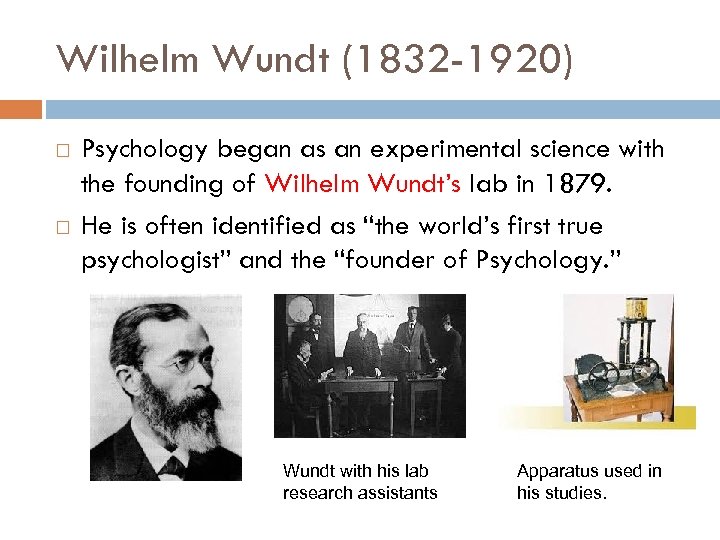
In 1879, at the University of Leipzig, Wundt was granted space for his equipment, which he transformed into the first official Institute for Experimental Psychology. This date is conventionally marked as the "birth" of psychology.
The following video explores why Wundt is given the title "Father of Psychology" and provides a detailed example of the kind of research conducted in his lab.
Module 4A _ Willhelm Wundt, the Father of Psychology
This video from Dr. Steve Joordens' course on the history of psychology explains the significance of Wundt's lab, his goal of finding the 'elements' of consciousness, his rigorous method of introspection, and his tri-dimensional theory of feeling.
Please watch from the beginning to 25:30. Pay close attention to: Why the founding of a lab (an empirical center) was the key event. Wundt's goal of creating a 'periodic table' of mental elements. The distinction between casual self-observation and his trained, scientific introspection. The metronome experiment as an example of how he studied feelings and conscious experience.
Wundt's new science had several key features:
- Subject Matter: The study of immediate conscious experience. Wundt wanted to analyze consciousness into its basic elements, much like a chemist analyzes a compound. He contrasted this with mediate experience (e.g., reading a thermometer), which is filtered through an instrument. Psychology's instrument was consciousness itself.
- Method: Experimental Introspection (or innere Wahrnehmung - internal perception). This was not casual daydreaming. It was a highly structured, rigorous process where trained observers would respond to precisely controlled stimuli (like lights, sounds, or metronome beats). They were trained to report their raw, immediate sensations and feelings without interpretation. For Wundt, reporting "I see a red square" was a "stimulus error"; the trained observer would report the raw qualities of "redness," "squareness," and any associated feelings.
- Research Areas: The Leipzig lab focused on two main areas:
- Sensation and Perception: Using psychophysical methods to map vision, hearing, and touch.
- Mental Chronometry: Building on Helmholtz's work, Wundt and his students used reaction time to measure the duration of mental processes. Following the Dutch physiologist F.C. Donders, they developed a subtractive method. For example, they would measure simple reaction time (e.g., press a key when you see a light) and then a more complex choice reaction time (e.g., press the left key for a red light, the right key for a green light). The difference in time between these two tasks was thought to represent the time taken for the mental process of "choice."
It's important to note that Wundt believed his laboratory methods were only suitable for studying basic conscious processes. He argued that higher mental processes like language, myth, and culture were shaped by history and society, and thus could not be studied with experiments. He devoted the last 20 years of his life to this other psychology, which he called Völkerpsychologie ("cultural psychology"), a project that filled ten volumes.
Conclusion
This lesson traced the critical path that led psychology out of philosophy and into the laboratory. The intellectual climate of 19th-century Germany, combined with key scientific breakthroughs, made the idea of a scientific psychology not only possible but inevitable.
Key Takeaways:
- Physiology provided the tools: Discoveries like the separation of sensory/motor nerves (Bell-Magendie), the localization of sensation in the brain (Müller), and the measurement of nerve impulse speed (Helmholtz) proved that mental events were physical, time-consuming processes that could be studied.
- Psychophysics provided the method: Weber and Fechner demonstrated that the relationship between physical stimuli and subjective sensation could be quantified and described by mathematical laws, effectively measuring the mind.
- Wundt provided the institution: By founding the first dedicated laboratory in 1879, Wundt created a formal home for the new science. His methods of experimental introspection and mental chronometry defined the first paradigm for psychological research, focused on analyzing the structure of immediate conscious experience.
Preview of the Next Lesson:
Wundt's approach, with its focus on breaking down consciousness into its fundamental components, became known as Structuralism. In our next lesson, we will analyze this first "school" of psychology in greater detail, primarily through the work of Wundt's student, E.B. Titchener. We will then examine the first major American challenger to this view: Functionalism, which asked not "what is the structure of the mind?" but rather "what is the mind for?".