Welcome back to your Japanese learning journey. In our last lesson, you added the k-, s-, and t-rows to your hiragana knowledge, learning key characters and important sound exceptions like shi, chi, and tsu.
Today, we will make another big leap toward mastering the basic hiragana script. We will cover four new rows: the n-row, the h-row, the m-row, and the y-row. This will add another 18 characters to your set, bringing your total to 38! As we go, we will uncover more sound variations and even get a first look at how some hiragana characters play special grammatical roles in sentences. By the end of this lesson, you will be able to read and write a very wide range of Japanese words.
Let's continue using the video from JapanesePod101.com that we started in the last lesson. Its mix of mnemonics and clear explanations will be a great guide.
The N-Row: な (na), に (ni), ぬ (nu), ね (ne), の (no)
We'll start with the n-row. The sounds are straightforward combinations of the 'n' consonant and the five vowels: na, ni, nu, ne, no.
Let's watch the video segment for this row to get acquainted with the shapes and sounds.
Learn ALL Hiragana in 1 Hour - How to Write and Read Japanese
This video segment from JapanesePod101.com covers the five characters of the n-row.
Watch the section on the n-row from the beginning up to the review. Pay attention to the mnemonics provided, like な (na) looking like a tangled 'knot' and に (ni) resembling a 'knee'.
To help these characters stick in your memory, mnemonics can be incredibly useful. The Tofugu guide offers some creative ways to remember these shapes.
Learn Hiragana: The Ultimate Guide - Tofugu
This guide provides memorable mnemonics for each character.
Read the section titled な に ぬ ね の. Focus on the stories for each character, such as ぬ (nu) looking like 'noodles' and ね (ne) being 'Nelly' the cat. Also read the mnemonic for の (no), which can be seen as a "No Smoking" sign.
Let's break down their structures:
- な (na): Four strokes. A short horizontal stroke, a diagonal, a small tick, and then a looping vertical stroke on the right. It can look complex, but think of it as a 't' shape followed by a loop.
- に (ni): Three strokes. A vertical line with a small hook, followed by two shorter, parallel horizontal lines. The mnemonic of a 'knee' with a kneecap and the leg below works well here.
- ぬ (nu): Two strokes. This is one of the more complex single characters. It starts like the left part of に, but the second stroke is a long, looping one. The 'noodle' mnemonic is helpful, as it's very curvy.
- ね (ne): Two strokes. A vertical line, followed by a complex second stroke that creates a 'Z' shape and finishes with a loop. Note the sharp turn, which distinguishes it from the smoother ぬ (nu).
- の (no): One simple, large, curving stroke. It's one of the most common characters you'll see, both as a sound and as a grammatical particle.
Take a few minutes now to practice writing each of these five characters. Pay special attention to the difference in flow between ぬ (nu) and ね (ne).
The H-Row: は (ha), ひ (hi), ふ (fu), へ (he), ほ (ho)
Next up is the h-row. This row has a few special points to keep in mind.
- The character ふ (fu) is pronounced with a sound halfway between an 'h' and an 'f'. It's a soft, breathy sound, made by blowing air lightly through your lips, rather than the hard 'f' of English.
- The characters は (ha) and へ (he) have special pronunciations when used as grammatical particles. We will study grammar later, but it's crucial to know this now:
- When は marks the topic of a sentence, it is pronounced "wa".
- When へ marks a direction, it is pronounced "e".
Let's watch the video, which explains these points well.
Learn ALL Hiragana in 1 Hour - How to Write and Read Japanese
This segment covers the h-row and its unique features, including the different sound modifications.
Watch the section from the beginning of the h-row up to the review. The video will introduce the characters and also explain the dakuten (two small ticks) and handakuten (a small circle) that change the 'h' sound to 'b' and 'p'. We will cover these formally in a future lesson, so just be aware of them for now.
Now, let's look at the stroke order in a clear, static format.
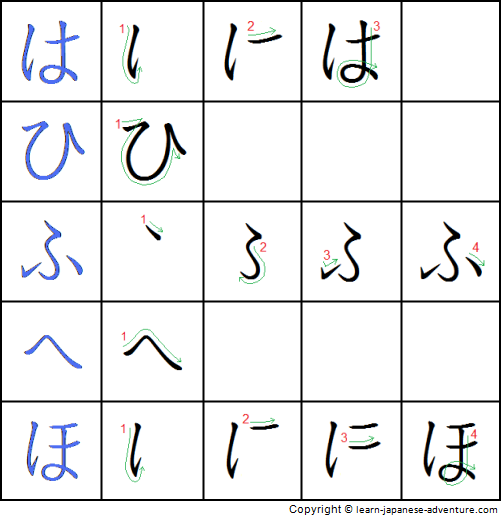
To further solidify these, let's turn back to our mnemonics guide.
Learn Hiragana: The Ultimate Guide - Tofugu
This section of the Tofugu guide provides more memorable images for the h-row.
Read the section titled は ひ ふ へ ほ. Pay attention to the mnemonics, like ひ (hi) looking like a smiling mouth ('he he he'), and へ (he) looking like a mountain peak (like Mt. St. Helens).
Let's review the strokes:
- は (ha): Three strokes. A vertical hooked line on the left, a horizontal line, and a final looping vertical line on the right. Note the similarity in structure to the ほ (ho) character.
- ひ (hi): One single, elegant curved stroke. It's simple but requires practice to get the proportions right.
- ふ (fu): Four strokes. A small tick, a large 'S' curve, and two smaller ticks on the sides. It looks a bit like Mount Fuji.
- へ (he): One simple stroke, like a small, lopsided hill. It is very easy to write but can be confused with the katakana version, which is identical.
- ほ (ho): Four strokes. It's almost identical to は (ha), but it has an extra horizontal line at the top. This is a key distinction.
Practice writing these five characters, paying close attention to the difference between は (ha) and ほ (ho).
The M-Row: ま (ma), み (mi), む (mu), め (me), も (mo)
The m-row is refreshingly straightforward, with no sound exceptions. The sounds are ma, mi, mu, me, mo.
Learn ALL Hiragana in 1 Hour - How to Write and Read Japanese
This video segment will introduce you to the m-row characters.
Watch the section on the m-row from the beginning up to the review.
And now for some mnemonics to help you remember them.
Learn Hiragana: The Ultimate Guide - Tofugu
This guide provides mnemonics for the m-row.
Read the section from the heading ま み む め も. Note the mnemonics like み (mi) looking like the number '21' ("Who turned 21? Me!"), and め (me) being distinguished from ぬ (nu) because it represents a 'messed up' noodle.
- ま (ma): Three strokes. Two parallel horizontal lines and a vertical line that goes through them and ends in a loop.
- み (mi): Two strokes. The first is a complex stroke that loops around, and the second is a long diagonal line.
- む (mu): Three strokes. A short horizontal line, a vertical line that goes through it and makes a loop, followed by a small tick.
- め (me): Two strokes. This one is very similar to ぬ (nu). The key difference is that め (me) lacks the final loop at the end.
- も (mo): Three strokes. A vertical line with a hook, followed by two parallel horizontal lines. It looks like the character for し (shi) with two extra horizontal lines.
Practice writing these five characters. Focus on distinguishing め (me) from ぬ (nu).
The Y-Row: や (ya), ゆ (yu), よ (yo)
Finally, we have the y-row. This row is unique because it only has three characters. The sounds for 'yi' and 'ye' do not exist in modern standard Japanese, so you only need to learn ya, yu, yo.
Learn ALL Hiragana in 1 Hour - How to Write and Read Japanese
This final segment introduces the three characters of the y-row.
Watch the section on the y-row from the beginning up to the review. This video will also give you a preview of yōon, which are combination sounds like きゃ (kya) made with a small や, ゆ, or よ. This is a topic for a future lesson, but it's good to see it now.
Learn Hiragana: The Ultimate Guide - Tofugu
Let's get the mnemonics for our final three characters of the day.
Read the section under the heading や ゆ よ. The mnemonics of や (ya) as a 'yacht' and よ (yo) as a 'yo-yo' are particularly helpful.
- や (ya): Three strokes. A large hook-and-loop shape, a small tick, and a long vertical line on the right.
- ゆ (yu): Two strokes. A vertical line with a loop at the bottom that then continues to the right, and a second vertical stroke that cuts through it.
- よ (yo): Two strokes. A short horizontal line and a vertical line with a loop at the bottom.
Practice writing these last three characters.
Consolidation and Practice
You have learned an incredible 18 new characters today! The best way to make them permanent is through practice.
Pronunciation Practice:
The MLC Japanese Language School website has excellent audio resources. Listen to the native pronunciation for the rows we learned today.
- Listen to the n- and h-rows here: na, ni, nu, ne, no, ha, hi, fu, he, ho
- Listen to the m- and y-rows here: ma, mi, mu, me, mo, ya, yu, yo
(Audio files courtesy of MLC Japanese Language School, Tokyo)
Writing Practice:
For writing, nothing beats repetition. I strongly recommend downloading and printing these worksheets.
Download Free Hiragana Katakana Charts (PDF)
This PDF contains practice sheets for all hiragana characters.
Click the link for Hiragana and Katakana Worksheets - Download all at once. Print out the pages for the な, は, ま, and や lines and trace the characters, then practice writing them on your own.
Reading Practice:
Let's try reading some words that use the characters you now know. Read them aloud, then practice writing them.
| Hiragana | Rōmaji | English Meaning |
|---|---|---|
| いぬ | inu | dog |
| ねこ | neko | cat |
| はな | hana | flower |
| ひと | hito | person |
| ふね | fune | ship |
| へや | heya | room |
| やま | yama | mountain |
| ゆき | yuki | snow |
| みせ | mise | shop |
| せなか | senaka | back (body part) |
Conclusion
You've made fantastic progress today. By adding these 18 characters, you are getting very close to knowing the entire basic hiragana script.
Key Takeaways:
- You can now read and write the n-row (なにぬねの), h-row (はひふへほ), m-row (まみむめも), and y-row (やゆよ).
- You learned the special pronunciation of ふ (fu).
- You are now aware that は (ha) and へ (he) are pronounced "wa" and "e" when used as grammatical particles.
- You can distinguish between similar-looking characters like ぬ/め, and は/ほ.
Looking Ahead:
In our next lesson, we will complete our study of the basic hiragana by learning the final few characters: the r-row, the w-row, and the very important syllabic nasal ん (n). Keep practicing