Welcome back! In the last few lessons, you've built a solid foundation by learning the majority of the hiragana script, including the vowels and the k, s, t, n, h, m, and y-rows. You've also learned to navigate some of the quirks of Japanese pronunciation, like the sounds for shi, chi, tsu, and fu.
Today, we reach a major milestone on your path to mastering Japanese. We will learn the final set of basic hiragana characters. This lesson covers the r-row, the w-row, and the unique syllabic nasal, ん. By the end of our 60 minutes, you will have learned all 46 basic hiragana characters, completing the first essential step towards reading and writing Japanese and preparing for your JLPT N5 exam.
The R-Row: ら (ra), り (ri), る (ru), れ (re), ろ (ro)
Let's begin with the five characters of the r-row. A crucial point here is the Japanese 'r' sound. It is quite different from the English 'r'. It's a light, quick sound produced by tapping the tip of your tongue against the ridge behind your upper front teeth, similar to the 't' sound in the American English pronunciation of "water" or "butter." It can sometimes sound like a soft 'd' or a rolled 'l'. Don't worry about perfecting it immediately; awareness is the first step, and your pronunciation will improve with practice.
For a clear demonstration of how to write these characters, we'll turn to TOMO sensei's video.
HIRAGANA Reading & Writing 09 RA column らりるれろ - for Beginners (with Hiragana Stroke Order)
This video from the TOMO sensei channel provides a slow, clear demonstration of the stroke order for each character in the r-row.
Watch the video segments for each character. Focus on the number of strokes and their direction. ら (ra) り (ri) る (ru) れ (re) ろ (ro) At the end of the video, from the comparison, the instructor highlights the difference between れ (re) and the character ね (ne) you learned in the last lesson. This is a very important distinction to remember.
Now that you've seen how they are written, let's use some mnemonics from the Tofugu guide to help you remember their shapes.
[PDF] tofugu-learn-hiragana-book.pdf
This PDF book provides memorable mnemonics for each hiragana character.
In the PDF, navigate to pages 51-55. Read the "how to remember" section for each character in the r-row. ら (ra) (page 51) り (ri) (page 52) る (ru) (page 53) れ (re) (page 54) ろ (ro) (page 55)
Let's review the key features:
- ら (ra): Two strokes. Notice the similarity to ち (chi) on top, but the second stroke is much more rounded.
- り (ri): Two strokes, but often written as one continuous stroke. The left stroke is shorter, and the right is a longer, elegant curve.
- る (ru): One stroke. This looks like the number '3' but with a loop at the bottom. It is very similar to ろ (ro).
- れ (re): Two strokes. It looks very much like ね (ne) but ends with a sharp, outward curve instead of a loop. The mnemonic of someone
retching is a good way to remember this shape. - ろ (ro): One stroke. This is the counterpart to る (ru), but it lacks the loop at the end. Think of it as a simple
road.
Take a moment to practice writing these five characters, paying special attention to the differences between る/ろ and れ/ね.
The W-Row and the Syllabic Nasal: わ (wa), を (wo), ん (n)
We are now at the final set of characters. The w-row is a bit unusual. Historically, it had more characters, but in modern Japanese, only わ (wa) and を (wo) remain. We will also cover ん (n) here, the only hiragana that represents a single consonant.
Let's see how to write them.
HIRAGANA Reading & Writing 10 WA column わをん - for Beginners (with Hiragana Stroke Order)
This TOMO sensei video demonstrates the stroke order for わ, を, and ん.
Watch the following segments: わ (wa) を (wo) ん (n)
These three characters have unique characteristics, especially を and ん. Let's use our resources to understand them better.
[PDF] tofugu-learn-hiragana-book.pdf
This guide provides mnemonics and explains the unique roles of these characters.
Find pages 57-59 in the PDF. For わ (wa) on page 57, note the comparison to ね and れ. For を (wo) on page 58, pay close attention to the note explaining that it is pronounced 'o' and is used as a grammatical particle. For ん (n) on page 59, the mnemonic is simple: it looks like the English letter 'n'.
The distinction between the vowel お and the particle を is fundamental. Both are pronounced "o," but their functions are completely different. Let's read a clear explanation of this.
1.6 ら (ra) – ん (n) and Hiragana Review – Japanese Introductory 1
This text explains the grammatical function of を (o) and the pronunciation of ん (n).
In this resource, please read two short sections. First, read the section titled What is the difference. This clarifies that を is a particle used to mark the object of a verb. Next, read the section on pronouncing ん. This explains that ん is a nasal sound that holds its own one-beat rhythm.
To summarize these crucial points:
- わ (wa): Two strokes. Like れ and ね, it has a vertical and a large curved part. The curve for わ is much more rounded and open.
- を (wo): Three strokes. Though its rōmaji is
wo, it is always pronounced "o" in modern Japanese, identical to お. Its only use is as a grammatical particle to mark the direct object of a verb. You will never see it as part of a regular word. - ん (n): One stroke. This is the only kana that is not a consonant-vowel syllable. It represents a syllabic 'n' sound and has the same time value (one mora) as any other hiragana. It can appear at the end of words (e.g., にほん, Japan) or in the middle (e.g., でんわ, telephone).
Consolidation: You Now Know All Basic Hiragana!
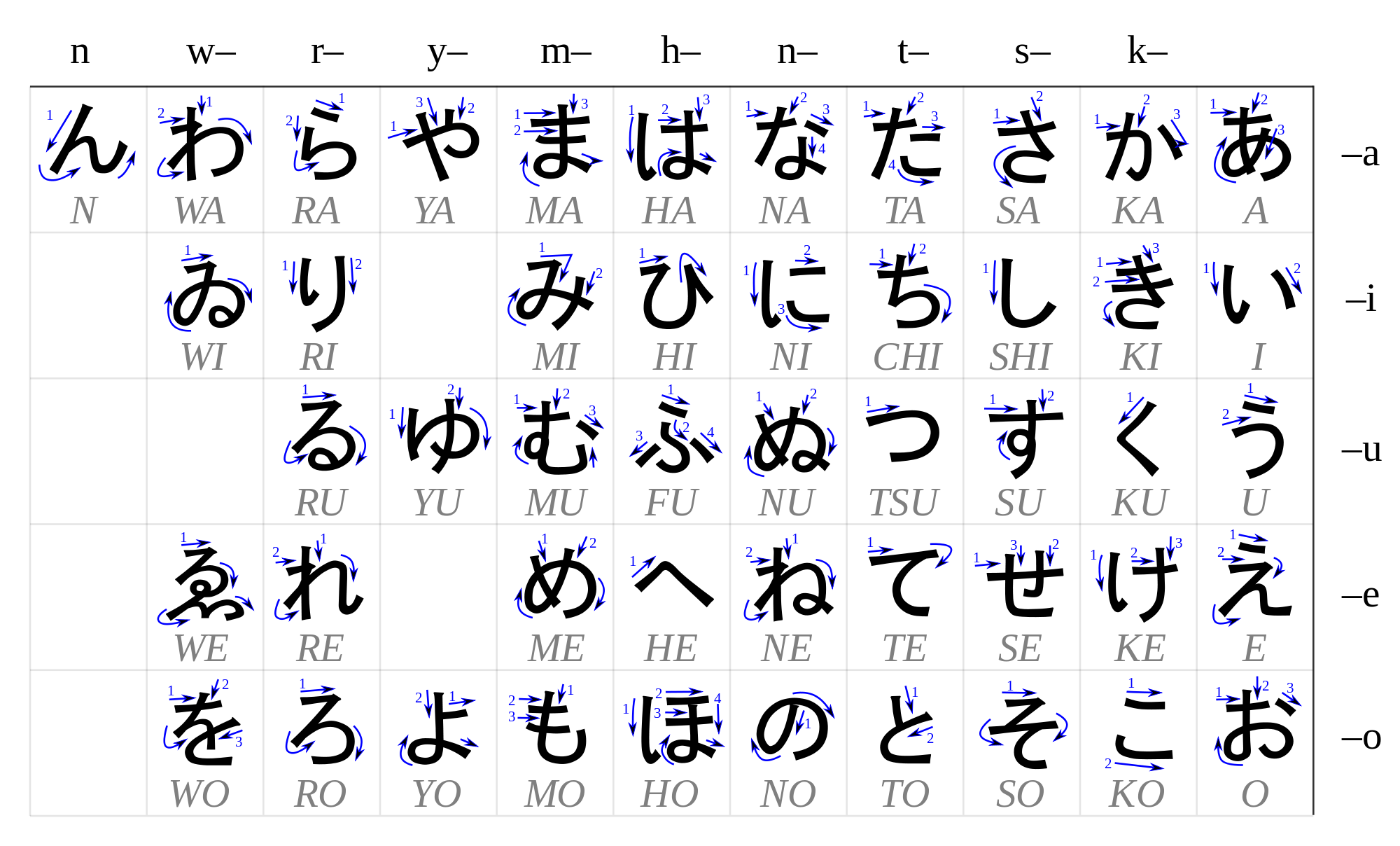
Congratulations! You have now learned all 46 basic hiragana characters. This is a huge accomplishment and the key that unlocks the ability to read and write in Japanese. Take a look at the full chart below—you can now recognize every single one of these characters.
Practice Time
Now it's time to solidify this final set of characters.
Pronunciation Practice:
Listen to the native pronunciation for the rows we learned today. Click the link below to hear the sounds for ra, ri, ru, re, ro, wa, wo, n.
- Listen to the r- and w-rows and ん here: ra, ri, ru, re, ro, wa, wo, n
(Audio file courtesy of MLC Japanese Language School, Tokyo)
Writing Practice:
Repetition is essential for mastering stroke order. The Japan Foundation provides excellent, free worksheets for practice.
1.6 ら (ra) – ん (n) and Hiragana Review – Japanese Introductory 1
This resource links to official worksheets for practicing your writing.
Scroll down to the heading How can I write hiragana? and click the link to the Japan Foundation's website. Download and print the worksheets for the ら and わ rows to practice tracing and writing these final characters.
Reading Practice:
Let's put everything together. Read these words aloud, then try writing them yourself. They use the characters from today's lesson along with ones you already know.
| Hiragana | Rōmaji | English Meaning |
|---|---|---|
| さくら | sakura | cherry blossom |
| くるま | kuruma | car |
| しろい | shiroi | white |
| よる | yoru | night |
| れきし | rekishi | history |
| わたし | watashi | I, me |
| でんわ | denwa | telephone |
| えほん | ehon | picture book |
| にほん | nihon | Japan |
| てんき | tenki | weather |
Conclusion
You have done it! By learning the r-row (らりるれろ), w-row (わを), and the syllabic nasal ん, you have completed your study of the 46 basic hiragana characters. This is a foundational skill for your JLPT N5 goal and all future Japanese study.
Key Takeaways:
- You can now read and write all 46 basic hiragana characters.
- The Japanese 'r' sound is a "flap" sound, distinct from the English 'r'.
- を (o) is pronounced just like お (o) but is used exclusively as a grammatical particle.
- ん (n) is a single consonant that counts as one full beat, or mora.
- You can distinguish between several sets of similar characters: る/ろ, れ/ね/わ.
Looking Ahead:
In our next lesson, we will build upon the hiragana you've just mastered. We will learn how to use two small marks, called dakuten (゛) and handakuten (゜), to modify the sounds of existing characters. This will allow you to create voiced sounds (like 'g', 'z', 'd', 'b') and the 'p' sound, dramatically expanding the range of words you can read and write. Keep practicing