Welcome back! In our last session, you accomplished a major goal by learning the final characters of the basic hiragana script: the r-row, the w-row, and the syllabic ん. With all 46 foundational characters now in your toolkit, you are ready to expand your reading and pronunciation abilities significantly.
In this lesson, we will explore how to modify some of the hiragana you already know to create new sounds. You will learn to apply two small diacritical marks, called dakuten (゛) and handakuten (゜). By the end of this lesson, you will be able to form and read the voiced hiragana sounds found in the が (ga), ざ (za), だ (da), ば (ba), and ぱ (pa) rows, adding another 25 sounds to your repertoire and bringing you much closer to full phonetic literacy in Japanese.
Introducing Voiced Sounds: Dakuten and Handakuten
The hiragana characters you've learned so far represent "unvoiced" sounds. By adding a small mark, we can change these sounds to their "voiced" counterparts, which involves vibrating your vocal cords. This is the difference between 'k' and 'g', or 's' and 'z' in English.
Japanese uses two marks for this:
- Dakuten (濁点), which looks like two small strokes (゛) and is often nicknamed "tenten" (点々, meaning "dots"). It is used to create the g-, z-, d-, and b-sounds.
- Handakuten (半濁点), which is a small circle (゜) and is often called "maru" (丸, meaning "circle"). It is used only with the h-row to create p-sounds.
To get a clear overview of how this works, let's watch a concise explanation.
Dakuten & Handakuten Made EASY (が・ざ・だ・ば・ぱ)
This video from Byte Nihongo provides a fantastic, quick summary of how dakuten and handakuten modify the sounds of hiragana.
Watch the entire video from the beginning to the end. It will walk you through each group of sound changes. Pay attention to the simple rule mentioned near the end: "No mark → original sound; Two dots → voiced sound; Small circle → P sound." What dakuten are K-group to G-group S-group to Z-group T-group to D-group H-group to B-group Handakuten for P-sounds
Now that you have a general idea, let's break down each group one by one.
Applying Dakuten (゛)
Dakuten can be applied to the hiragana in the k, s, t, and h-rows.
-
K-row → G-row
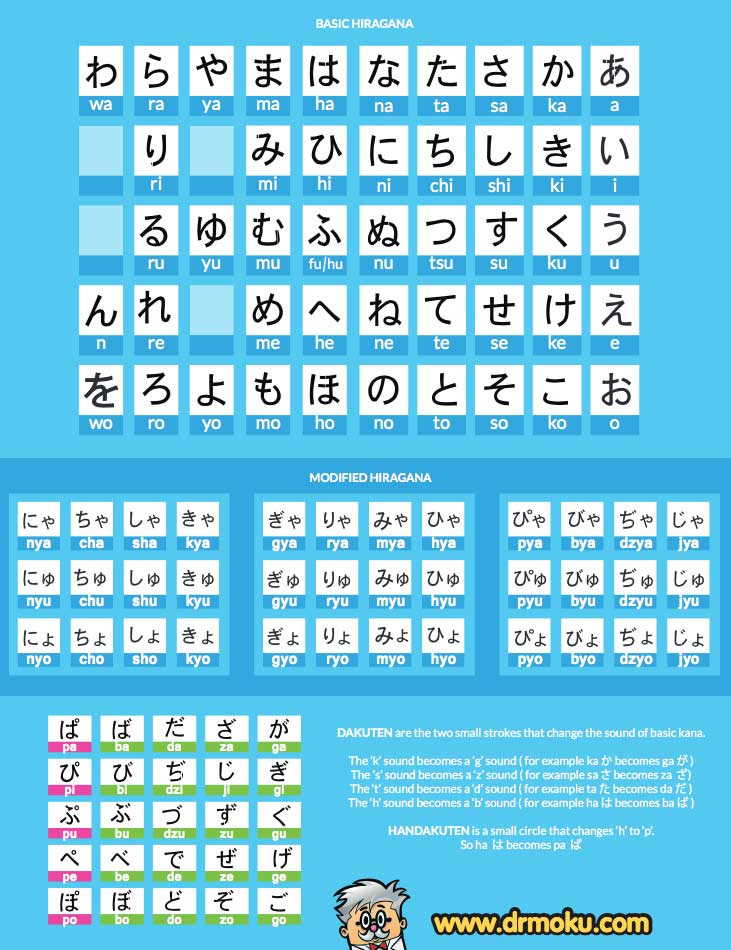
This is the most straightforward change. The unvoiced 'k' sound becomes a voiced 'g' sound.- か (ka) + ゛ → が (ga)
- き (ki) + ゛ → ぎ (gi)
- く (ku) + ゛ → ぐ (gu)
- け (ke) + ゛ → げ (ge)
- こ (ko) + ゛ → ご (go)
-
S-row → Z-row
The 's' sound becomes a 'z' sound. Note the important exception with し (shi).- さ (sa) + ゛ → ざ (za)
- し (shi) + ゛ → じ (ji) (Note: not 'zi')
- す (su) + ゛ → ず (zu)
- せ (se) + ゛ → ぜ (ze)
- そ (so) + ゛ → ぞ (zo)
-
T-row → D-row
The 't' sound becomes a 'd' sound. Here we have two important exceptions with ち (chi) and つ (tsu).- た (ta) + ゛ → だ (da)
- ち (chi) + ゛ → ぢ (ji) (Note: not 'di')
- つ (tsu) + ゛ → づ (zu) (Note: not 'du')
- て (te) + ゛ → で (de)
- と (to) + ゛ → ど (do)
-
H-row → B-row
The 'h' sound becomes a 'b' sound.- は (ha) + ゛ → ば (ba)
- ひ (hi) + ゛ → び (bi)
- ふ (fu) + ゛ → ぶ (bu)
- へ (he) + ゛ → べ (be)
- ほ (ho) + ゛ → ぼ (bo)
A Note on Pronunciation: じ vs. ぢ and ず vs. づ
You probably noticed that both し+゛ (じ) and ち+゛ (ぢ) are romanized as 'ji'. Similarly, す+゛ (ず) and つ+゛ (づ) are both romanized as 'zu'.
For the purposes of the JLPT N5 and in modern standard Japanese, the pronunciation of these pairs is identical.
- じ (ji) and ぢ (ji) are pronounced the same.
- ず (zu) and づ (zu) are pronounced the same.
In almost all words, you will see じ and ず. The characters ぢ and づ are very rare, appearing only in specific circumstances like when a sound is repeated (e.g., つづく, tsuzuku, to continue) or in compound words. You do not need to worry about the distinction for now, but you must be able to read all four.
TOMO sensei, whose videos you've seen before, explains this very clearly.
How to Read HIRAGANA Voiced Sound & P-Sound [Ga, Za, Da, Ba & Pa Columns] - Easy Guide for Beginners
This video provides pronunciation practice and highlights the identical sounds of じ/ぢ and ず/づ.
Watch the following two segments to reinforce this important point: First, watch the practice for the 'za' column from this section. The instructor specifically points out the pronunciation of じ (ji). Next, watch the practice for the 'da' column from this part. Here, the instructor explicitly states that じ and ぢ sound the same, as do ず and づ.
Applying Handakuten (゜)
Handakuten is simpler: it is only used with the h-row characters to change the 'h' sound into a plosive 'p' sound.
H-row → P-row
- は (ha) + ゜ → ぱ (pa)
- ひ (hi) + ゜ → ぴ (pi)
- ふ (fu) + ゜ → ぷ (pu)
- へ (he) + ゜ → ぺ (pe)
- ほ (ho) + ゜ → ぽ (po)
Here is a chart that puts all of these modified sounds together for your reference.
Practice Time
Now, let's put this knowledge into practice to solidify your understanding.
1. Pronunciation Practice
Listen to the native pronunciation for all the sounds we learned today. Repeat after the speaker to get a feel for the sounds.
- Listen to the voiced and p-sounds here: ga, gi, gu, ge, go, za, ji, zu, ze, zo, da, ji, zu, de, do, ba, bi, bu, be, bo, pa, pi, pu, pe, po
(Audio file courtesy of MLC Japanese Language School, Tokyo)
2. Reading Practice
Try to read the following words aloud. They are composed entirely of hiragana you now know.
| Hiragana | Rōmaji | English Meaning |
|---|---|---|
| かぎ | kagi | key |
| ぎんこう | ginkō | bank |
| でんわ | denwa | telephone |
| かぞく | kazoku | family |
| みず | mizu | water |
| まど | mado | window |
| ことば | kotoba | word, language |
| えんぴつ | enpitsu | pencil |
| さんぽ | sanpo | a walk, stroll |
| てんぷら | tenpura | tempura |
3. Interactive Practice
To test your recognition skills in a more dynamic way, you can use online flashcards. The MLC Japanese Language School provides free Quizlet sets that are perfect for this.
Download Free Hiragana Katakana Charts (PDF)
This page links to interactive Quizlet flashcards that will help you practice reading the new sounds.
Scroll down to the section titled Practice with Quizlet. Click the link for the Hiragana Quiz. This will take you to a set of exercises that cover all the basic hiragana as well as the dakuten and handakuten characters. Spend some time with the "Flashcards" or "Learn" mode.
Conclusion
Excellent work today! You have just unlocked a huge portion of the Japanese sound system. By learning to apply dakuten (゛) and handakuten (゜), you've expanded your hiragana knowledge from 46 to 71 characters.
Key Takeaways:
- Dakuten (゛) adds voicing to consonants: k → g, s → z, t → d, and h → b.
- Handakuten (゜) is used only on the h-row to create p-sounds.
- You must remember the special pronunciations: し (shi) + ゛ = じ (ji), and ち (chi) + ゛ = ぢ (ji).
- For practical purposes, the pairs じ/ぢ and ず/づ are pronounced identically in modern Japanese.
Looking Ahead:
We are now on the final step of mastering hiragana for your JLPT N5 exam. In the next lesson, we will cover the remaining phonetic rules: combination sounds known as yōon (like きゃ, きゅ, きょ), doubled consonants using the small っ, and long vowels. After that, you will be able to read any word written in hiragana