Welcome back! In our last session, you took a significant first step by mastering the five hiragana vowels: あ, い, う, え, and お. You learned how to write them with the correct stroke order and practiced reading your first Japanese words.
Today, we'll build directly on that foundation. Most hiragana characters represent a mora, which is typically a consonant followed by one of those five vowel sounds. We will now learn the first three consonant rows: the k-row, the s-row, and the t-row. This will add 15 new characters to your repertoire, dramatically expanding your ability to read and write Japanese. As always, we will focus on correct pronunciation and precise stroke order.
Let's begin by watching a short video that will introduce the characters we're covering today. This video uses helpful mnemonics to aid memorization.
Learn ALL Hiragana in 1 Hour - How to Write and Read Japanese
This video from JapanesePod101.com covers all the characters for today's lesson with memorable tips. As you watch the relevant sections, you will notice the narrator mentions adding a mark (called dakuten) to change the sound (e.g., from 'ka' to 'ga'). This is an important concept that we will cover in detail in a future lesson. For now, just focus on the primary characters: か, さ, た and their respective rows.
We will watch this video in segments as we learn each row.
The K-Row: か (ka), き (ki), く (ku), け (ke), こ (ko)
The k-row is formed by combining the 'k' consonant sound with the five vowels you already know. The sounds are straightforward: ka, ki, ku, ke, ko.
Let's watch the video segment for the k-row to get familiar with their shapes and sounds.
Learn ALL Hiragana in 1 Hour - How to Write and Read Japanese
Watch this first segment to learn the k-row characters.
Focus on the part from the start of the k-row to the end of the explanation for こ (ko). Pay attention to the mnemonics, like か looking like a blade cutting, き looking like a key, and so on. Remember to ignore the parts about the dakuten mark for now.
Now that you have a mental image for each character, let's focus on writing them correctly. The following resource provides clear, static diagrams for stroke order.
This guide provides excellent stroke-by-stroke diagrams.
Scroll down to the heading Write Hiragana in the ka-line. Study the diagrams for か, き, く, け, and こ. Pay special attention to the note about the character き (ki). In handwriting, the last two strokes are typically separate, even though many fonts connect them.
Let's break them down:
- か (ka): Three strokes. A curved vertical line on the left, a horizontal line that cuts through it, and a small diagonal tick on the right.
- き (ki): Four strokes (in handwriting). Two parallel horizontal lines, a vertical line cutting through them, and a final curved stroke at the bottom. The third and fourth strokes should not connect.
- く (ku): One simple stroke. It looks like a less-than sign (<).
- け (ke): Three strokes. A curved vertical line on the left, a horizontal line, and a final vertical line that crosses the horizontal one and curves slightly.
- こ (ko): Two strokes. Two horizontal curves, one above the other, resembling two small hills.
Take a moment to practice writing each of these characters 5-10 times on paper.
The S-Row: さ (sa), し (shi), す (su), せ (se), そ (so)
Next is the s-row. The sounds are mostly predictable, with one important exception: the combination of 's' and 'i' is pronounced shi, not 'si'.
Let's see the video for the s-row.
Learn ALL Hiragana in 1 Hour - How to Write and Read Japanese
This segment will introduce the s-row characters.
Watch from the beginning of the s-row until the end of the explanation for そ (so). The video will highlight the 'shi' pronunciation and offer mnemonics, such as し looking like a fishing hook.
Now let's examine the stroke order in detail.
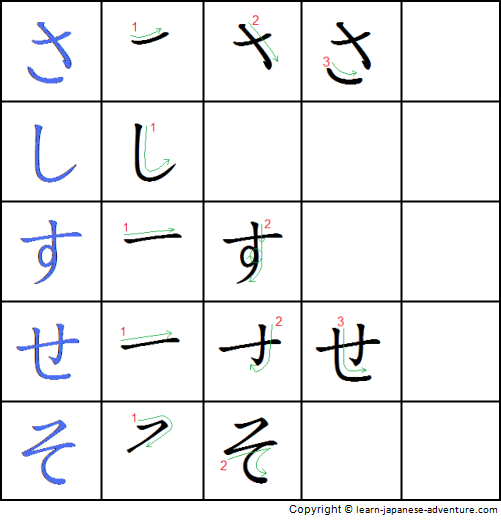
- さ (sa): Three strokes. A horizontal line, a vertical line crossing it with a hook, and a final curved stroke underneath. Like き, the last two strokes are often separated in handwriting, though fonts may connect them.
- し (shi): One simple stroke, like a large fish hook.
- す (su): Two strokes. A horizontal line, and a vertical line that goes down, makes a loop, and then sweeps out.
- せ (se): Three strokes. A horizontal line, a vertical hook on the right, and a final vertical line on the left.
- そ (so): One complex stroke. It looks like a 'Z' with an extra curve at the bottom. Practice this as a single, continuous motion.
Practice writing each of these characters. Notice the visual similarity between き and さ. The main difference is that き has two top horizontal strokes, while さ has only one.
The T-Row: た (ta), ち (chi), つ (tsu), て (te), と (to)
The final set for today is the t-row. This row has two sound exceptions:
- 't' + 'i' becomes chi (as in "cheese").
- 't' + 'u' becomes tsu (like the 'ts' in "cats").
Let's watch the final video segment.
Learn ALL Hiragana in 1 Hour - How to Write and Read Japanese
This last segment covers the t-row and its unique sounds.
Watch from the start of the t-row to the end of the explanation for と (to). The video will explain 'chi' and 'tsu' and also mention a small version of つ (っ). This is a pronunciation marker called sokuon that we will study in detail in a later lesson. For now, just be aware of it.
Let's confirm the stroke order for the t-row.
Refer back to our writing guide for the t-row diagrams.
Find the heading Write Hiragana in the ta-line and study the stroke order for た, ち, つ, て, and と.
- た (ta): Four strokes. A horizontal line, a vertical line crossing it, and then two small strokes resembling a smaller こ.
- ち (chi): Two strokes. A horizontal line, and a second stroke that goes down, loops to the left, and finishes by crossing the first stroke. Notice its visual similarity to さ, but mirrored and with different proportions.
- つ (tsu): One simple, sweeping, curved stroke, like a wave.
- て (te): One stroke. A short horizontal line followed by a long curve underneath.
- と (to): Two strokes. A short vertical line with a tick, and a large curved stroke to its right.
Spend some time writing these five characters until you feel comfortable with their shapes and stroke orders.
Reading and Writing Practice
You now know 20 hiragana characters! Let's put them to use. Try to read the following words aloud, then practice writing them.
| Hiragana | Rōmaji | English Meaning |
|---|---|---|
| かさ | kasa | umbrella |
| すし | sushi | sushi |
| せき | seki | seat / cough |
| ちか | chika | underground / basement |
| くつ | kutsu | shoes |
| あせ | ase | sweat |
| そこ | soko | there |
| あか | aka | red |
| いけ | ike | pond |
| つくえ | tsukue | desk |
This is a huge step forward. Being able to recognize and write these characters is essential for your JLPT N5 goal. Consistent practice is the only way to make them second nature.
Conclusion
In this lesson, we've significantly expanded your hiragana knowledge.
Key Takeaways:
- You can now read and write the 15 characters of the k-row (かきくけこ), s-row (さしすせそ), and t-row (たちつてと).
- You've learned the key pronunciation exceptions: し (shi), ち (chi), and つ (tsu).
- You understand the common handwriting convention for き and さ, where certain strokes remain separate.
- You have started building a vocabulary by reading and writing simple words.
Looking Ahead:
You are well on your way to mastering the hiragana script. In our next lesson, we will continue this journey by learning the n-, h-, m-, and y-row characters. Keep practicing the 20 characters you know now—write them a few times each day to build muscle memory.