Introduction
Hello! In our last lesson, we explored how to pass structs to functions, both by value and by pointer. We saw a glimpse of the typedef keyword as a convenient way to avoid repeatedly typing struct MyStructName. For example, we used typedef struct { ... } Note; so we could just write Note instead of struct Note.
Today, we're going to dive deep into typedef to fully understand its power and purpose. This lesson directly addresses the learning outcome: Use typedef to create aliases for complex types. While it might seem like simple syntactic sugar, typedef is a cornerstone of writing clean, readable, and portable C code.
We'll cover:
- The fundamental syntax and how it differs from
#define. - The common patterns for using
typedefwithstructs, including a crucial edge case for self-referential data structures. - How
typedeftames the complexity of advanced types like function pointers. - Its role in creating portable code that works across different systems—a vital concept in embedded programming.
1. The Core Idea: Creating a True Type Alias
At its heart, typedef creates a new name, or an alias, for an existing data type. The compiler understands this alias as being completely equivalent to the original type. This is fundamentally different from a preprocessor macro, which is just a text-replacement tool.
Let's start with a foundational reading that covers the basics and highlights this critical distinction.
This article from OverIQ provides a clear explanation of the typedef syntax, its application to various types, and a crucial comparison with #define.
Please read the following sections from the article: Start from the beginning and read until you reach 'typedef with a pointer'. This covers the basic syntax and scope. Read the sections 'typedef with a pointer' and 'typedef with an Array' to see how it applies to more complex declarators. Finally, read the section 'typedef and #define' very carefully. The example comparing typedef int* iptr; and #define ptr int * is one of the most important concepts to understand about typedef.
The key takeaway from the #define vs. typedef comparison is how they behave in a multi-variable declaration:
-
#define INTPTR int *INTPTR p1, p2;expands toint * p1, p2;
Here,p1is a pointer to anint, butp2is just a regularint. The*only binds to the first variable. -
typedef int* IntPointee;IntPointee p1, p2;
Here, the compiler knowsIntPointeeis a type alias for "pointer to int". Therefore, bothp1andp2are declared as pointers toint.
This demonstrates that typedef provides a true type abstraction, which is safer and less surprising than simple text substitution.
2. The Most Common Use: typedef with struct
As you've seen, the most frequent application of typedef is to simplify struct declarations. Without it, you must use the struct keyword every time you declare a variable, which is verbose.
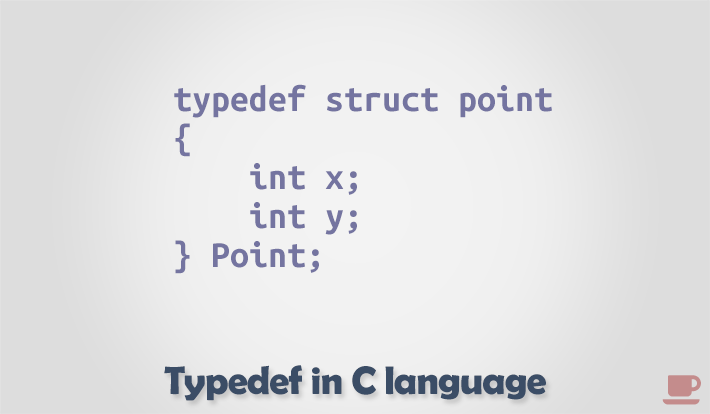
There are a few ways to style this, each with subtle implications.
Simple C - Using typedef and struct
This video from Bluefever Software walks through the evolution of using typedef with structs, from the most verbose to the most common and concise syntax.
Watch the following segments: The Problem (01:03 - 02:35): Understand why you need to write struct Wizard w1; and how that can be inconvenient. The Syntaxes (03:58 - 06:10): Pay close attention to the three ways typedef is applied to the struct: as a separate statement, combined with a named struct, and combined with an anonymous struct. The last one is what we used in the previous lesson.
This leads to a critical question: is there any reason not to use the most concise, anonymous struct form (typedef struct { ... } MyType;)? The answer is yes, especially when you build complex, linked data structures.
For example, how would you define a node for a linked list, which needs to contain a pointer to itself?
// This will NOT compile!
typedef struct {
    int data;
    Node *next; // The compiler doesn't know what 'Node' is yet.
} Node;
To solve this, you need to give the struct an internal name (a "tag") that the compiler can refer to inside the definition.
Using typedef with structs in C
The following video from Logic Lambda clearly explains this exact problem and presents the standard solution.
Watch from the beginning to 03:17. Focus on: The difference between the 'struct tag' and the 'typedef name'. The explanation of why the struct tag is necessary for self-referential structures (like a linked list node). The final example demonstrating the correct way to define a self-referential struct.
Best Practice:
For any struct that might be part of a linked data structure (like a list, tree, or graph), it's best to provide both a struct tag and a typedef alias. A common and clean convention is to use the same name for both:
typedef struct Node {
    int data;
    struct Node *next; // Use the struct tag inside
} Node; // The alias is now available

// Now you can use the clean alias for variable declarations
Node *head = NULL;
3. Taming Complexity: typedef for Function Pointers
Now we'll see where typedef moves from a convenience to an essential tool for readability. C allows you to have pointers to functions, which is a powerful concept used for callbacks, state machines (relevant to your interest in automation), and implementing certain design patterns.
However, the syntax for declaring function pointers is notoriously difficult to read.
Consider the declaration for the standard C signal function, which sets a handler for a system signal:void (*signal(int, void (*)(int)))(int);
This is nearly unreadable. It declares signal as a function that takes an int and a function pointer, and it returns another function pointer.
typedef lets us break this down into understandable pieces.
Understanding typedefs for function pointers in C
This Stack Overflow discussion is an excellent resource for understanding how typedef clarifies function pointer syntax. We'll focus on the most helpful answers.
This is a dense topic, so take your time. Read the first half of the top-voted answer (by Jonathan Leffler). Focus on how he introduces typedef void (*SignalHandler)(int signum); and then rewrites the signal declaration using this new, readable type. This shows the 'before' and 'after'. Next, scroll down to the answer by 'psychotik' (starts with 'A function pointer is like any other pointer...'). It provides a much simpler, self-contained example of defining and using a typedef for a function pointer. Finally, look at the answer by Carl Norum, which introduces the cdecl tool. This is a practical tip for deciphering complex C declarations in the future.
Let's summarize the key idea with a simpler example. Imagine you have functions for arithmetic operations:
float add(float a, float b) { return a + b; }
float subtract(float a, float b) { return a - b; }
Without typedef, a pointer to such a function looks like this:float (*operation_ptr)(float, float);
With typedef, we can create a clean, descriptive type:typedef float (*binary_op_t)(float, float);
Now, using it is much cleaner:
binary_op_t my_operation = add; // Declare and assign a function pointer
float result = my_operation(10.5, 3.2); // Call the function via the pointer
This becomes incredibly powerful when you store these pointers in structs or arrays to build dynamic systems.
4. Enhancing Portability
Finally, typedef plays a crucial role in writing portable code. You've probably seen types like size_t from <stdio.h> or int32_t from <stdint.h>. These are not built-in C types; they are typedef aliases defined by the standard library.
For instance, size_t is the type returned by the sizeof operator. The C standard guarantees it's an unsigned integer type, but its exact size can vary.
- On one system, it might be
typedef unsigned int size_t; - On another, it could be
typedef unsigned long long size_t;
By writing your code to use size_t for sizes and counts, you ensure your code will compile and run correctly on both systems without changes. This is critical in embedded systems and cross-platform development, where integer sizes can vary between architectures (e.g., 16-bit, 32-bit, 64-bit). The <stdint.h> header provides a set of typedefs for fixed-width integers (int8_t, uint32_t, etc.) that are essential for this purpose.
Conclusion
You've now seen that typedef is much more than a shortcut. It's a fundamental C feature for creating abstractions that make code more readable, less error-prone, and more portable.
Key Takeaways:
- True Alias:
typedefcreates a compiler-recognized alias for a type, unlike#definewhich performs simple text substitution. - Readability: It drastically simplifies the use of
structsand makes complex declarations, like function pointers, manageable. - Safety: It helps avoid common errors, like declaring only one pointer in a multi-variable declaration meant to contain all pointers.
- Self-Reference: For
structsthat point to themselves (like in linked lists or trees), you must use astructtag in addition to thetypedefalias. - Portability: Standard library
typedefs likesize_tand the types in<stdint.h>are essential for writing code that works across different computer architectures.
Next Up
Now that we have a solid grasp on creating clean, custom data types with struct and typedef, our next step is to organize our programs. In the following lesson, we will learn how to split a C project into multiple source (.c) and header (.h) files. You'll see how typedef definitions are a perfect candidate for placing in header files to be shared across your project.