Introduction
Hello! In our last lesson, we explored C++ namespaces and how they help us organize code and prevent naming conflicts by keeping functions with the same name in separate, distinct scopes. This is essential for managing large projects.
Today, we'll look at the other side of that coin. Instead of keeping functions with the same name separate, we'll learn how to deliberately create multiple functions with the same name within the same scope. This powerful C++ feature is called function overloading.
Your goal for this lesson is to learn how to overload functions by providing multiple versions with different parameters. Since you've worked with Java, the concept of overloading will likely be familiar. We'll focus on the specific rules and mechanisms in C++, including how the compiler decides which version of a function to call.
1. What is Function Overloading?
Function overloading allows you to define multiple functions with the same name, as long as their parameter lists are different. This enables you to create a single, intuitive name for a group of functions that perform similar operations on different types or numbers of inputs.
For example, instead of creating separate functions like addInts(int, int) and addDoubles(double, double), you can simply create two versions of a function named add.
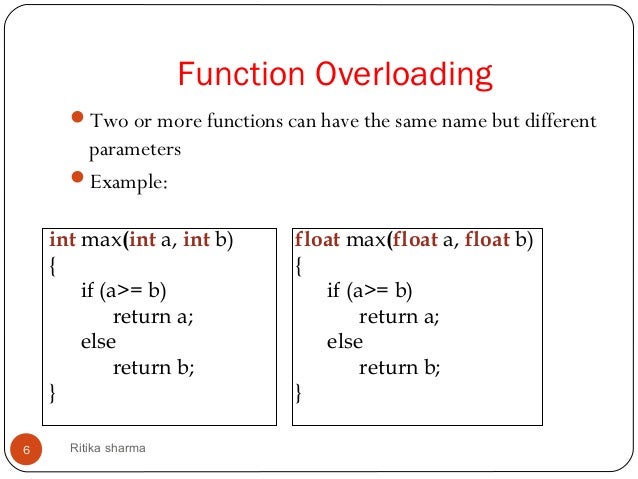
The main benefit is writing cleaner, more readable, and more intuitive code. You're creating a consistent interface for related actions.
Let's watch a short video that introduces the concept and provides a practical example.
Function Overloading - C++ Tutorial 22
This video from Caleb Curry provides a clear introduction to function overloading and demonstrates how to create overloads for different data types.
Please watch from the beginning to 1:54. The video explains what function overloading is and shows how a printCollection function can be overloaded to handle C-style arrays, std::array, and std::vector.
As the video shows, the compiler is smart enough to figure out which printCollection to call based on the type of argument you provide.
2. The Rules of Overloading
For the compiler to distinguish between overloaded functions, their signatures must be unique. In C++, a function's signature for overloading purposes is primarily determined by its name and its parameter list.
You can create a valid overload in two main ways:
- By using a different number of parameters.
- By using different types of parameters.
This next video demonstrates both of these techniques with clear, practical examples.
C++ Programming Tutorial 70 - Function Overloading Examples
This video, also from Caleb Curry, provides excellent examples of the two primary ways to overload a function.
Please watch from 1:02 to 7:03. Pay attention to how: The swap function is overloaded to handle both int and std::string types (different parameter types). The area function is overloaded to handle a square (one parameter), a rectangle (two parameters), and a struct (a custom type).
What Doesn't Work: Return Type
One of the most important rules to remember is that you cannot overload a function based on its return type alone. The parameter list must be different.
Why is this? Imagine you had two functions like this:
int getRandomValue();
double getRandomValue();
If your code then contained the line getRandomValue();, how would the compiler know which function to call? The return value might be ignored, so there's no context to make the decision. This ambiguity is why it's not allowed.
Function overload differentiation
The website Learn C++ offers a concise and excellent explanation for why return types aren't used to differentiate overloaded functions.
Please read the section titled "The return type of a function is not considered for differentiation". It provides a clear example and rationale that solidifies this crucial rule.
Here is a summary of the rules for differentiating overloads:
| Function Element | Used for Overloading? |
|---|---|
| Number of parameters | Yes |
| Type of parameters | Yes |
const/volatile qualifiers on parameters |
Yes (for pointers/references) |
| Function return type | No |
typedef or type aliases |
No (they are synonyms, not new types) |
3. Under the Hood: How the Compiler Chooses an Overload
Your interest in how things work behind the scenes will be satisfied here. The process of the compiler selecting the right overloaded function is called overload resolution.
When you call an overloaded function, the compiler follows a process to find the "best" match:
-
Name Mangling: First, it's useful to know that the compiler doesn't actually see two functions with the same name. It performs a process called name mangling, where it changes the internal name of a function based on its parameter list. For example,
void print(int)might become_print_iandvoid print(double)might become_print_d. This ensures every function has a unique name for the linker. -
Finding Candidate Functions: The compiler creates a list of all functions with the matching name that are visible in the current scope.
-
Finding the Best Match: For each candidate, the compiler checks how well the arguments you provided in the call match the function's parameters. It ranks the matches in a specific order:
- 1. Exact Match: This is the best case. The argument types perfectly match the parameter types (e.g., calling
print(10)for aprint(int)function). - 2. Match with Promotions: Small integer types (like
char,short) are "promoted" toint.floatis promoted todouble. - 3. Match with Standard Conversions: Other built-in conversions are considered, like
inttodoubleor a pointer to a derived class to a pointer to a base class. - 4. Match with User-Defined Conversions: Conversions you define yourself using constructors or conversion operators.
- 5. Match with Ellipsis (
...): A match with a C-style variadic function is the weakest match.
- 1. Exact Match: This is the best case. The argument types perfectly match the parameter types (e.g., calling
If the compiler finds one clear "best" match, it uses that function. If it finds two or more functions that are an equally good match, it will issue a compile error for an ambiguous call.
Function Overloading | Microsoft Learn
The Microsoft Learn documentation provides a technical deep dive into this process. Reading this will give you a solid understanding of the compiler's logic.
Read the section titled "Argument matching". Focus on understanding the concept of creating a "set of candidate functions" and finding the "best matching function". Don't worry about memorizing every conversion rule; the goal is to grasp the overall process.
4. A Quick Preview: Overloading vs. Overriding
It's common for newcomers to confuse function overloading with function overriding. It's helpful to distinguish them now to avoid confusion later.

-
Function Overloading (what we're learning today) is about multiple functions with the same name and different parameters in the same scope. It's resolved at compile-time. This is also known as static polymorphism.
-
Function Overriding is a concept from object-oriented programming where a subclass provides a specific implementation of a method that is already defined by its parent class. It's resolved at run-time. This is known as dynamic polymorphism. We will cover this in detail in Module 8 when we discuss inheritance.
5. Practical Exercise
Time to put this into practice. Let's create a simple logging utility with overloaded functions.
- Create a new C++ file for this exercise.
- Write a function
void log(const std::string& message)that prints a message to the console, perhaps prepended with "[LOG]: ". - Overload the
logfunction to accept anint. This version should convert the integer to a string and then call the originallog(const std::string&)function to avoid duplicating the printing logic. (Hint:std::to_string()is useful here). - Overload the
logfunction again to accept adouble. This version should also convert the double to a string and call the originallogfunction. - In your
mainfunction, call all three versions oflogto test them:int main() { log("Application starting..."); log(42); log(3.14159); return 0; } - Compile and run your program. You should see three formatted log messages. This pattern—where some overloads just prepare data and call another "master" overload—is a very common and effective way to reduce code duplication.
Conclusion
In this lesson, you've learned how to leverage function overloading to create more intuitive and readable C++ code. By providing multiple versions of a function with the same name but different parameter lists, you can build a unified interface for similar operations.
Key Takeaways:
- Function overloading allows multiple functions to share the same name as long as their parameter lists differ in number or type.
- It is a form of static polymorphism, resolved at compile-time.
- You cannot overload a function based on the return type alone.
- The compiler uses a process called overload resolution to find the best matching function for a given call, or it will issue an ambiguity error.
- Overloading is distinct from overriding, which is a run-time concept related to inheritance.
Next Up
This lesson concludes our module on the core improvements C++ offers over C. You've learned about C++ I/O streams, std::string, references, new/delete, namespaces, and now function overloading.
In our next module, we will begin our journey into one of the most powerful parts of C++: the Standard Template Library (STL). We'll start by exploring std::vector, a dynamic array that is a much safer and more flexible alternative to C-style arrays.