Hello. In our previous lesson, we explored the innovative literary architecture of Dostoevsky's novels, focusing on the concept of the 'polyphonic novel'. We saw how he creates a structure where independent, conflicting voices and ideas can clash without a final authorial judgment. Now, we shift our focus from the structure of the novel to the structure of the world it depicts.
To fully grasp the drama unfolding in The Brothers Karamazov, we need to understand the social stage on which it is set. The conflicts between the characters—their struggles with money, status, faith, and ideology—are deeply rooted in the specific historical context of 19th-century Russia. This lesson will serve as a blueprint of that society. We will describe the Russian social class structure of the 1860s and 1870s, examining the dominant nobility, the vast peasant class recently freed from serfdom, and the emerging, radical force of the intelligentsia.
Think of this as examining the societal floor plan. Understanding the load-bearing walls, the decaying foundations, and the new, disruptive extensions will give you a clearer view of the pressures acting on the Karamazov family.
1. The Architecture of Russian Society: A Rigid Pyramid
Russian society in the mid-19th century was starkly hierarchical, often visualized as a pyramid. At the top sat the Tsar and the royal family, supported by a small elite, while the immense weight of the structure was borne by the laboring masses at the bottom. Unlike the more fluid class systems that had developed in Western Europe, Russia's was rigid, with birth and land ownership defining one's place.
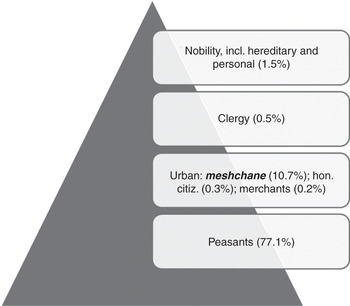
This image provides a stark visual representation of the era's demographics. Let's dig into the details of these social strata.
This article from Alpha History provides a clear, concise overview of the class structure. It will help us put names and roles to the layers of the pyramid.
Please read the first three main sections: Start with Hierarchies and classes, which introduces the pyramid concept and provides census data. Continue to The land-owning aristocracy, focusing on the role and mindset of the elite. Finally, read the section on The middle classes to understand this small but important group.
As you've read, Russian society was dominated by a tiny, conservative land-owning nobility that stood atop a vast peasant population. The "middle class" was so small as to be almost "missing," a crucial difference from contemporary Britain or France. Fyodor Pavlovich Karamazov, as a landowner, belongs to this privileged upper stratum, though his behavior makes him a caricature of it rather than a pillar. His wealth and status, which he so often abuses, are derived from this system.
2. The Great Upheaval: The Emancipation of the Serfs
The single most important social event shaping the world of The Brothers Karamazov was Tsar Alexander II's Emancipation of the serfs in 1861, just a few years before the novel is set. Prior to this, a huge portion of the peasant population were serfs—legally bound to the land and, for all practical purposes, the property of the nobles who owned it.

The Emancipation was a monumental reform, but its execution was deeply flawed. It was less a liberation than a reconfiguration of control, a fact that created immense social tension. To understand the reality of life for the "former serfs," let's explore what serfdom was and how the emancipation actually worked.
The Emancipation of the Russian Serfs, 1861 | History Today
This article from History Today provides a detailed analysis of the Emancipation and its consequences. It explains the nuances of this pivotal event.
Please read two key sections: Begin with the introductory paragraphs to understand what serfdom entailed and how it differed from slavery. Then, jump to the section titled Betrayal of the Peasants?. This is the most crucial part. Focus on the mechanics of the "freedom" granted: the allocation of land, the burden of "redemption payments," and the new role of the village commune (mir).
The "betrayal" described in the article is the key takeaway. Though no longer owned by a landlord, the freed peasant was often worse off. Saddled with 49 years of "redemption payments" for the worst parcels of land, they were now tied not to a lord, but to debt and the village commune (mir). This created a vast population that was technically free but impoverished, disenfranchised, and resentful. The Karamazov family's elderly servant, Grigory Kutuzov, is a product of this world—a former serf whose life remains inextricably bound to his master's estate, embodying the loyalty and suffering of his class.
For a more condensed look at these changes, this video summarizes the key points.
How Alexander II's Great Reforms Shaped Russia
The channel Blitz Analysis provides a concise overview of Alexander II's reforms. We'll focus on the part explaining the Emancipation.
Please watch from the explanation of the Emancipation statue. Pay attention to the concepts of "redemption payments" and "collective responsibility" through the peasant commune.
3. The New Voice: The Rise of the Intelligentsia
The social earthquake of the Emancipation, combined with other liberalizing reforms, created cracks in the old order. Into these cracks stepped a new and volatile social group: the intelligentsia.
The intelligentsia was not a formal class defined by wealth or birth, but a group defined by education and a shared set of concerns. Composed of students, journalists, professionals, and even disaffected nobles, they were obsessed with Russia's destiny and fiercely critical of the status quo. They debated Western philosophy, championed science, and wrestled with the "cursed questions" of God, freedom, and morality.
The flawed Emancipation created the perfect breeding ground for this group's radical ideas.
Understand Russia: Emancipation of Russia's Serfs
This video from Modern Wall Street clearly explains the long-term consequences of the emancipation and how it fueled a new intellectual movement.
Please watch the section from the discussion of land division. The key point is how the reforms created a "generation of land disenfranchised peasants" and how this social vacuum was filled by radical, often socialist, ideas.
This is the intellectual environment that produced Ivan Karamazov. He is the ultimate embodiment of the intelligentsia in the novel. He is not a wealthy landowner or a struggling peasant; his power lies in his intellect and his ideas—ideas that are radical, dangerous, and deeply influential. His famous "rebellion" against God and his "Legend of the Grand Inquisitor" are not just personal thoughts; they are quintessential expressions of the philosophical turmoil that gripped the Russian intelligentsia. The cynical seminarian, Rakitin, who plans to become a critic and is fascinated by modern ideas for careerist reasons, is another, less noble example of this new type.
Conclusion
In this lesson, we have mapped the social architecture of Dostoevsky's Russia. What we find is not a stable structure, but one on the brink of collapse.
Here are the key takeaways:
- A Top-Heavy Pyramid: Russian society was a rigid hierarchy with a tiny, privileged nobility at the top and a massive peasant class at the bottom.
- The Flawed Emancipation: The abolition of serfdom in 1861, while historic, left the peasantry impoverished and tied to new forms of economic and administrative control, creating widespread discontent.
- Three Key Factions: The story of The Brothers Karamazov plays out between the representatives of these groups: the decaying and irresponsible nobility (Fyodor), the long-suffering and newly "freed" peasantry (Grigory), and the new, radical intelligentsia (Ivan).
- A Society in Flux: The novel is set in a moment of extreme social tension. The old certainties were gone, but a just and stable new order had failed to materialize, creating a fertile ground for the moral, spiritual, and familial conflicts that Dostoevsky explores.
You now have the social blueprint for the world the Karamazovs inhabit. You can see the sources of Fyodor's wealth, understand the background of his servants, and place Ivan's intellectualism in its proper historical context.
Having examined the physical and social world, our next lesson will delve into the spiritual landscape. We will explore the central role of the Orthodox Church in Russian life and, specifically, the unique institution of the elders (startsy), which provides the novel with one of its most powerful counterweights to the chaos: Father Zosima.