Hello, and welcome back.
In our last lesson, we examined the content of Dostoevsky's work—his profound exploration of human psychology, his engagement with life-or-death philosophical questions, and his focus on spiritual crisis. We saw him as an author who places his characters under immense pressure to reveal the deepest truths of the human soul.
Today, we turn from the what to the how. A novel filled with such intense, contradictory ideas requires a unique structure. Dostoevsky couldn't simply tell you who is right or wrong; he needed to create a space where these ideas could battle for supremacy on their own terms. To do this, he pioneered a revolutionary literary form.
This lesson will explain the concept of the 'polyphonic novel,' a term coined by the Russian theorist Mikhail Bakhtin to describe Dostoevsky's unique achievement. This framework is perhaps the single most important tool for understanding the architecture of his novels and the dynamic, conflicting voices you are encountering in The Brothers Karamazov.
1. From Monologue to Polyphony: A New Literary Structure
Traditionally, most novels are monologic (from mono, meaning "one," and logos, meaning "speech" or "idea"). In a monologic novel, while there may be many characters, there is ultimately one master consciousness: the author's. The characters and plot serve to illustrate the author's central worldview. The narrator guides the reader's moral and intellectual judgment.
Dostoevsky, according to Bakhtin, does something radically different. He creates polyphonic novels (from poly, "many," and phon, "sound" or "voice"). Think of the difference between a lone singer holding a melody and a choir where multiple, independent melodic lines are woven together.
To get a clear initial definition of this concept, please watch the first part of this short, animated video.
Three Minute Thought: Mikhail Bakhtin on Polyphony
This video from Flicker Theory, 'Three Minute Thought: Mikhail Bakhtin on Polyphony,' provides a concise explanation of the term. It uses the musical analogy and clarifies the distinction between polyphonic and monologic literature.
Please watch from the beginning until 02:48. Focus on the core definition: a polyphonic novel features a 'plurality of independent and unmerged voices and consciousnesses' that are not subordinated to the author's voice.
As the video explains, the key is that characters in a Dostoevskian novel possess genuine autonomy. They are not puppets for the author's ideas; they are independent centers of consciousness, each with a valid and compelling worldview that clashes with the others.

2. Dostoevsky's "Symphony of Voices"
Bakhtin's theory is laid out in his book Problems of Dostoevsky’s Poetics. To understand his argument more deeply, let's look at a textual explanation.
Dialogism in Literature: Bakhtin, Polyphony, Power of Many Voices
This article from The Literary Scholar, 'Dialogism in Literature,' provides an excellent summary of Bakhtin's ideas. We will focus on the section that specifically defines the polyphonic novel.
Please read 'Section 1: The Polyphonic Novel: Dostoevsky and the Symphony of Voices.' Pay special attention to the idea that polyphony is a 'battle of voices,' not a harmony, and look closely at the table comparing Dostoevsky and Tolstoy. This contrast makes the concept very clear.
This idea of a "battle of voices" is crucial. Dostoevsky doesn't resolve the debates for us. He presents Ivan's powerful argument against God with as much conviction and intellectual force as he presents Zosima's counter-argument of faith.
To use an architectural analogy, a monologic novel is like a building with a clearly defined program and circulation path—think of a museum or a cathedral, where the architect guides the visitor toward a specific experience or focal point. Dostoevsky's polyphonic novel is more like a dense, complex city square. It's a space where multiple structures—a church, a courthouse, a marketplace, a tavern—all with different functions, styles, and "truths," are placed in dynamic tension. The architect doesn't dictate a single path but designs the space in which these different elements can interact. The "meaning" of the square arises from the unresolved, ongoing dialogue between them.
3. Characters as "Souls Arguing Their Existence"
The consequence of this polyphonic structure is that Dostoevsky's characters achieve a unique kind of freedom. They are, in Bakhtin's view, "unfinalizable"—they cannot be fully defined or summed up from the outside, not even by their own author. They are in a constant state of becoming, defined by their dialogue with others and with themselves.
How to Read Dostoyevsky's The Brothers Karamazov
In this clip, literary commentator Benjamin McEvoy discusses this very aspect of Dostoevsky's characterization, drawing directly on Bakhtin.
Watch from 06:34 to 08:44. Notice the key phrases: 'Dostoevsky composed in voices' and the concept of 'unfinalizability.'
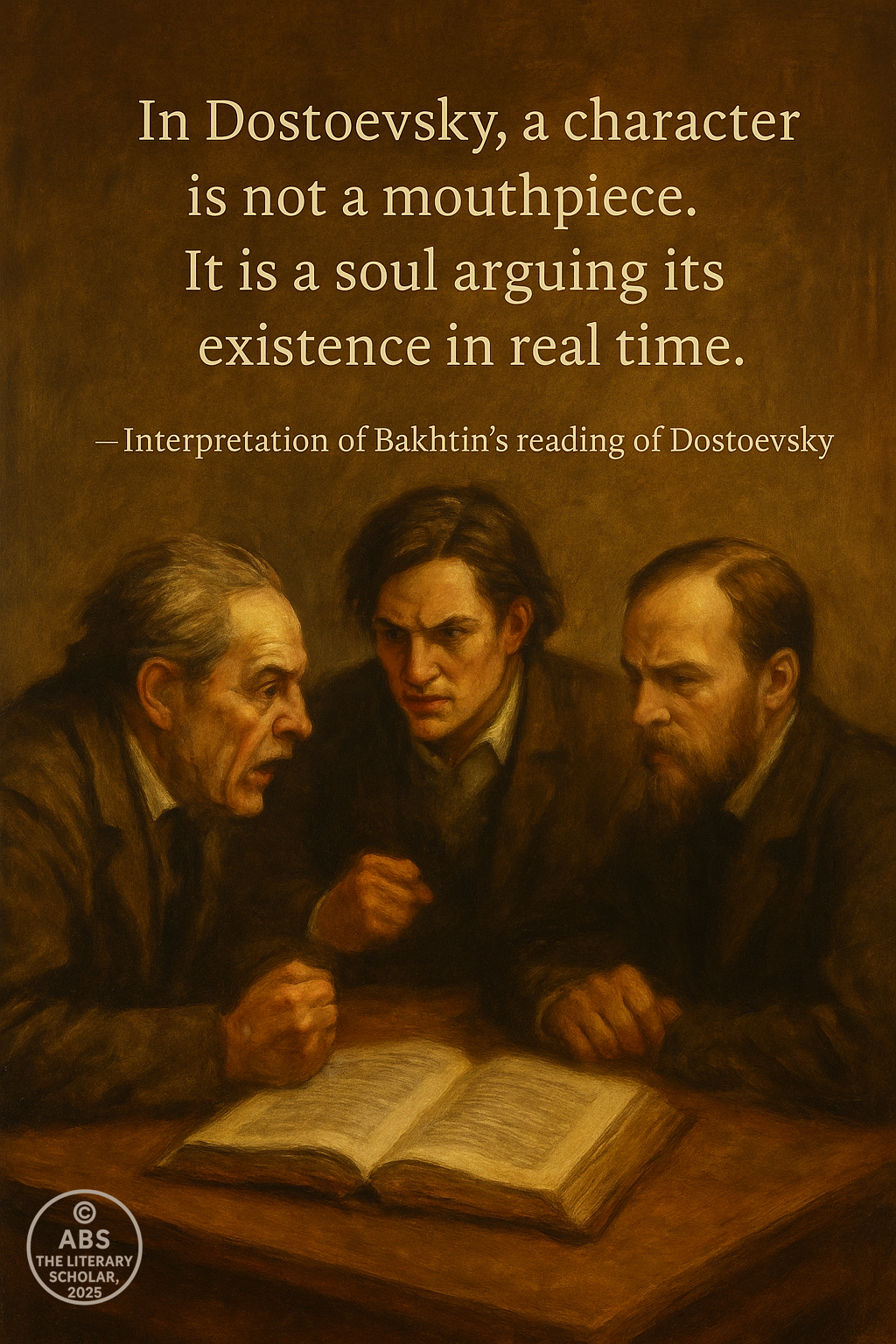
4. Polyphony in The Brothers Karamazov: A Case Study
This theoretical framework becomes incredibly practical when we apply it to the Karamazov family. The three brothers—Dmitri, Ivan, and Alyosha—are often seen as personifications of different parts of the human soul: the sensual (body), the intellectual (mind), and the spiritual (spirit).
One way to see Dostoevsky's uniqueness is to contrast this with an ancient model of the soul, like Plato's. Plato also saw the soul as divided into three parts (appetite, reason, and spirit), but he created a clear hierarchy: reason should rule the others for a person to be just.
Dostoevsky takes these same components but refuses to impose a hierarchy. He throws them into a polyphonic clash. The following reading explores this contrast in detail, showing how Bakhtin's concept of polyphony illuminates Dostoevsky's radical departure from a hierarchical, monologic view of the soul.
The Divided Soul and Dostoevsky's Polyphonic Response to Plato
The essay 'The Divided Soul and Dostoevsky's Polyphonic Response to Plato' by Tomas Roy offers a brilliant analysis of how polyphony works in 'The Brothers Karamazov.'
Please read the following parts of the essay: The first paragraph (introduction) to grasp the main argument. The paragraph beginning 'In The Brothers Karamazov, the three legitimate children...' which directly analyzes Dmitri, Ivan, and Alyosha. The three paragraphs starting from 'While Plato and Dostoevsky’s normative understandings...' through to the end of the paragraph that quotes Bakhtin on 'unmergedness.' This section contrasts Plato's hierarchy with Dostoevsky's polyphony. The final two paragraphs of the essay, which summarize how Dostoevsky creates an open-ended dialogue within and between his characters. \nFocus on how Dostoevsky allows these different 'parts' of the soul (embodied by the brothers) to argue as equals, rather than proclaiming one as the rightful ruler.
As the essay argues, Dostoevsky doesn't give us a tidy, resolved chord where reason is in charge. He gives us a complex, evolving musical piece where the melodies of sensuality, intellect, and spirit are all playing at once, sometimes clashing, sometimes harmonizing, but always remaining distinct. The novel's drama comes from this "open-ended dialogue between contradictory points of view."
Conclusion
Understanding the polyphonic novel is key to appreciating Dostoevsky's genius. It's the literary architecture that makes his deep explorations of psychology and philosophy possible.
Here are the key takeaways from this lesson:
- Polyphony vs. Monology: Unlike traditional monologic novels with a single authorial worldview, Dostoevsky's polyphonic novels feature multiple independent and equal voices.
- Autonomous Characters: Characters like Ivan, Dmitri, and Alyosha are not just puppets; they are "free people" who embody distinct, competing ideologies.
- A Battle of Ideas: The novel is structured as a "dialogue" where conflicting truths (e.g., faith vs. atheism, reason vs. passion) clash without a final resolution imposed by the author.
- The Reader's Role: You, the reader, are not a passive recipient of a single truth. You are placed in the middle of this "symphony of voices" and must actively engage with the debate.
This framework equips us with a powerful lens through which to analyze the conflicts and character arcs in The Brothers Karamazov.
Having now established the biographical, thematic, and structural foundations of Dostoevsky's art, we are ready to turn to the world in which the novel is set. The next module will provide the essential historical context of 19th-century Russia. Our very next lesson will explore the social class structure, the role of the Orthodox Church, and the intellectual movements that form the vibrant, turbulent backdrop for the Karamazov family's story.