Welcome back to our course on applied linguistics. In our previous lesson, we explored the distinction between theoretical and applied linguistics, separating them based on their fundamental purpose—whether it is to understand language for its own sake or to solve real-world problems.
Today, we will examine another crucial way to categorize the study of language: by its scope. We will differentiate between micro-linguistics, which focuses on the internal building blocks of language, and macro-linguistics, which examines language in its broader external context. This distinction will help you map the various subfields of linguistics and understand their relationships to one another.
1. Defining the Core Distinction
Linguistics can be viewed through two different lenses: a narrow one that focuses on the language system itself, and a broad one that looks at how that system interacts with the world. These are known as micro- and macro-linguistics.
To begin, let's get a clear definition of these two areas from a short video.
What is linguistics part 02 | Macro-linguistics & Micro-linguistics
This video, "What is linguistics part 02," provides a direct explanation of the distinction between micro- and macro-linguistics.
Please watch from the beginning up to the list of subfields. As you watch, focus on how the speaker defines micro-linguistics as the study of abstract language systems and their internal components.
As the video explains, micro-linguistics is concerned with the inner workings of language. It studies the structure of a language system without regard to its social meaning or practical application. Given your background in English linguistics, you are already familiar with its core subfields:
- Phonetics & Phonology: The study of speech sounds and sound systems.
- Morphology: The study of word formation.
- Syntax: The study of sentence structure.
- Semantics: The study of literal meaning.
Think of micro-linguistics as examining the individual components of an engine—the pistons, gears, and wires—to understand how they are constructed and fit together.
2. Broadening the Perspective
In contrast, macro-linguistics expands the view to see how language functions in a wider context. Let's return to the same video to define this perspective.
What is linguistics part 02 | Macro-linguistics & Micro-linguistics
Now let's look at the other side of the coin. The same video provides a concise definition of macro-linguistics.
Rewatch the definition of macro-linguistics from the definition and then jump to the end to see some examples of its subfields from the examples. Note how the focus shifts to language in its "broadest sense," including its connection to culture, society, and behavior.
As you just heard, macro-linguistics looks at language from an external point of view, exploring its connection to other disciplines and to human life. It asks questions about how language is acquired, used in society, and processed by the brain. Its subfields include:
- Sociolinguistics: The study of language in relation to social factors.
- Psycholinguistics: The study of language in relation to psychological and neurobiological factors.
- Historical Linguistics: The study of language change over time.
- Discourse Analysis: The study of language use beyond the sentence level.
Returning to our analogy, macro-linguistics studies the car in motion—how the driver operates it, its role in traffic, its journey, and its environmental impact.
3. Visualizing the Levels of Language
A great way to conceptualize this distinction is to think of it as different levels of magnification. The podcast Lingthusiasm offers an excellent analogy for this.
Transcript Episode 101: Micro to macro - The levels of language
This transcript captures a discussion about the structure of introductory linguistics courses, which often move from the smallest units of language to the largest.
Please read the introduction of the episode, from the beginning down to where the text says, "Lauren: Let’s start with the smallest individual units." Pay attention to the analogy of zooming out from a tiny particle to an entire galaxy. This powerfully illustrates the journey from micro- to macro-linguistic analysis.
This "zooming out" framework shows that micro- and macro-linguistics are not separate subjects but different perspectives on the single, complex phenomenon of language.
The following diagram provides a clear map of these branches, visually separating the core structural components (micro) from the broader, interdisciplinary fields (macro).
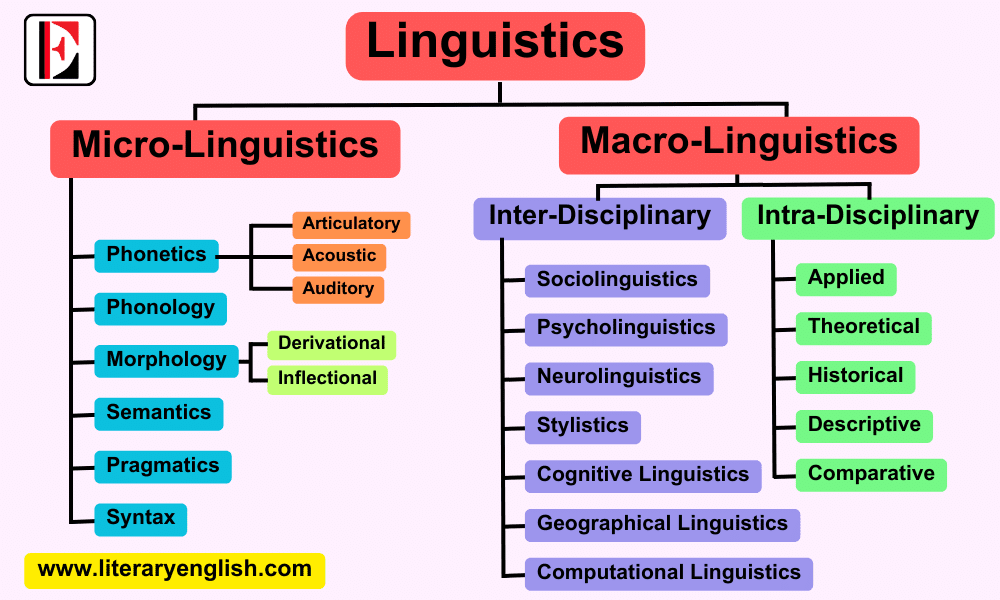
As you can see, the fields of micro-linguistics form the foundational structure, while the fields of macro-linguistics build upon that foundation to explore how language operates in the world.
Summary: Micro vs. Macro
This table summarizes the key differences between the two perspectives.
| Aspect | Micro-linguistics | Macro-linguistics |
|---|---|---|
| Focus | The internal structure of the language system. | Language in its external context (social, psychological, etc.). |
| Scope | Narrow; language as an abstract, self-contained system. | Broad; language as a social and cognitive phenomenon. |
| Key Question | "What is language?" | "How is language used?" |
| Example Fields | Phonetics, Phonology, Morphology, Syntax, Semantics. | Sociolinguistics, Psycholinguistics, Discourse Analysis. |
This micro/macro distinction often aligns with the theoretical/applied split we discussed previously. Core micro-linguistic research is frequently theoretical, while macro-linguistic fields like sociolinguistics and psycholinguistics are often inherently applied, providing insights for language policy, education, and therapy.
Conclusion
In this lesson, we have added another dimension to your map of the linguistic landscape by differentiating its subfields based on their scope.
Key Takeaways:
- Micro-linguistics takes a narrow, internal view, focusing on the fundamental structural components of language: sounds, words, and grammar.
- Macro-linguistics takes a broad, external view, examining how language relates to society, the mind, history, and culture.
- These two areas are not mutually exclusive but represent different levels of analysis, from the smallest building blocks to the largest contexts of use.
In our next lesson, we will "zoom in" to the micro-linguistic level and formally identify the primary subfields of theoretical linguistics—phonetics, phonology, morphology, syntax, and semantics—reinforcing the foundational knowledge for our ongoing exploration.