Welcome to your first lesson in this introduction to applied linguistics. Your background in English linguistics provides an excellent foundation for our work. This course is designed to give you a broad overview of how the study of language is put into practice.
In this lesson, we will begin by addressing a fundamental distinction that defines the entire field: the difference between theoretical and applied linguistics. By the end of our session, you will be able to distinguish between these two major branches of linguistics based on their core purpose and focus. This will set the stage for all the topics that follow.
1. The Two Sides of Linguistics
To understand applied linguistics, we first need a clear picture of what it is being "applied" from. Linguistics as a discipline can be broadly divided into two main areas: one focused on theory and the other on application.
- Theoretical Linguistics: This is the study of language for its own sake. Its goal is to understand the nature of language, describe its structures, and build theories and frameworks to explain how it works. You might think of this as the "pure science" of language.
- Applied Linguistics: This branch takes the theories, findings, and methods from linguistics and uses them to address real-world, language-based problems. It is the practical, problem-solving arm of the discipline.
This image provides a concise definition of each branch.

Let's break down what constitutes the "theoretical" side first.
Linguistics for beginners: What it is and why you should ...
This article from Medium provides a clear, accessible overview of the different branches of linguistics. We'll focus on the core areas of study that form the foundation of theoretical linguistics.
Please read the list of bullet points that begins with "Semantics" and ends with "Pragmatics." As you read, notice how each area focuses on describing a fundamental component of the language system itself.
The fields you just read about—phonetics, phonology, syntax, morphology, and semantics—are the classic domains of theoretical linguistics. They are concerned with questions like:
- What sounds exist in a language and how do they pattern? (Phonetics & Phonology)
- How are words formed? (Morphology)
- How are sentences structured? (Syntax)
- How do words and sentences convey literal meaning? (Semantics)
The primary goal here is to build a model of language, not necessarily to fix a problem with it.
2. From Theory to Practice
Now, let's turn to applied linguistics. While theoretical linguistics asks, "What is language?", applied linguistics asks, "How can we use our knowledge of language to solve a problem?"
The following short video clip offers a great analogy for this relationship.
An Overview of Applied Linguistics
This video, "An Overview of Applied Linguistics" from KTHLearningLab, explains the relationship between linguistics and its application in a very intuitive way.
Watch the section from the engineering analogy. Pay close attention to how the speaker characterizes applied linguistics as taking scientific discoveries and putting them to practical use.
This idea of being the "engineering of linguistics" perfectly captures its core purpose. Applied linguistics serves as a bridge between the abstract knowledge generated by theoretical linguistics and the concrete language-related challenges people face.
This next reading selection gives a direct definition and makes the distinction very clear.
What Is Applied Linguistics? 9 Examples That Define, Inspire And ...
This article from My English Pages provides a straightforward definition of applied linguistics.
Read the first two sections of the article, under the headings "What is applied linguistics?". Notice how the text repeatedly emphasizes solving "real-life conundrums" and addressing "real-life problems."
3. Contrasting the Focus: Examples
The difference between the two fields becomes clearest when we look at the questions they try to answer.
| Theoretical Linguistics Focus | Applied Linguistics Focus |
|---|---|
| Investigating the abstract rules of grammar in a language. | Developing more effective methods for teaching that grammar to second language learners. |
| Describing the sound system of a specific dialect. | Using that description to create better speech therapy materials for speakers of that dialect. |
| Analyzing the structure of sentences in legal documents. | Advising lawyers on how to write clearer, less ambiguous contracts. |
The following video explores the types of real-world problems that motivate applied linguists.
This lecture by Dr. Youssef Tamer delves into the definitions and scope of applied linguistics. We will focus on the key questions and problems that the field addresses.
Watch the segment from the guiding questions, where the speaker lists several questions that applied linguistics tries to answer. Then, watch from Brumfit and Grabe's definitions to see how scholars formally define the field around these "real world problems."
As you saw, the focus is squarely on challenges encountered by learners, teachers, policymakers, translators, and many others in their daily lives. The theoretical study of syntax, for example, might involve a linguist analyzing sentence structure in isolation. In contrast, an applied linguist takes that knowledge and uses it to address issues in education, technology, or law.
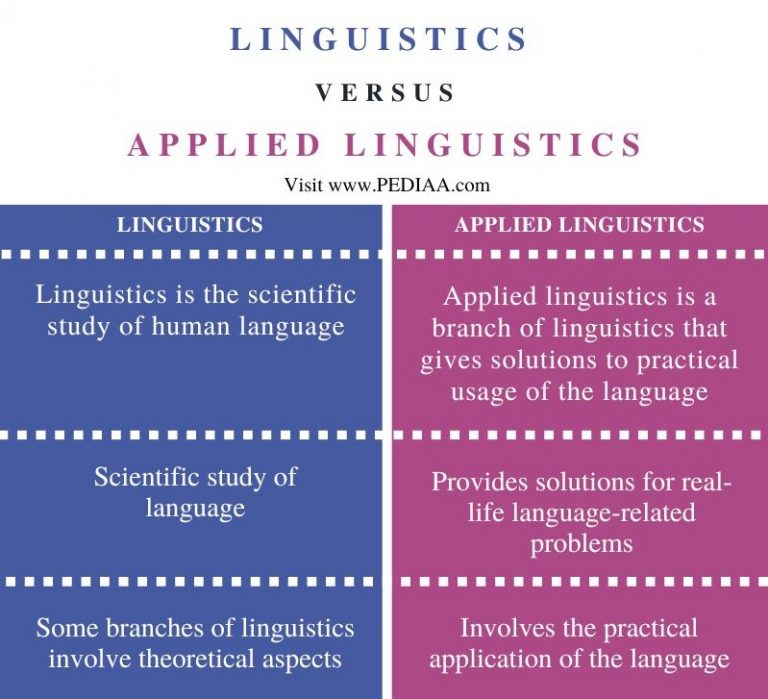
This chart provides a final, simple summary of the key differences.
Conclusion
In this lesson, we have established the foundational distinction between the two main branches of linguistic inquiry.
Key Takeaways:
- Theoretical Linguistics is concerned with understanding the structure and nature of language for its own sake. Its purpose is to describe language and build theories about it. Its focus is on core components like phonology, syntax, and semantics.
- Applied Linguistics is focused on using linguistic knowledge to solve practical, real-world problems. Its purpose is to intervene and provide solutions for issues related to language learning, teaching, policy, and communication.
You now have a clear framework for understanding the different goals within the broader field of linguistics.
In our next lesson, we will build on this by exploring various subfields, differentiating between micro-linguistics (the study of language's internal structure) and macro-linguistics (the study of language in its broader social context).