Welcome back. In our previous lesson, we established a high-level map of linguistics by distinguishing between the internal, structural focus of micro-linguistics and the external, contextual focus of macro-linguistics.
This lesson zooms in on the core of that map. We will formally identify the primary subfields within theoretical linguistics, which is largely synonymous with micro-linguistics. Your background in English linguistics means you're already acquainted with these areas, so our goal today is to organize them into a coherent system and solidify their definitions. We will explore the "building blocks" of language, from the smallest sounds to the structure of sentences and their literal meanings.
The Hierarchy of Linguistic Analysis
Before we look at each subfield individually, it's helpful to understand that they represent different levels of a structured hierarchy. Language can be deconstructed from large units like sentences into progressively smaller components, all the way down to the individual features of a sound. Each level of this deconstruction corresponds to a specific subfield of linguistics.
The following video provides an excellent overview of this hierarchical structure.
Introduction to Linguistics: First Lecture
This clip from the "Introduction to Linguistics" lecture by the Language Science channel illustrates how linguists analyze language at different levels.
Please watch the segment from hierarchy of analysis. Focus on the progression from sentences down to sounds and how the speaker explicitly maps each level—syntax, morphology, phonology, and phonetics—to a subfield of study.
As the video demonstrates, we can think of language as a layered system. Let's now examine each of these layers—the core subfields of theoretical linguistics—in more detail.
The Core Subfields
We will now work our way through the five main subfields, moving from the smallest units (sounds) up to sentence-level meaning. The following video offers a concise tour of each area.
A Linguistics Guide for Beginners!
The video "A Linguistics Guide for Beginners!" by TheLingOtter provides clear, bite-sized explanations of each core subfield with helpful examples.
We will watch this video in segments. As you watch, notice how each field answers a different question about the structure of language.
1. Phonetics and Phonology: The Study of Sounds
While closely related, phonetics and phonology look at sounds from different perspectives. Phonetics studies the physical nature of speech sounds, while phonology studies how those sounds are organized into a system within a specific language.
Watch the first two sections of the video to see this distinction in action.
A Linguistics Guide for Beginners!
These segments define phonetics and then contrast it with phonology.
Watch from the start of the phonetics section at phonetics, and continue through the phonology section until phonology. Pay close attention to the "dancing" example, which clearly illustrates the different questions a phonetician and a phonologist would ask.
- Phonetics is the scientific study of speech sounds. It is concerned with how sounds are produced (articulatory phonetics), their physical properties like frequency and amplitude (acoustic phonetics), and how they are perceived by the ear (auditory phonetics).
- Phonology is the study of the sound systems and patterns of a language. It investigates the rules that govern how sounds can be combined and which sound differences are meaningful. For instance, in English, the difference between the 'p' sound in pie and the 'b' sound in bye changes the word's meaning, making /p/ and /b/ distinct phonemes.
2. Morphology: The Study of Word Structure
Moving up the hierarchy from sounds, we arrive at words. Morphology is the study of the internal structure of words and the rules of word formation.
A Linguistics Guide for Beginners!
This next segment introduces morphology and the concept of a morpheme.
Please watch the section on morphology. Note the definition of a morpheme as the smallest unit of meaning, not just sound.
As the video explains, words are composed of one or more morphemes. In the word undeserving, there are three morphemes:
un-(a prefix meaning "not")deserve(the root word)-ing(a suffix indicating a verb tense or adjectival form)
Morphology examines how these pieces can be combined to create new words and change their grammatical function.
3. Syntax: The Study of Sentence Structure
Once we have words, the next step is to combine them into sentences. Syntax is the field that studies the rules governing this combination.
A Linguistics Guide for Beginners!
This part of the video explains the role of syntax in creating grammatical sentences.
Watch the segment on syntax. The Lego analogy is a simple but effective way to think about syntactic rules.
Syntax is essentially the grammar of sentence construction. It dictates the correct order of words to form grammatical phrases and sentences. For example, English syntax allows "The dog barks" (Subject-Verb) but not "*Barks the dog." Syntacticians often use "syntax trees" to visually represent the hierarchical structure of a sentence.
4. Semantics: The Study of Meaning
Finally, after we've formed a grammatical sentence, we must be able to interpret its meaning. Semantics is the study of literal meaning in language, independent of context.
A Linguistics Guide for Beginners!
This final segment defines semantics and highlights its importance in resolving ambiguity.
Watch the explanation of semantics. The example of the ambiguous will is a great practical application of semantic analysis.
Semantics deals with the meaning of words, phrases, and sentences—what is often called their "dictionary definition." It examines relationships between words (like synonymy and antonymy) and how the meaning of a sentence is composed from the meanings of its parts.
Summary: The Levels of Language
These five subfields form the core of theoretical linguistics, each providing a different lens through which to analyze the intricate structure of human language. The following diagram visually summarizes these levels, showing how they build upon one another from sounds to meaning.
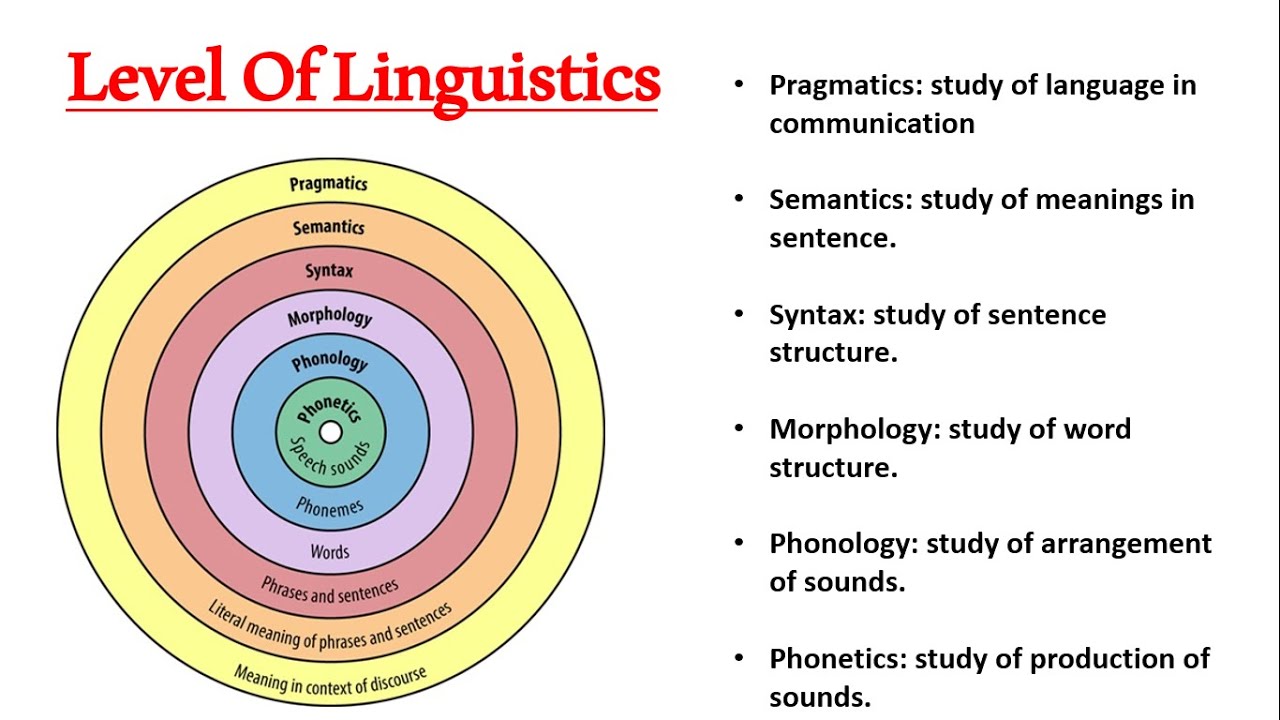
As you can see, the structure is a nested system. You need sounds to build words, words to build sentences, and sentences to convey meaning.
Conclusion
In this lesson, we have formally identified and defined the five primary subfields of theoretical linguistics. By organizing them into a hierarchy, from sounds to meaning, we can see how they collectively form a comprehensive model for describing the internal structure of language.
Key Takeaways:
- Theoretical linguistics is structured as a hierarchy of analysis.
- Phonetics studies the physical properties of speech sounds.
- Phonology studies the abstract sound systems of languages.
- Morphology studies the structure and formation of words.
- Syntax studies the rules of sentence construction.
- Semantics studies the literal, context-independent meaning of words and sentences.
In our next lesson, we will dive a little deeper into semantics. We will explore the crucial distinction between the literal meaning of an utterance and the intended meaning it carries in a particular context, a topic that begins to bridge the gap between theoretical and applied linguistics.