Welcome to your third lesson. In our previous session, we delved into the fascinating chemistry of the photographic emulsion, exploring how light creates a latent image and how developer makes it visible. We saw that the magic happens within the silver halide crystals suspended in gelatin.
Today, we'll shift our focus from the emulsion itself to the foundation it's coated on: the paper base. While the emulsion chemistry is largely consistent, the type of paper base used dramatically changes the printing experience. This lesson will compare the two main types of black and white printing paper—Resin-Coated (RC) and Fiber-Based (FB). We will analyze their construction, compare their practical characteristics, and solidify why RC paper, which you've chosen to work with, is the ideal platform for mastering your darkroom skills.
The Fork in the Road: RC vs. FB Paper
At its core, the choice between RC and FB paper comes down to a fundamental difference in their physical construction. This single difference has a cascade of effects on everything from processing times and durability to cost and final appearance.
Paper Construction
Let's start by examining the physical layers of each paper type.
Fiber-Based (FB) Paper is the traditional, classic form of photographic paper. Its structure is relatively simple: a high-quality paper fiber base, a brightening layer, and the emulsion.
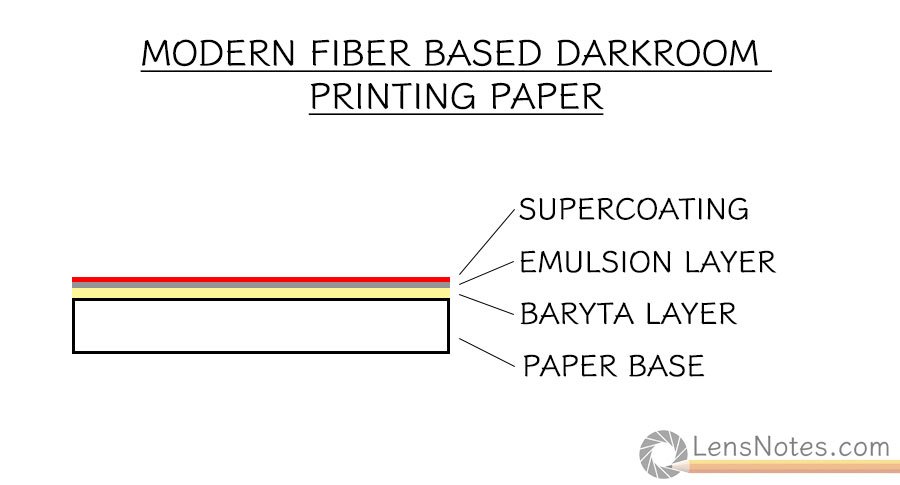
The key components are:
- Paper Base: A thick, high-quality paper stock, which gives the final print its substantial weight and feel.
- Baryta Layer: A coating of barium and strontium sulfates applied over the paper base. It serves two main purposes: it creates a chemically inert barrier to prevent impurities from the paper from affecting the emulsion, and its bright white surface increases the perceived brightness and clarity of the image.
- Emulsion & Supercoating: The light-sensitive silver-gelatin emulsion and a protective gelatin supercoating, just as we discussed in the last lesson.
Resin-Coated (RC) Paper was developed to overcome some of the practical challenges of FB paper. It "waterproofs" the paper base by sandwiching it between two layers of plastic.
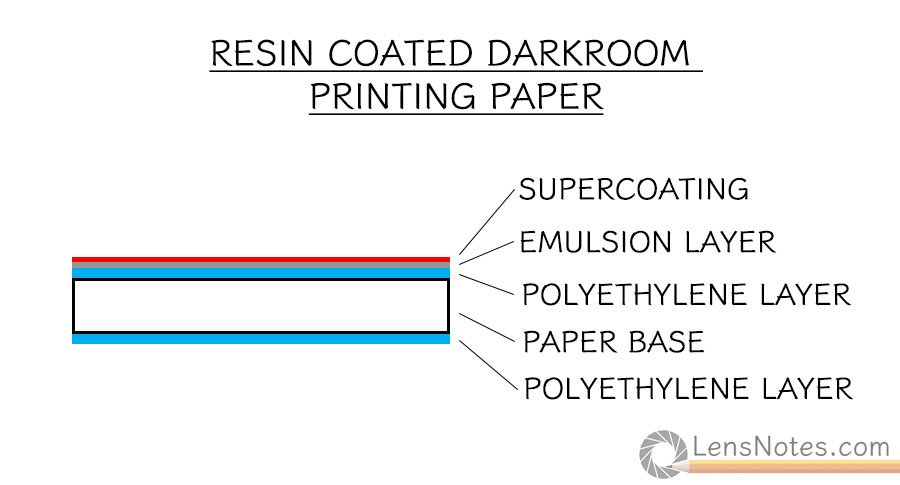
The key difference is:
- Laminated Base: The paper base is completely sealed between two layers of polyethylene (the "resin"). This prevents water and chemicals from ever reaching the paper fibers. The emulsion is then coated on top of this plastic surface.
To get a more detailed understanding of these structures, please read the following article from Lens Notes.
Resin Coated vs Fiber Based Photographic Paper - Lens Notes
This article provides an excellent breakdown of the structural differences between the two paper types.
Please read the two sections detailing the construction of Fiber based paper and Resin coated paper. Pay attention to the role of the baryta layer in FB paper and the polyethylene layers in RC paper.
Practical Implications of Paper Construction
The simple fact that FB paper absorbs liquid while RC paper repels it is the root of all their practical differences. For someone with an engineering mindset, this is a classic case of how a material's physical properties dictate its performance and processing requirements.
Let's break down the consequences in a systematic way.
1. Ease of Use and Processing Time
This is the most significant difference you'll encounter.
- RC Paper: Because the base is waterproof, only the thin emulsion layer interacts with the chemicals. This means processing is fast and efficient.
- Development: ~1 minute.
- Fixing: ~30-60 seconds.
- Washing: As little as 2-5 minutes is sufficient to remove all residual chemistry from the non-absorbent surface.
- FB Paper: The paper base acts like a sponge, soaking up every chemical it touches. This necessitates longer processing times and makes the paper delicate when wet.
- Development: ~2-3 minutes.
- Fixing: ~1-2 minutes, but must be timed carefully to avoid over-saturating the paper fibers with fixer.
- Washing: 30 to 60 minutes in running water is required to ensure all the absorbed fixer is removed from the paper fibers. This can be shortened by using a chemical wash aid (hypo-clearing agent), but that adds another step and chemical to the process.
The official ILFORD guide below offers a great visual and verbal explanation of these differences.
Photographic Papers - ILFORD Photo Darkroom Guides
This video from ILFORD Photo, a leading paper manufacturer, clearly demonstrates the practical differences in handling and processing RC and FB papers.
Watch the section on RC papers, noting the short wash times and ease of handling. Then, watch the following section on FB papers, paying close attention to the much longer and more involved washing and drying procedures described.
2. Drying and Flatness
- RC Paper: Since the paper base never gets wet, it dries quickly (15-20 minutes in the air) and remains perfectly flat.
- FB Paper: As the water-logged paper fibers dry, they shrink unevenly, causing the print to curl dramatically. Achieving a flat FB print requires special techniques like air-drying on screens followed by pressing under heavy weight for days, or using a heated dry-mount press. This adds significant time and effort to the workflow.
3. Durability
- RC Paper: The polyethylene lamination makes the paper incredibly tough and resistant to tearing or kinking, even when wet. You can handle it in the chemistry with confidence.
- FB Paper: When wet, the paper fibers are swollen and fragile. The paper can be easily torn or damaged by tongs if not handled with care.
4. Cost and Resource Efficiency
From a resource management perspective, the differences are stark.
- Paper Cost: RC paper is typically 30-50% cheaper than its FB equivalent.
- Resource Consumption: FB printing requires significantly more water for its long wash cycle. It also benefits from an additional chemical (hypo-clear), adding to the cost and complexity. The longer processing times can also translate to higher costs if you are renting darkroom time.
This detailed article provides an excellent summary of these points, especially regarding efficiency and cost.
Resin-coated Versus Fibre-based Enlarging Papers
This article from Yateley Darkroom offers a concise but thorough comparison, including a very useful summary table.
First, review the side-by-side comparison table for a quick overview. Then, read the sections on Ease of Use and Cost to reinforce your understanding of the practical and financial advantages of RC paper for learning.
5. Aesthetics and Archival Quality
This is the one area where FB paper traditionally holds an edge.
- Look and Feel: FB prints have a certain "prestige." The image appears embedded in the paper fibers, which many believe gives a greater sense of depth and permanence. The weight and texture of an unmounted FB print are undeniably luxurious.
- Archival Stability: A properly processed and washed FB print, made of paper, gelatin, and metallic silver, is of proven archival quality, capable of lasting centuries. The long-term stability of the plastics in RC paper is less certain, though modern RC papers are exceptionally stable.
- Dry-Down Effect: As prints dry, their appearance can shift slightly. FB prints tend to "dry down" darker and with slightly more contrast, while RC prints can sometimes lighten a little. This is a subtle but important factor in advanced printing.
The Verdict: Why RC Paper is Your Best Choice
Let's summarize the comparison in a table:
| Characteristic | Resin-Coated (RC) Paper | Fiber-Based (FB) Paper |
|---|---|---|
| Construction | Paper base sealed in plastic | Bare paper fiber base |
| Processing | Fast (5-10 mins total) | Slow (45-90 mins total) |
| Durability | High (tough when wet) | Low (fragile when wet) |
| Drying | Dries quickly and flat | Dries slowly and curls |
| Cost | Lower | Higher |
| Resource Use | Low (less water, fewer chemicals) | High (more water, needs wash aid) |
| Aesthetics | Excellent quality, flat finish | "Prestige" feel, deeper blacks |
| Archival | Very good | The gold standard |
For your goal of moving from basic to refined printing, RC paper is the clear and logical choice.
- Efficiency: It allows you to maximize your darkroom time focusing on the creative aspects of printing—exposure, contrast control, dodging, and burning—rather than on the laborious mechanics of washing and flattening.
- Cost-Effectiveness: The lower cost per sheet means you can experiment freely, make test strips, and even make mistakes without the financial pressure. This freedom is essential for learning.
- Consistency: The stability and flatness of RC paper provide a reliable, predictable surface. This removes extraneous variables, allowing you to see the direct results of your creative decisions.
Think of it this way: you are learning to master a complex process. RC paper provides a stable, simplified platform for that learning. Once the core skills are second nature, you can transition to FB paper for specific projects where its unique aesthetic and archival properties are required. This is a common professional workflow, as mentioned in the video below.
Choosing B&W paper for making darkroom prints.
To conclude, let's hear a final recommendation from experienced printer Ira Gardner.
Listen to his strong recommendation to work with resin coated paper to learn. He then describes his professional workflow, where he uses RC paper for all his test prints before switching to fiber paper for the final museum-quality print. This perfectly illustrates the value of RC paper as a primary tool for practice and refinement.
Conclusion
Today we have thoroughly compared the two families of darkroom paper. You should now have a solid, evidence-based understanding of why your choice to focus on RC paper is the most strategic approach for this course.
Key takeaways:
- Photographic papers are either Fiber-Based (FB), with an absorbent paper base, or Resin-Coated (RC), with a waterproof, plastic-laminated base.
- This structural difference makes RC paper far faster to process, easier to handle, more durable, and more cost-effective.
- FB paper is traditionally favored for its aesthetic depth and superior, proven archival quality, but it demands significantly more time, care, and resources.
- By using RC paper for learning, you can focus your energy and resources on mastering the essential creative techniques of printing, which is the primary goal of this course.
Now that we've settled on our printing medium, our next lesson will turn to the first chemical it encounters in the printing process. We will explore developers, examining how your choice of developer, its dilution, and its temperature can profoundly influence the final tonality and contrast of your prints.