Hello! Welcome to your next lesson in the "Staying Vigilant in the Crypto Space" module.
In our last lesson, we covered the landscape of common crypto scams, including phishing, fake giveaways, and rug pulls. You learned to be skeptical of "too good to be true" offers and the importance of doing your own research (DYOR).
Today, we will zoom in on a specific and widespread form of market manipulation you briefly encountered: the pump and dump scheme. Your goal for this lesson is to learn how to recognize the signs of this manipulation. Understanding how these schemes work is critical for navigating crypto markets safely and avoiding traps designed to prey on new investors.
1. What is a Pump and Dump Scheme?
A pump and dump is a coordinated effort to artificially inflate the price of a cryptocurrency (the "pump") and then sell it off en masse at the higher price (the "dump"). This leaves later investors holding a rapidly devaluing asset.
These schemes are illegal in traditional stock markets, but due to the unregulated nature of many cryptocurrencies, they are unfortunately common. The organizers typically target coins with low trading volume and market capitalization, as their prices are easier to manipulate with less capital.
Crypto Pump and Dump EXPLAINED: How to Spot and Avoid It
To start, let's get a clear and concise definition of what a pump and dump is and its two main phases. This video from CoinGecko provides an excellent overview.
Watch the segment from 00:13 to 01:55. Focus on the definition of the 'pump' phase (creating hype) and the 'dump' phase (selling off for profit).
The image below breaks down the typical lifecycle of a pump and dump scheme, showing who profits and who loses.

From your experience with online business, you can think of this as a malicious form of marketing. Scammers generate artificial hype—much like creating fake buzz for a product—to drive up demand and price, with the sole intention of cashing out before the public realizes the asset has no real value.
2. The Anatomy of a Pump and Dump Group
These schemes are often organized in large, semi-public groups on platforms like Telegram and Discord. The organizers create a sense of community and exclusivity, making members feel like they are "insiders" who are about to profit from the "outsiders" who will buy after them.
The reality is far more deceptive.
I Joined a Pump and Dump Scheme So You Don't Have To
This investigative video from Coffeezilla exposes the inner workings of these pump and dump groups. It reveals the core deception: the group members who think they are part of the scam are actually the intended victims.
Watch the following clips to understand the structure and lies behind these groups: The Premise (00:00 - 01:52): Understand what these groups promise and why they are scams. The Setup (01:52 - 03:41): See how the groups are organized on Discord/Telegram and what a pump looks like on a chart. The Lie vs. The Truth (04:36 - 07:18): This is the most crucial part. Pay close attention to how the organizers deceive members by secretly buying the coin in advance and selling to the group members, not outsiders.
As the video explains, the only people who reliably profit are the small, hidden inner circle of organizers who know the target coin weeks in advance. They accumulate the coin at a low price and then use the group's coordinated buying to create the price spike they need to sell into. It’s not about being the "fastest clicker"; it's about having insider information that the general members of the group do not possess.
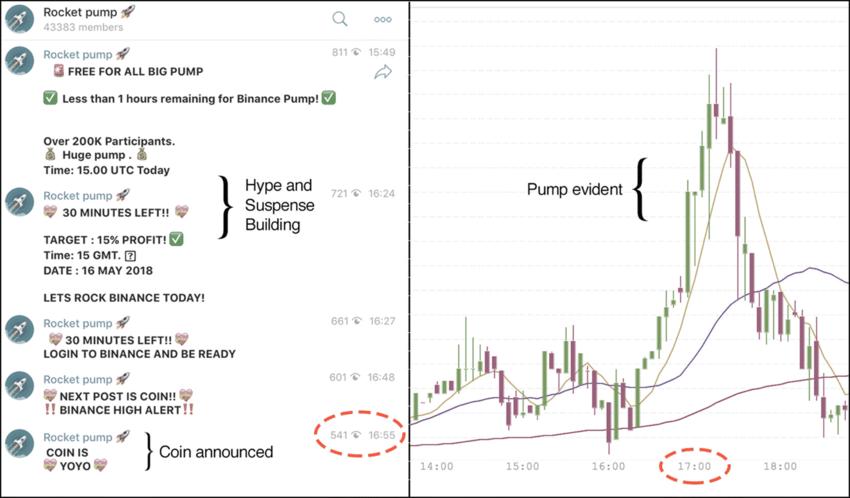
The image below shows this process in action: a Telegram group coordinating a pump and the resulting spike on the price chart.
3. How to Spot the Red Flags
Now for the most practical part: how do you identify a potential pump and dump before you get caught in it? Here are the key signs to watch for.
How to Spot Crypto Pump & Dump Schemes Using Blockchain ...
This article from Altrady provides a detailed breakdown of a pump and dump's lifecycle and the tell-tale signs of manipulation.
Read the section titled 'Understanding the Full Lifecycle of a Pump and Dump'. It clearly outlines the stages from coin selection to the final dump.
Based on the resources, here is a summary of the most important red flags:
- Sudden, Intense Social Media Hype: You see a flood of posts on Twitter, Telegram, or Reddit about a little-known coin. This is often driven by bots and paid influencers all promising massive, imminent gains. Be very wary of any project whose main value proposition is hype.
- Obscure, Low-Liquidity Tokens: Scammers choose unknown coins with very low trading volume. You can check this on sites like CoinMarketCap or CoinGecko. A low market cap and low liquidity (e.g., under $100,000 in daily volume) means the price is easy to manipulate.
- Extreme Price and Volume Spikes: When you look at the chart, you see a near-vertical price increase—a "green candle" that dwarfs all previous price action—on massive volume. This is not natural growth; it's a sign of coordinated buying.
- Guaranteed or Unrealistic Returns: The promotion includes phrases like "100x gem," "guaranteed profit," or "get in before we go to the moon." Legitimate projects focus on technology and use cases, not on promising specific price gains.
- Pressure and Urgency (FOMO): The messaging is designed to create a Fear Of Missing Out (FOMO). Announcements are timed to the second, creating a frantic rush to buy. This is a psychological tactic to make you act without thinking.
4. Real-World Examples
To solidify your understanding, let's look at a couple of historical examples of pump and dump schemes mentioned in the resources.
- Sonum (SNM): As mentioned in the CoinGecko video, this old 2017 project suddenly surged by nearly 7,000% in a single day in 2021 before crashing over 90% the very next day. This extreme volatility for an otherwise dormant project is a classic sign of manipulation.
- SaveTheKids ($KIDS): The Altrady article details this 2021 scam. Promoted by social media influencers, the token was marketed as a charity project. However, insiders were able to dump their tokens almost immediately after launch, causing the price to collapse and leaving their followers with worthless assets. This highlights how even a noble-sounding cause can be a front for a scam.
Conclusion
You now have a clear framework for recognizing one of the most common forms of market manipulation in crypto. Unlike legitimate marketing that aims to build sustainable interest, a pump and dump is a predatory scheme built on deception.
Key Takeaways:
- A pump and dump involves artificially inflating a low-volume coin's price to sell it to unsuspecting buyers.
- They are organized in social media groups that create a false sense of being an "insider," when the members are actually the targets.
- Key red flags include intense hype around obscure coins, promises of guaranteed profits, and near-vertical price charts.
- The only way to win is not to play. Avoid these schemes entirely. The promise of easy money is the bait in the trap.
What's Next?
Now that you can identify blatant manipulation like a pump and dump, you might wonder: how do you evaluate projects that aren't obvious scams but are still very risky? In the next lesson, we will address that by learning how to differentiate between legitimate projects and high-risk speculative tokens. This will help you develop a more nuanced approach to assessing potential investments.