Hello! Welcome to the first lesson of our final module, "Staying Vigilant in the Crypto Space."
In the previous module, you gained the practical skills to navigate Binance Futures, from calculating leverage to monitoring and closing your positions. Now, we'll shift our focus from the mechanics of trading to the crucial skill of protecting your capital. The crypto world offers many opportunities, but it also has unique risks that every participant must learn to recognize and avoid.
Today's lesson is designed to help you identify common crypto scams, such as fake giveaways, phishing emails, and rug pulls. Understanding these threats is the first and most important step in safeguarding your funds as you begin your journey on Binance and in the broader crypto ecosystem.
1. Phishing and Impersonation: The Art of Deception
One of the most common threats you'll face is phishing. This is a fraudulent attempt by a scammer to trick you into revealing sensitive information, such as your password, 2FA codes, or wallet seed phrase. Scammers achieve this by impersonating a legitimate entity, like Binance, in an email, message, or on a website.
These attacks often rely on social engineering—manipulating your emotions, like fear or urgency, to make you act without thinking.
The Ultimate Guide to Spotting and Stopping Crypto Scams
To start, let's explore the different forms phishing can take. This article from the Binance blog provides a great overview of modern phishing tactics you might encounter.
Read the section titled 'Phishing Scams'. It covers QR code scams, impersonation on messaging apps, and the risks of signing blockchain messages on fake sites.
Now, let's see a real-world example of how scammers execute an impersonation scam and what red flags to watch for.
Crypto Scams Exposed - 5 Tips To Not F*ck Up!
This video from Cyber Scrilla exposes several common scams. We'll focus on the section where the creator details his own experience with an impersonation scam.
Watch the segment from 02:55 to 05:32. Pay close attention to the social engineering tactics used and the list of red flags he provides at the end of the section.
Practical Application: Anti-Phishing on Binance
Binance provides tools to help you combat phishing. One of the most effective is the Anti-Phishing Code. This is a unique code that you set in your security settings. Once enabled, every legitimate email from Binance will include this code. If you receive an email claiming to be from Binance without your code, you know it's a scam.
Here's how to visually distinguish between a fake and a real communication.

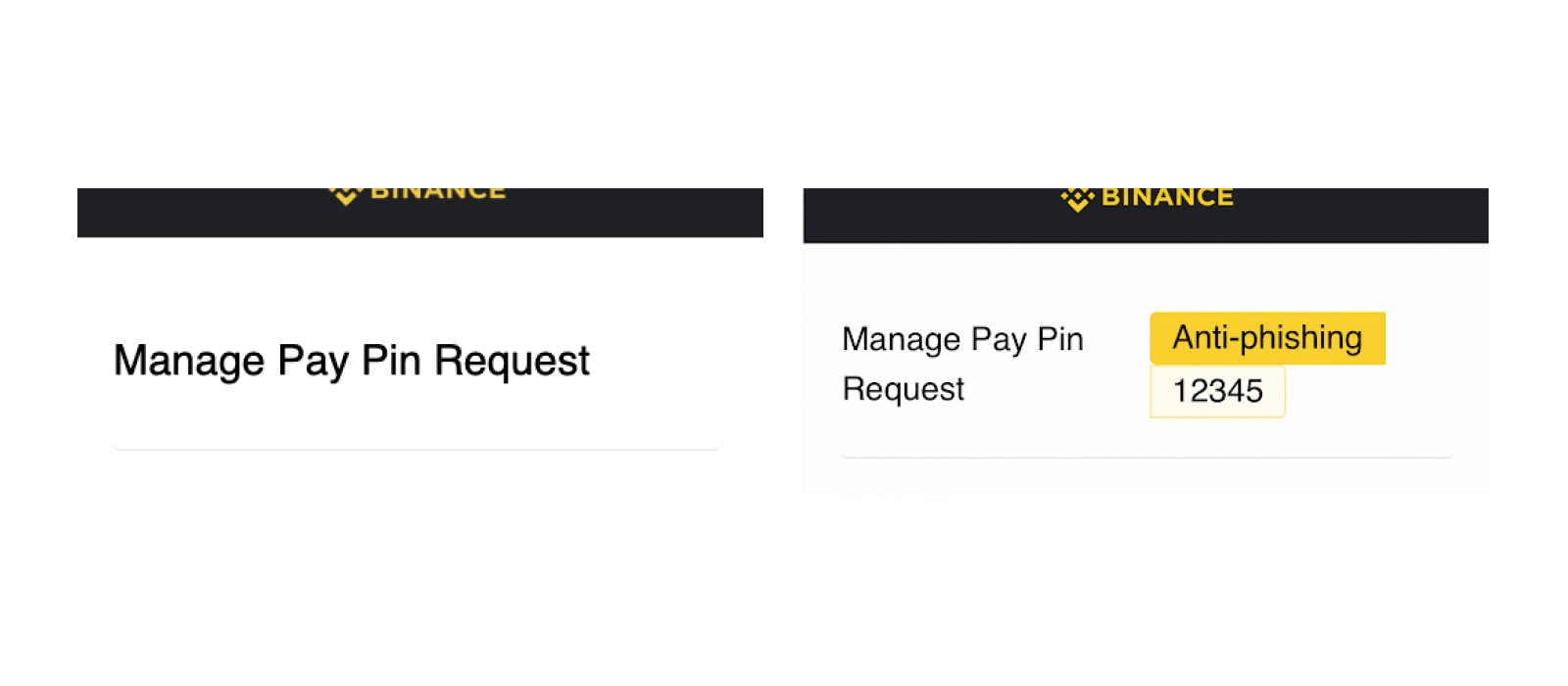
Setting up your anti-phishing code is a simple, powerful step you can take to protect your account. We will cover the setup of this feature in a later lesson.
2. Fake Giveaways and "Too Good to Be True" Offers
A classic scam preys on the universal desire for a great deal. In crypto, this often takes the form of fake giveaways, airdrops, or investment schemes promising impossibly high returns.
The rule is simple: If an offer seems too good to be true, it is.
A common format is the "send 1, get 2 back" scam. A scammer, often impersonating a famous person like Elon Musk or an official project account, will post on social media announcing a giveaway. The post will instruct users to send a certain amount of crypto to a specific address, promising to send back double the amount. This is always a scam. You will never get anything back.
These scams can be surprisingly effective when combined with a sense of urgency or a high-profile account hack.
Crypto Scams Exposed - 5 Tips To Not F*ck Up!
Let's return to the 'Crypto Scams Exposed' video to see how a high-profile account was used to execute this type of scam, stealing hundreds of thousands of dollars in minutes.
Watch the segment on phishing scams from 05:32 to 08:43. The example of Vitalik Buterin's hacked Twitter account (starting around 06:17) is a perfect illustration of a fake giveaway/NFT drop scam.
Another variation is the airdrop scam, where unsolicited tokens appear in your wallet.
Crypto Scams Exposed - 5 Tips To Not F*ck Up!
Watch this final clip from the same video to understand how these seemingly free tokens are a trap.
Watch from 08:43 to 10:04. The video explains that interacting with these tokens or visiting their associated websites can lead you to a phishing site designed to drain your wallet.
The key takeaway is to never interact with unsolicited tokens and be extremely skeptical of any offers promising free money or guaranteed high returns.
3. Rug Pulls: When the Project Disappears
A rug pull is a malicious maneuver where a crypto project's developers abandon it and run away with investors' funds. This scam is particularly common with new, hyped-up tokens on decentralized exchanges (DEXs).
Given your interest in driving traffic for businesses, you'll find it interesting that scammers use a dark version of marketing—aggressive social media campaigns, paid influencers, and viral hype—to build excitement and lure investors before they pull the plug.
Rug Pulls 101 – The Tricks, the Signs, and What to Watch For on the DEX
This Binance Academy article, 'Rug Pulls 101', provides an excellent, detailed explanation of what rug pulls are and how they work.
First, read the sections 'What Is a Rug Pull?' to get a clear definition, and 'How Does a Rug Pull Work?' to understand the typical lifecycle of this scam.
Rug pulls can be executed in several ways. The most common are liquidity pulls and "pump and dump" schemes.
Rug Pulls 101 – The Tricks, the Signs, and What to Watch For on the DEX
Now, let's look at the different types of rug pulls. The same article breaks them down clearly.
Read the section 'Types of Rugpulls'. It details liquidity rug pulls, pump and dumps, and hidden tricks in the smart contract code.
How to Spot a Potential Rug Pull
Protecting yourself from rug pulls requires skepticism and research—a practice known in crypto as DYOR (Do Your Own Research). Here are some critical red flags to look for, summarized from the "Rug Pulls 101" article:
- Anonymous Team: The project's founders and developers are anonymous or have no verifiable track record.
- Aggressive FOMO Marketing: The project promises unrealistic returns (e.g., "100x guaranteed!") and is heavily promoted by anonymous influencers.
- Unlocked Liquidity: The project's liquidity pool on a decentralized exchange is not locked. This means the developers can withdraw all the funds at any moment.
- Uneven Token Distribution: A huge percentage of the token supply is held by just a few wallets (usually the developers), who can dump the price at will.
- No Code Audit: The project's smart contract has not been audited by a reputable third-party security firm.
Always approach new, hyped projects with extreme caution.
Conclusion
Today, we've taken a crucial step in securing your crypto journey. By learning to identify the most common scams, you've built a foundational layer of defense for your future activities on Binance and beyond.
Key Takeaways:
- Phishing & Impersonation: Scammers will try to trick you into revealing sensitive information by impersonating trusted entities like Binance. Always verify the source and use tools like an Anti-Phishing Code.
- Fake Giveaways & Offers: If an offer seems too good to be true, it is a scam. Never send crypto to receive more in return, and don't interact with unsolicited tokens.
- Rug Pulls: Developers of new projects can abandon them and steal investor funds. Always Do Your Own Research (DYOR) and look for red flags like anonymous teams and unlocked liquidity.
- The Golden Rule: Be skeptical, question everything, and never act out of urgency or fear (FOMO).
What's Next?
In this lesson, we briefly mentioned "pump and dump" schemes as a type of rug pull. In our next lesson, we will dive deeper into this topic. You will learn to recognize the signs of potential market manipulation (e.g., pump and dump schemes), giving you a sharper eye for spotting unnatural market behavior.