Hello! Welcome back to our journey into Binance Futures.
In our last lesson, we discussed how leverage is a "double-edged sword," capable of amplifying both your profits and your losses. We briefly mentioned that the ultimate risk of amplified losses is liquidation, where a trade is forcibly closed and your initial investment is lost.
Today, we're going to dive deep into that exact concept. This is one of the most critical lessons in futures trading. Understanding how liquidation works is not just theoretical; it's essential for survival and risk management. Our goal is to explain the concept of liquidation and its risk in leveraged trading. We'll cover what it is, the mechanics behind it, and how to see it coming.
1. What is Liquidation?
In simple terms, liquidation is the automatic, forced closure of your trading position by the exchange. This happens when you can no longer meet the margin requirements for your leveraged position—in other words, your losses have grown so large that they are about to exceed the collateral you put up for the trade.
The exchange steps in to close your position to prevent you from falling into a negative balance. You lose the capital (margin) you allocated to that trade.
Let's look at the process step-by-step.
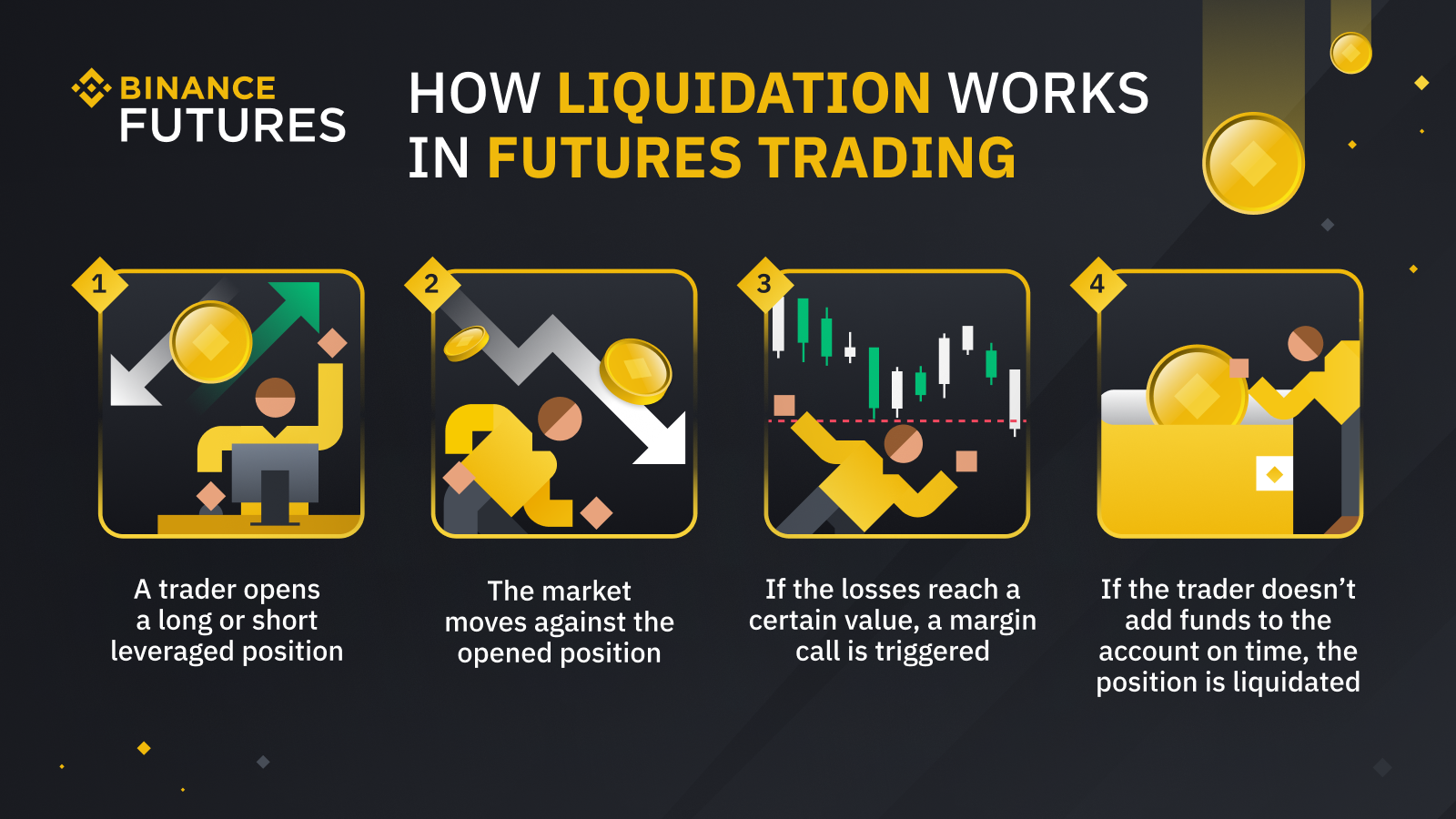
To solidify this definition, let's start with a clear, practical example from an article by Binance.
Crypto Futures Basics: What Is Liquidation and How to Avoid It?
The article 'Crypto Futures Basics: What Is Liquidation and How to Avoid It?' provides a perfect real-world example of how a leveraged position can be liquidated.
Read the sections 'What Is Liquidation in Crypto Futures Trades?' and 'When Would Liquidation Occur?'. Focus on the BTC/BUSD example to see how a small 5% price drop can wipe out a 20x leveraged position.
As you can see from the example, high leverage means a small price movement against you is all it takes to trigger a liquidation. This is the direct consequence of the amplified losses we discussed in the previous lesson.
2. The Mechanics: Margin Ratio and Maintenance Margin
So, how does the system know exactly when to liquidate you? It's not arbitrary. It's based on two key concepts: Maintenance Margin and the Margin Ratio.
- Margin (Collateral): The funds in your futures wallet securing your open position.
- Maintenance Margin: The minimum amount of margin you must maintain to keep your position open. If your margin balance falls below this level, liquidation occurs.
- Margin Ratio: This is your account's "health bar." It's a percentage that shows how close you are to being liquidated. When it reaches 100%, your position is liquidated.
The following video explains these terms and how they fit together beautifully.
Binance Futures Trading for Beginners 2026 - FULL GUIDE
The video 'Binance Futures Trading for Beginners' clearly defines margin, maintenance margin, and the all-important margin ratio.
Watch from 07:46 to 10:19. Pay close attention to the definition of the margin ratio and what happens when it hits 100%. This is the core mechanism of liquidation.
Before your margin ratio hits 100%, Binance will often issue a margin call—a warning that you are close to liquidation and should either add more margin to your account or reduce your position.
3. The Trigger: Mark Price vs. Last Price
This is a crucial detail that trips up many beginners. Your position is not liquidated based on the price you see on the main chart (the "Last Price"). Instead, Binance uses the Mark Price.
- Last Price: The price of the most recent trade executed on Binance.
- Mark Price: A more stable and fair price, calculated as an average from price data across several major spot exchanges.
Binance uses the Mark Price to prevent unfair liquidations that could be caused by a single exchange's sudden price spike or manipulation. A position is liquidated only when the Mark Price hits your liquidation price.
The article below explains this concept and introduces the two margin models you can use on Binance.
Binance Futures Liquidation Explained
The article 'Binance Futures Liquidation Explained' details the mechanics of liquidation and clarifies the critical difference between the Mark Price and the Last Price.
Read the section 'Liquidation mechanics and mark price', including the subsections 'Margin models explained' and 'Mark price, not the last price'. Focus on why the Mark Price is used as the trigger.
4. Knowing Your Liquidation Price
Now for the most practical part. Since liquidation is tied to a specific price, how do you know what that price is for your trade? The higher the leverage you use, the closer your liquidation price will be to your entry price, giving you less room for the market to move against you.

Fortunately, you don't have to guess. Binance provides a built-in Futures Calculator to determine your exact liquidation price before you even place a trade. This is your most important risk management tool.
Let's see how to use it.
Binance Futures Tutorial 2026 (Step-By-Step Guide)
In this 'Binance Futures Tutorial', the host provides a step-by-step demonstration of how to use the Futures Calculator to find your potential liquidation price.
Watch from 23:38 to 26:16. Follow along as the calculator is used to show how changing the position size and leverage directly impacts the liquidation price. This is a key practical skill.
5. The Hidden Cost: Liquidation Fees
As if losing your entire margin wasn't bad enough, liquidation also comes with a penalty. When Binance forcibly closes your position, it charges a Liquidation Clearance Fee. This fee is taken from the notional value of your position. This is another strong reason to avoid liquidation at all costs.
Binance Futures Liquidation Explained
Let's return to the 'Binance Futures Liquidation Explained' article to understand the final consequence of liquidation.
Read the section titled 'Binance liquidation fee'. Understand that this fee is an additional penalty charged during a forced liquidation.
Conclusion
Today we've unpacked the single greatest risk in futures trading: liquidation. It's not a random event, but a predictable outcome based on the mechanics of margin and leverage. A disciplined trader doesn't fear liquidation; they respect it and plan for it.
Key Takeaways:
- Liquidation is the forced closure of your position when your margin balance falls below the required maintenance margin.
- The Margin Ratio is the "health bar" of your account; when it hits 100%, liquidation is triggered.
- Liquidation is triggered by the Mark Price, not the Last Price, to ensure fairness and prevent manipulation.
- Higher leverage brings your liquidation price dangerously close to your entry price.
- The Binance Futures Calculator is an essential tool to calculate your liquidation price before you trade.
- On top of losing your margin, you are also charged a liquidation fee.
What's Next?
We've now introduced the calculator as a way to foresee your liquidation price. In the next lesson, we will make full use of this tool. The learning outcome will be to use the Binance Futures calculator to assess potential P&L and liquidation price. We will move from just understanding the risk to actively planning for profit targets and risk levels on a trade.