Hello! Welcome back to our module on Binance Futures.
In our last lesson, we established the fundamental differences between spot and futures trading. The most critical distinction we touched upon was leverage, which allows you to control a large position with a small amount of capital. We briefly noted that this can amplify both profits and losses and introduces a major risk called liquidation.
Today, we're going to focus entirely on that concept. Our goal is to describe how leverage can amplify both gains and losses. Understanding this "double-edged sword" is arguably the most important principle for anyone considering futures trading. It's the key to both its potential and its significant risks.
1. What is Leverage? A Deeper Look
At its core, leverage is simply the use of borrowed funds to increase your trading position size. The amount of leverage is expressed as a ratio, like 2x, 5x, or 20x.
If you have $100 and you use 5x leverage, you are effectively trading with $500 ($100 of your own money and $400 borrowed from the exchange). Your own capital ($100 in this case) is called collateral.
To get a formal definition and see how this works, please read the first part of this article from Binance.
What is Leverage in Cryptocurrency Trading? - Binance
The article 'What is Leverage in Cryptocurrency Trading?' from Binance explains the core concept of using borrowed capital and how the leverage ratio works.
Read the section titled 'What is leverage in cryptocurrency trading?'. Focus on how leverage expands your buying power and the meaning of ratios like 10x or 20x.
Now, let's see this principle in action and explore how this multiplication of buying power affects your results.
2. The Power of Amplified Gains
The main appeal of leverage is its ability to magnify your profits from small price movements. Let's walk through a clear example.
Scenario: You expect Bitcoin's price to rise.
- Your Capital (Collateral): $200
- Leverage: 5x
- Your Position Size: $200 (your capital) x 5 (leverage) = $1,000
Now, let's say Bitcoin's price increases by 10%.
- Without Leverage: If you had just bought $200 worth of Bitcoin, a 10% increase would give you a profit of $20. Your new balance would be $220. A respectable 10% return on your investment.
- With 5x Leverage: Your trade was worth $1,000. A 10% increase on a $1,000 position is a $100 profit.
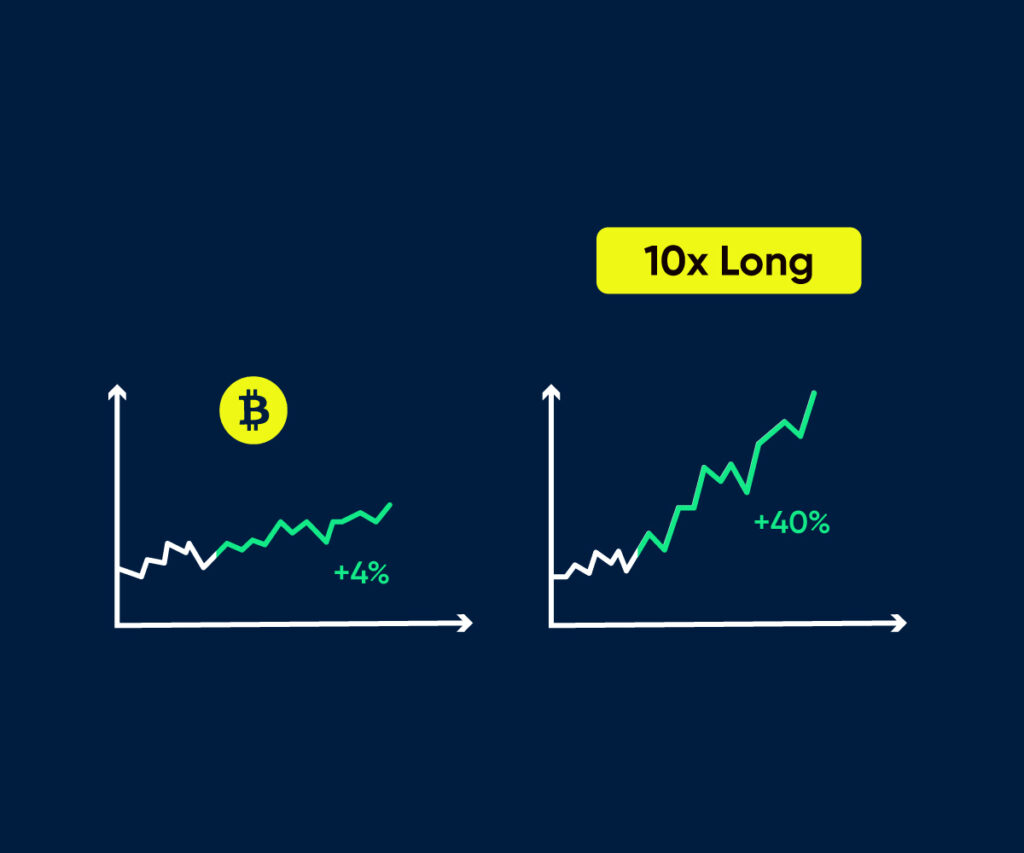
Think about that. The market only moved 10%, but your profit was $100 on an initial investment of just $200. That's a 50% return on your capital. Your profit was amplified five times, exactly matching your leverage.
The following video provides a great animated explanation of this process.
Crypto Leverage Trading explained (with Animations)
The video 'Crypto Leverage Trading explained' visually demonstrates how a leveraged position works and how profits are calculated.
Watch from 00:51 to 01:38 and from 02:13 to 03:35. The video clearly explains how 5x leverage can turn a small price rise into a much larger percentage gain on your initial capital.
Here is a visual representation of this amplifying effect.
3. The Danger of Amplified Losses
This is the part that every new trader must fully respect. Leverage is indiscriminate; it amplifies losses just as powerfully as it amplifies gains.
Let's use the same scenario, but this time the price moves against you.
Scenario: You bet on Bitcoin's price rising, but it falls.
- Your Capital (Collateral): $200
- Leverage: 5x
- Your Position Size: $1,000
Now, let's say Bitcoin's price decreases by 10%.
- Without Leverage: If you had bought $200 of Bitcoin, a 10% drop would be a $20 loss. You would have $180 left. You still own your Bitcoin, and you can wait for the price to potentially recover.
- With 5x Leverage: Your trade was worth $1,000. A 10% drop on a $1,000 position is a $100 loss.
This $100 loss is deducted from your $200 collateral. You are now left with just $100. A 10% market move against you has resulted in a 50% loss of your capital.
The Ultimate Risk: Liquidation
What happens if the price drops by 20%?
A 20% loss on your $1,000 position is $200. This is equal to your entire initial capital. When this happens, the exchange automatically closes your position to ensure you don't lose more than you put in. This is called liquidation. You lose 100% of the capital you committed to that trade.
This is the double-edged sword:
- A 20% price move in your favor would have made you a $200 profit, doubling your money (a 100% return).
- A 20% price move against you results in a $200 loss, wiping out your investment (a -100% return).
The following video explains this risk of amplified losses very clearly.
How to Trade Crypto Futures (Step-by-Step Crypto Futures Trading Guide)
In this clip from 'How to Trade Crypto Futures', the speaker gives a direct comparison of a trade with and without leverage, showing how the amplified downside can wipe out an entire account.
Watch from 12:47 to 13:51. Pay close attention to how a 20% price drop affects a 5x leveraged position compared to a non-leveraged one.
To solidify this concept, please read the examples from the same Binance article we looked at earlier. It clearly lays out the numbers for both gains and losses.
What is Leverage in Cryptocurrency Trading? - Binance
These examples from the Binance article numerically demonstrate how a 10x leveraged position can lead to huge profits or complete liquidation.
Read the sections titled 'Example of a leveraged long position' and 'Example of a leveraged short position'. Focus on how the same percentage price movement leads to drastically different outcomes (high profit vs. total loss).
4. Leverage on Binance: A Practical View
When you trade on Binance Futures, you choose your leverage level. As a beginner, it is critical to start with very low leverage or none at all.

While Binance offers leverage up to 125x, this is extremely risky and should be avoided. A price movement of less than 1% against you at 125x leverage would result in complete liquidation.
Conclusion
Today we've broken down the powerful and dangerous nature of leverage. It acts as a multiplier on your trading results, for better or for worse.
Key Takeaways:
- Leverage allows you to control a position size that is a multiple (e.g., 5x, 10x) of your own capital (collateral).
- Amplified Gains: A small price movement in your favor is multiplied by your leverage factor, leading to a much higher percentage return on your initial capital.
- Amplified Losses: A small price movement against you is also multiplied, leading to a much higher percentage loss.
- The amplification of losses creates the risk of liquidation, where a price move against you can wipe out 100% of the capital in your trade.
What's Next?
We've introduced the concept of liquidation as the ultimate risk of using leverage. In the next lesson, we will focus exclusively on this. You will learn what liquidation is, how the liquidation price is calculated, and why it is the single greatest danger you must manage in futures trading.