Welcome to the next lesson in our foundational module. In our last session, we mastered the essential tools for trade execution: market, limit, and stop-loss orders. You now understand how to give the market precise instructions. Today, we turn to a concept that dictates how much you can trade: leverage and margin.
This lesson will explain the powerful, yet perilous, concepts of leverage and margin. These tools can significantly amplify your trading power, but they come with equally amplified risks. Your background in physics has equipped you with a strong intuition for systems where small inputs can lead to large outputs; you'll find parallels here. By the end of this lesson, you will understand what leverage and margin are, how they are related, and the critical risk of a "margin call" and liquidation.
The Principle of the Lever
In mechanics, a lever allows you to move a heavy object with a small amount of force. In trading, leverage serves a similar purpose: it allows you to control a large position size with a small amount of your own capital. It's expressed as a ratio, like 10:1 (or "10x"), which means for every $1 of your own money, you can control $10 worth of an asset.
The capital you must deposit to open and maintain a leveraged position is called margin. It is not a fee, but rather a good-faith deposit, or collateral, that your broker holds while your trade is open.
Let's start with some formal definitions from a resource focused on the Indian market context.
Difference Between Margin & Leverage Trading | Mirae Asset
This article from Mirae Asset provides clear, distinct definitions for margin and leverage.
Please read the first two sections, What is a Margin? and What is Leverage?. Note how "margin" is described as the borrowed funds or the facility itself, while "leverage" is the multiplier effect it provides. In practice, you'll find these terms are often used interchangeably, but it's good to understand the distinction.
To put it simply:
- Leverage is the tool that multiplies your exposure.
- Margin is the capital required to use that tool.
The infographic below offers a great visual summary of these core ideas.
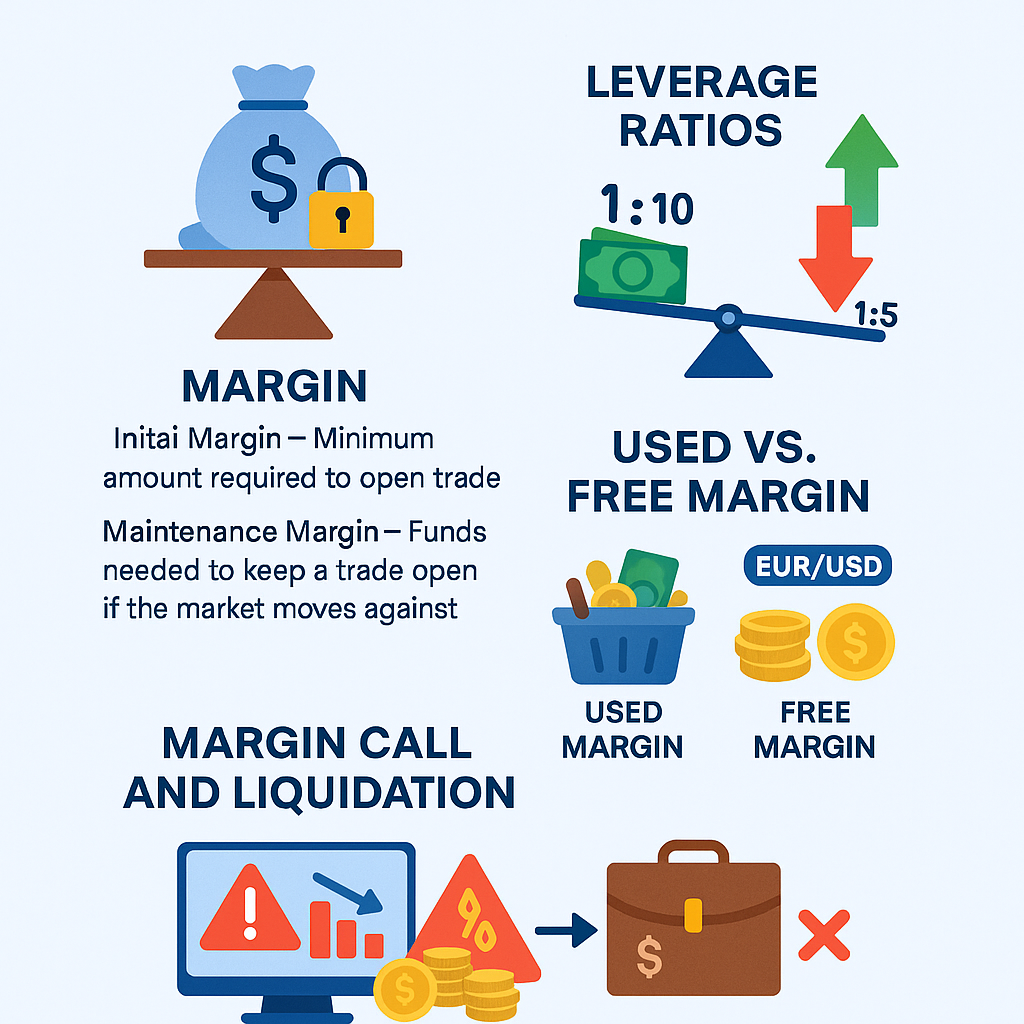
The Double-Edged Sword: Amplified Gains and Losses
Leverage magnifies everything. A small price movement in your favor leads to a large profit relative to your margin. A small price movement against you leads to a large loss.
Let’s consider a simple example:
You want to trade an asset currently priced at $100. You have $1,000 in your account.
- Without Leverage: You can buy 10 units ($1,000 / $100). If the price rises by 5% to $105, your position is now worth $1,050. You've made a $50 profit, which is a 5% return on your capital.
- With 10x Leverage: Your $1,000 margin allows you to control a $10,000 position. You can buy 100 units ($10,000 / $100). If the price rises by 5% to $105, your position is now worth $10,500. After paying back the $9,000 you borrowed, your profit is $500. This is a 50% return on your $1,000 margin.
The reverse is also true. If the price falls by 5% to $95:
- Without Leverage: Your position is worth $950. You have a $50 loss (-5%).
- With 10x Leverage: Your position is worth $9,500. You have a $500 loss (-50% of your margin).
The following resource provides an excellent, detailed walkthrough of this dynamic in the context of cryptocurrency markets, which often offer very high leverage.
Crypto Leverage Trading for Beginners: How It Works and What to ...
This article from Changelly clearly explains how leverage ratios work and the impact they have on your trades.
First, review the section Common leverage ratios, focusing on the table that connects leverage, margin required, and the price drop needed for liquidation. Then, read the concrete Example of Leverage, which illustrates the profit and loss amplification we just discussed.
The Inevitable Risk: Margin Calls and Liquidation
What happens when a leveraged trade goes against you? Your broker won't let your account balance go negative and risk their own money. To prevent this, they enforce margin requirements.
-
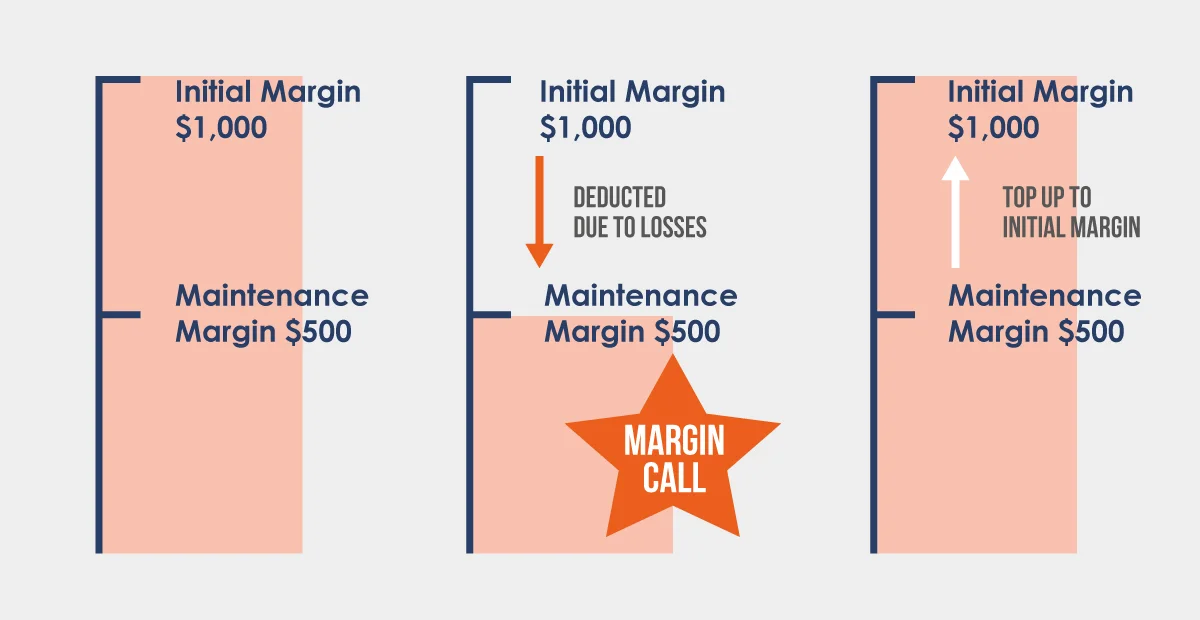
Initial Margin: The amount you need to deposit to open the position. We've already discussed this. For a 10x leveraged trade, the initial margin is 10% of the position size.
-
Maintenance Margin: The minimum amount of equity you must maintain in your account to keep the position open. This is a threshold set by the broker, typically as a percentage (e.g., 25% or 30%). Your equity is the current value of your position minus the borrowed funds.
-
Margin Call: If your trade moves against you and your equity drops below the maintenance margin level, your broker issues a margin call. This is a demand for you to deposit more funds into your account to bring your equity back up to the required level.
-
Liquidation: If you fail to meet the margin call, the broker will automatically and forcibly close your position at the current market price. Your initial margin is lost, and the broker uses it to repay the loan.
The image below perfectly illustrates this dangerous sequence.
The following video provides a practical and detailed explanation of this entire process, including a numerical example and a discussion of how margin calls created a "cascade sell-off" during the 2020 market crash.
What is Margin Trading? Your Margin Account Explained!
This video by Jake Broe uses a brokerage account to explain the practical realities of margin, including the risks.
Please watch two key sections: First, watch the section on risks and rewards. The presenter explains margin maintenance requirements and the scary reality of a margin call and forced liquidation. Next, watch the numbers example using Apple stock. This provides a step-by-step calculation showing how a 25% drop in stock price can trigger a margin call and result in amplified losses.
Types of Margin and Practical Considerations
For day trading, especially in crypto and forex, you'll encounter two main ways to manage margin across your trades:
- Isolated Margin: Margin is assigned to a single, specific position. If that position gets liquidated, it only affects the margin allocated to it. Your other trades and the rest of your account balance are safe. As a beginner, you should always start with isolated margin.
- Cross Margin: All your open positions and your entire account balance are used as a shared margin pool. This allows a winning position to cover the losses of a losing one, preventing liquidation for longer. However, if the market moves against all your positions, your entire account balance is at risk of being liquidated.
The crypto trading guide we looked at earlier explains this crucial difference well.
Crypto Leverage Trading for Beginners: How It Works and What to ...
Let's return to the Changelly guide to understand this key risk management feature.
Read the section How Leverage Trading Works. Focus on the definitions of Isolated Margin and Cross Margin. This is a critical setting you will need to be aware of on any trading platform you use.
Finally, it's important to know that available leverage differs by market and regulation.
- Forex & Crypto: Often offer very high leverage (50x, 100x, or even more) through offshore brokers.
- Equities: Leverage is typically much lower and more regulated. For instance, in the US and India, intraday equity traders might get access to around 4x-5x leverage.
For beginners, high leverage is a trap. The recommendation is to start with very low leverage (2x-5x) or none at all until you have a consistently profitable strategy.
Conclusion
Today, we've unpacked the powerful concepts of leverage and margin. They are fundamental to modern trading, allowing for capital efficiency and the potential for significant returns from small price movements. However, this power comes at a steep price: amplified risk.
Here are the key takeaways:
- Leverage is a tool that lets you control a large position with a small amount of capital.
- Margin is the collateral you must post to use leverage.
- Leverage is a double-edged sword, amplifying both your profits and your losses.
- A Margin Call is a demand from your broker to add more funds when a trade goes against you and your equity falls below the Maintenance Margin level.
- Failure to meet a margin call results in Liquidation, the forced closure of your position and the loss of your initial margin.
You now understand the core mechanics of how markets work: how prices are set (supply/demand, bid/ask), how you interact with them (order types), and how you can amplify your position size (leverage/margin).
In our final lesson of this introductory module, we will briefly survey the primary asset classes you'll be trading—equities, forex, and cryptocurrencies—to understand their basic characteristics before we dive deeper into their specific market structures in the next module.