Hello! Let's dive into our next lesson.
In our last session, we explored the foundational concepts of the bid price, ask price, and the resulting spread. We established that the spread is a fundamental cost of trading and that liquidity plays a crucial role in determining its size. You now understand the static structure of the market at any given moment. Today, we shift our focus to the dynamic tools you will use to interact with this structure: trading orders.
The goal of this lesson is to differentiate between the three most fundamental order types: market orders, limit orders, and stop-loss orders. Mastering these is not optional; it's the very mechanism through which you will execute your trading strategy. Choosing the correct order type gives you control over your entry price, your exit price, and, most critically, your risk.
The Trader's Toolkit: An Overview of Order Types
When you decide to buy or sell an asset, you don't just click a button and hope for the best. You give your broker a precise set of instructions in the form of an order. The type of order you choose dictates how and when that instruction is carried out.
Let's begin with a quick overview of the main order types you'll encounter. The following reading, which uses cryptocurrency as its context, provides clear initial definitions.
Ultimate Guide to Crypto Order Types: All You'll Ever Need
This blog post from Bitsgap offers concise definitions for the fundamental order types.
Please read the first part of the article, starting from the section What Are the Types of Crypto Trading Orders? This will introduce you to market, limit, and stop orders. Don't worry about the more complex types for now; we'll focus on these three.
As you can see, the core decision revolves around a trade-off: do you prioritize the speed of execution, or the price at which you execute? This choice leads us to the first two fundamental order types.
The Trade-Off: Speed vs. Price
1. Market Order: Prioritizing Speed
A market order is the most basic instruction: "Buy or sell this asset for me right now at the best available price."
- When you place a buy market order, you are filled at the current ask price.
- When you place a sell market order, you are filled at the current bid price.
This means you are guaranteed to get into or out of the market almost instantly, which is critical in fast-moving situations. However, this speed comes at the cost of price certainty. The price you are filled at might be slightly different from the price you saw a split-second before clicking the button. This difference is called slippage. In highly liquid markets (like major forex pairs or blue-chip stocks), slippage is often minimal. In illiquid markets, it can be a significant hidden cost.
Let's look at a practical guide from the perspective of the Indian stock market.
Types of Orders in Stock Market India: The Complete Guide - Sahi
This guide from Sahi.com provides excellent, practical advice tailored to Indian investors.
Read the section on Market order. Notice the specific advice about avoiding market orders on illiquid mid-cap and small-cap stocks due to the risk of slippage.
2. Limit Order: Prioritizing Price
A limit order puts you in control of the price. The instruction is: "Buy or sell this asset only at this specific price or better."
- A buy limit order is placed below the current market price. It will only execute if the price drops to your specified level or lower.
- A sell limit order is placed above the current market price. It will only execute if the price rises to your specified level or higher.
The advantage is clear: you will never get a worse price than you specified. The trade-off is that your order is not guaranteed to execute. If the market never reaches your price, your order remains unfilled, and you might miss the trading opportunity entirely.
Let's return to the guide on Indian stock market orders.
Types of Orders in Stock Market India: The Complete Guide - Sahi
We'll continue with the Sahi.com guide.
Read the section on Limit order. This section clearly explains the core function and the primary trade-off of using a limit order.
Most trading platforms present these choices clearly. The animated GIF below shows a typical order panel from Zerodha, a popular Indian broker. You can see the user can toggle between "Market" and "Limit" and, for a limit order, can specify the exact price.

3. Stop-Loss Order: Managing Risk
The stop-loss order is arguably the most critical order type for capital preservation. It is a defensive order designed to get you out of a losing trade automatically before the loss becomes unmanageable.
A stop-loss is a dormant order that activates only when the price moves against you and hits a predetermined "trigger price." Once triggered, it becomes another order type to exit your position. This leads to a crucial distinction that trips up many new traders.
Stop-Loss Market (SL-M) vs. Stop-Loss Limit (SL-L)
When your trigger price is hit, what kind of order do you want to send to the market?
- Stop-Loss Market (SL-M): When the trigger price is hit, a market order is sent. This guarantees your exit, but it does not guarantee the price. In a volatile market or during an overnight price gap, you might be filled at a much worse price than your trigger.
- Stop-Loss Limit (SL-L): When the trigger price is hit, a limit order is sent. This guarantees your exit price (or better), but it does not guarantee your exit. If the market gaps past your limit price, your order will trigger but may not be filled, leaving you in a trade that is rapidly losing money.
Your physics background has taught you to think in terms of systems with defined states and conditions. You can think of a stop-loss as a conditional if-then statement: IF the price reaches the trigger level, THEN execute an exit order (either market or limit).
The choice between SL-M and SL-L involves a trade-off between certainty of exit and certainty of price. For a day trader, getting out of a bad trade is often more important than the exact price of the exit.
The guide for Indian markets explains this vital difference exceptionally well.
Types of Orders in Stock Market India: The Complete Guide - Sahi
Let's look at the final foundational order type in the Sahi.com guide.
Focus on the section Stop-loss order. Pay close attention to the Tata Motors example, which perfectly illustrates the "gap problem" with Stop-Loss Limit orders. Note the concluding sentence: "SL-L guarantees your exit price but not the exit. SLM guarantees the exit but not the price."
Bringing It All Together
We've covered the definitions and trade-offs of the three foundational order types. The image below provides a great visual summary for various buy and sell orders. "Buy/Sell Limit" orders are for entering at a more favorable price, while "Buy/Sell Stop" orders are for entering when price breaks a certain level (often used for breakouts or as stop-loss triggers).
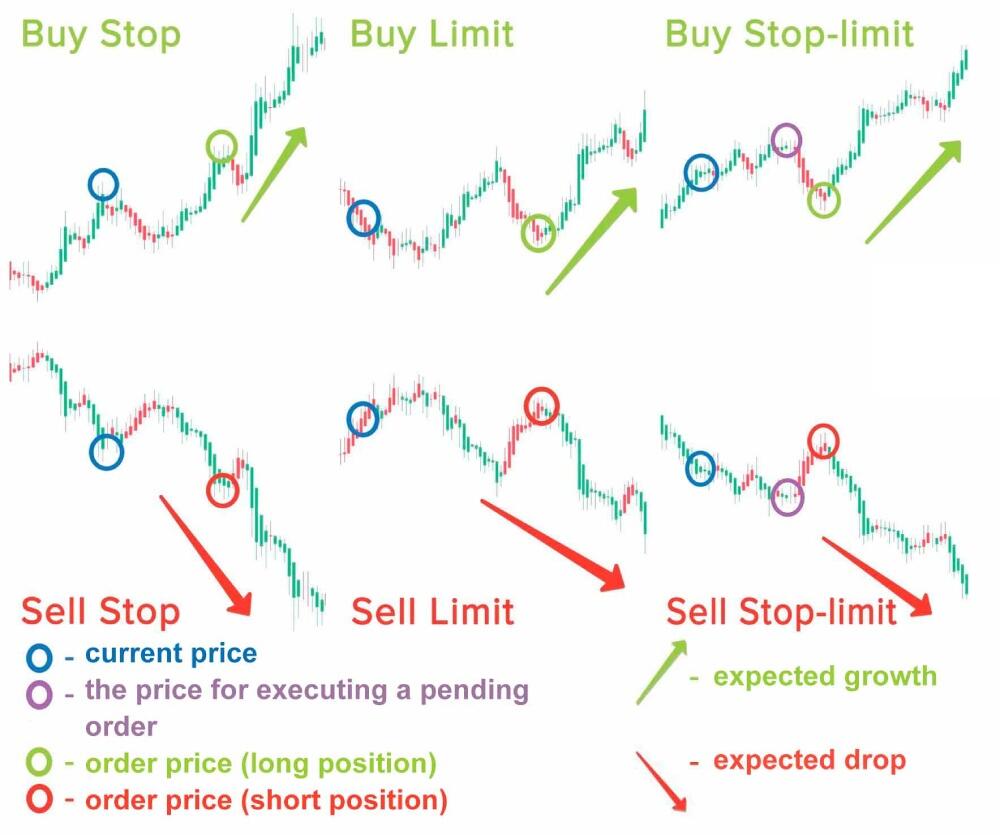
To solidify your understanding and see these orders demonstrated in a real trading interface, the following video provides a comprehensive and practical walkthrough. The host gives a very useful mental shortcut for applying these orders in a live trading context.
Stop Loss Orders And Limit Orders Explained - When And How To Use It - Trading Basics
This video from Markus Heitkoetter clearly explains the practical differences and applications of these orders.
Please watch the entire video (about 8 minutes). It will serve as an excellent summary of our lesson. Pay special attention to these parts: The distinction between a buy stop vs. a buy limit. The distinction between a sell stop vs. a sell limit. The practical shortcut he provides for when to use stop orders vs. limit orders for entries, stop-losses, and profit targets. His strong warning about the use of market orders, which he calls the "oops order."
Conclusion
You have now learned about the three fundamental instructions you can give the market. Understanding the trade-offs between them is essential for effective trade execution and risk management.
Here are the key takeaways:
- Market Order: Use when speed is critical and you accept the risk of slippage. It guarantees execution but not price.
- Limit Order: Use when price is critical and you accept the risk of not getting filled. It guarantees price but not execution.
- Stop-Loss Order: A defensive order to limit losses. You must choose between a Stop-Market (SL-M), which guarantees the exit, and a Stop-Limit (SL-L), which guarantees the exit price.
In our next lesson, we will build on this by exploring the concepts of leverage and margin. Now that you know how to enter and exit the market, we will discuss the tools that determine how large a position you can take.